The Generalitat buys an unpublished painting by Lluís Borrassà in an auction in Paris
'Martyrdom of Saint Lawrence' comes from one of the altarpieces that the painter made for the cathedral of Barcelona

-
CAT -
CAST
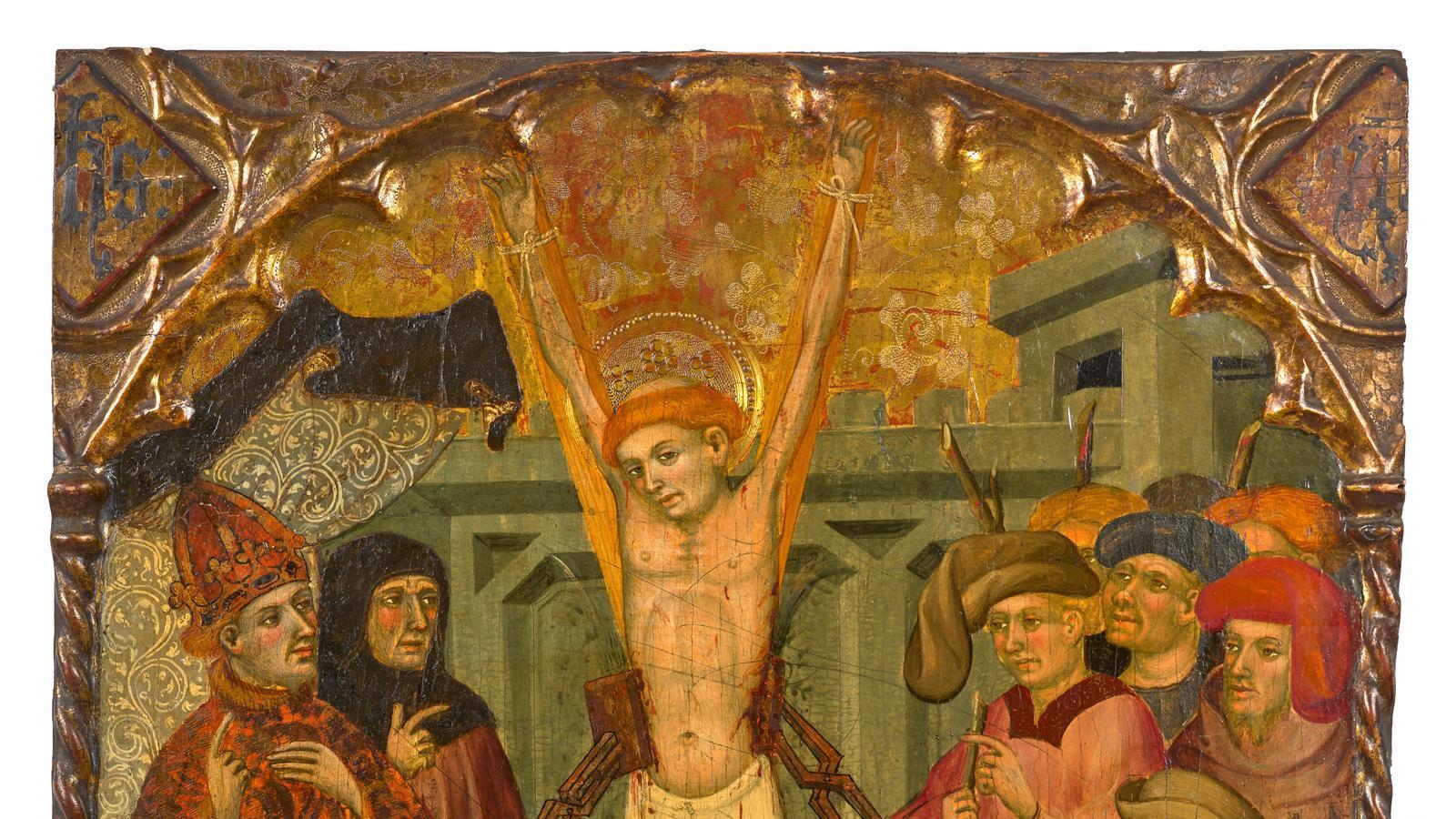
BarcelonaThe presence of Lluís Borrassà in public museums is growing: as the ARA has learned, the Generalitat has just purchased the "Martyrdom of Saint Lawrence" for 160,000 euros at the Artcurial auction house in Paris. That is to say, five times the starting price, which was between 30,000 and 40,000 euros. To the sale price, the auction house's commission must be added, so the final price is about 213,760 euros. The painting, which will go to the National Art Museum of Catalonia (MNAC), belonged to the collection of Maxime Mazerand, in the Drôme, until the mid-eighties of the 20th century. Subsequently, through family succession, it ended up in a private collection in Marseille.
This painting, hitherto unpublished, is part of the predella of one of the most important altarpieces painted by Lluís Borrassà for the Barcelona Cathedral in 1419, which is currently dismembered. Borrassà received the commission for four altarpieces, and the "Martyrdom of Saint Lawrence" belongs to one that was dedicated to three saints: Saint Lawrence, Saint Hippolytus, and Saint Thomas Aquinas. Borrassà made it at the request of Canon Ferrer Despujol for the Saint Lawrence chapel, located in the left lateral nave of the cathedral. The contract, signed on February 17, 1419, between the painter and the patron, specified what the artist had to represent on the predella: "five stories of Saint Lawrence" (literally 'mossèn sant Llorenç').
At first glance, the scene could have been mistaken for a martyrdom of Saint Vincent, but in reality, it is one of the first tortures that Saint Lawrence suffered, prior to his death on the gridiron. After ordering Lawrence to be stripped, the prefect of Rome had him severely whipped and then imprisoned. The episode represented here shows Saint Lawrence being tortured with red-hot irons that had previously been heated in a brazier. According to the MNAC's curator of Gothic art, Cèsar Favà, the scene also includes another martyrdom, that of the blows from sticks. "The characters on the right side have sticks in their hands. The sticks and the body of the saint are full of blood," points out Favà, who was the curator of an exhibition on Borrassà at the museum in 2023. On the other hand, Favà draws attention to the fact that one of the characters on the left is racialized, a detail that makes one think about how otherness was treated in the painting of that time.
Regarding the rest of the panels of this altarpiece, five more fragments have recently been reunited, related to the part dedicated to the life of Saint Hippolytus. Some fragments are preserved in the Prado Museum and the others are deposited in the National Art Museum of Catalonia.
An exceptional painter
Borrassà is considered the main representative of the international Gothic in Catalonia at the beginning of the 15th century. This means that Borrassà broke with the tradition of Italo-Gothic painting of almost hieratic and frontal figures and, towards 1400, adopted the refinement, combined with the naturalism, of the international Gothic. Likewise, his paintings are characterized by a unique narrative sense that incorporates details extracted from daily life, characteristic outfits of the fashion of the time, and much more vivid and contrasted colors. Therefore, it is an unpublished painting in the sense that there was no photographic record of its existence.
Martyrdom of Saint Lawrence has been linked to the altarpiece of the Barcelona Cathedral thanks to the work of the Barcelona clothing historian Josep Puiggarí, who traced the figures of numerous ancient Catalan paintings to prepare a work dedicated to dress. His collections of drawings are kept at the Real Academia de San Fernando. On page 87 of the volume compiled in 1854, we find the left part of this painting with the title "Martyrdom of Saint Lawrence", that is to say, proof that the work was effectively in the cathedral during the first half of the 19th century.
