Massive protest and strike at half throttle
The first general strike for housing has an uneven following but culminates in massive marches and disturbances
-
CAT -
CAST
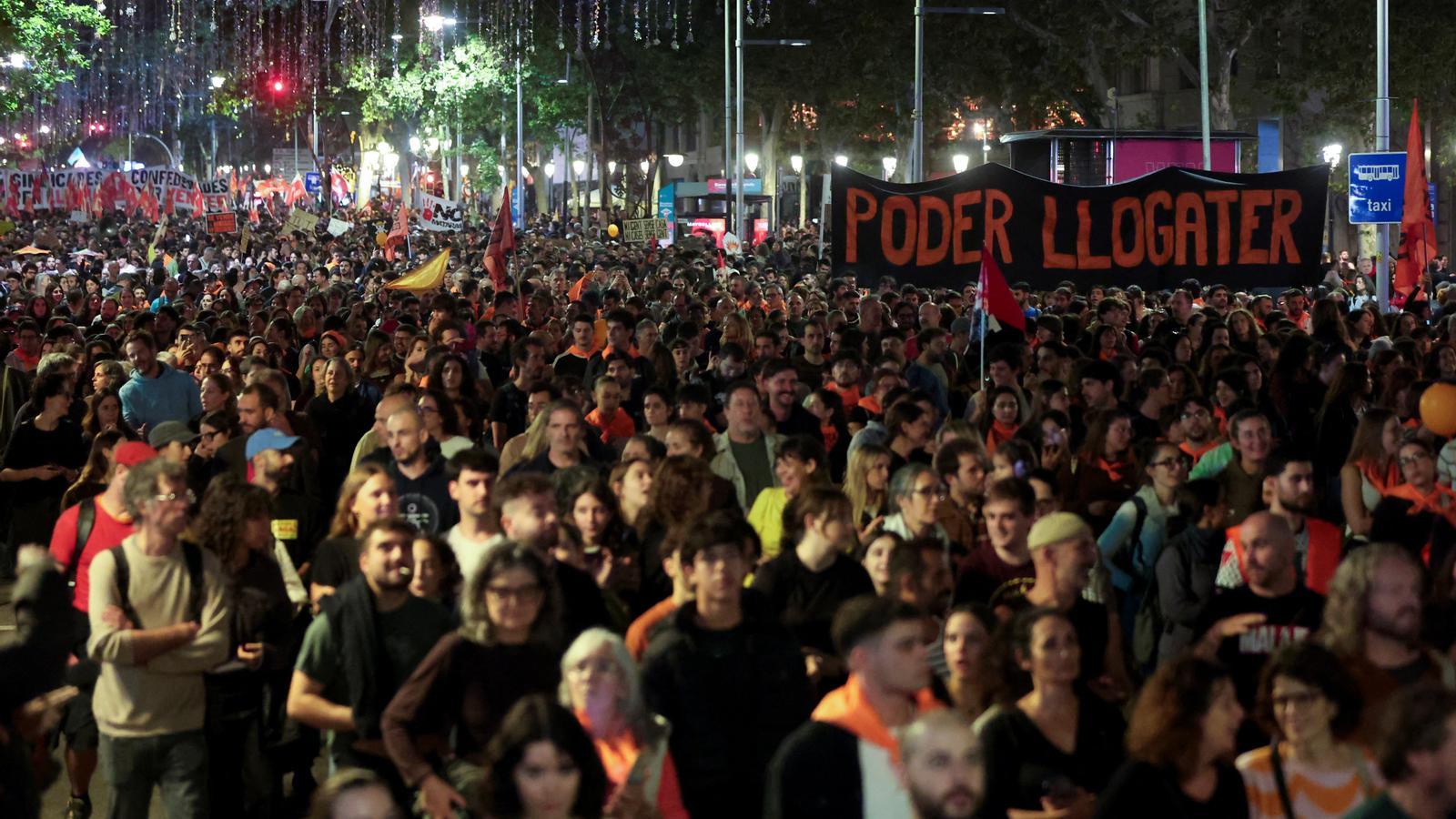
BarcelonaIf the goal of the November 11th general strike was to achieve a total shutdown of the economy, the result was closer to failure than success. If, on the other hand, it was about provoking a "general strike feeling", that is, achieving a significant disruption of daily life so that the bulk of the population was aware that a mobilization was underway, then the promoters of the general strike managed to fulfill the task. The images of the afternoon demonstrations, with tens of thousands of people flooding the Passeig de Gràcia in Barcelona and significant marches in the rest of the country's cities and the rest of the State, serve the goal the promoters had set for themselves: to launch a powerful warning on the eve of an election campaign that will decide, among many other things, what course to take regarding housing policies. The disturbances that took place at the end of the day, however, fuel the right-wing narrative that more order and a firm hand are needed.

From the very first moment, it was clear that this would not be a typical general strike, despite the involvement of the major unions, CCOO and UGT. When the clock struck midnight, fireworks were launched in the center of Barcelona to greet the start of the first general strike since 2012, and shouts of joy were heard. Neighborhood strike committees had been preparing the mobilization for weeks, with street assemblies, poster hanging, and all kinds of activities to raise awareness of their demands, which are basically those of the Renters' Union, and now the time for their baptism had arrived: the thrill of the first general strike. Most of them were young people who had no memory of the strikes of 2012 or 2010; at most, perhaps of the country-wide stoppage of October 3, 2017. And on this occasion, it is they who have taken the initiative. The visible face of the protest has not been industrial workers, traditionally the most organized and unionized, but young people more or less politicized (with a special prominence of the Socialist Youth Organization, OJS), who have found in housing a generational banner.
These young people on their own, however, would not have had the capacity to stop the large industry or the transport sector. November 11th is the result, then, of the alliance between these young people who find shelter under the ideas of the Tenants' Union and who mobilize every week to stop evictions, with the classic unions, which did not want to be overtaken by the wave nor lose the opportunity to try to connect with the new generations, totally alien to the union culture. The sum of the know how of the unions regarding general strikes with the capacity for youth mobilization, combined with minimum services in public transport set by the Generalitat that were truly minimal (25% during peak hours when in other parts of the State they were 65%), turned mobility in Barcelona into a living hell from early in the morning with multiple road blocks. If you add to all this that Mercabarna was blocked at dawn, just like the large industrial estates, with Seat as the great emblem, first thing in the morning it was already very clear that it would not be a normal day.
Lower electricity consumption
The street blockades were also joined by the action of pickets. The reality is that in the city of Barcelona and in most of the country, small businesses opened their doors, with the shutters half-lowered in some cases, with a certain normality. Bars and cafes also opened normally, especially in non-central locations. There were, indeed, many fewer people on the street and, consequently, less economic activity. But there was not, in any case, a generalized shutdown like the legendary one of 1988 against Felipe González or that of 2002 against José María Aznar. The electricity consumption data do not lie: early in the morning, 10% less electrical demand was recorded compared to the Wednesday of the previous week, but as the hours passed, consumption normalized. Nothing to do with 14 years ago.

The unions themselves acknowledged that the strike had only worked in territories with significant industrial weight, such as Catalonia, the Basque Country, Aragon, and parts of Andalusia, or with a deep-rooted union culture, such as Asturias. In places like Extremadura and the Castiles, the impact was much smaller. Furthermore, the weather did not help: in many places, it was not even possible to hold the afternoon demonstrations due to the danger posed by storm Charles.
These data are what allowed the employers' associations (the CEOE estimated the turnout at 5%) and right-wing parties to treat the strike with disdain and, as Vox did, label it a "general circus" in favor of the Spanish government. The right, and specifically the PP, directed its main criticisms against the unions, against whom it has been nursing a lot of resentment over these years and whom it accuses of acting as a transmission belt for Sanchismo. A tweet from the PP with an image of union members eating seafood lit up the networks. On Tuesday, Isabel Díaz Ayuso had encouraged Alberto Núñez Feijóo to do away with all the "union rubbish".
Police violence
The Spanish government opted for a discreet profile, without going on strike but also without an agenda, yet without hiding its interest in the mobilization being a success. In Catalonia, the discordant note was provided by the leader of the pro-independence far-right, Sílvia Orriols, who confronted members of a picket line in Ripoll. In many Spanish cities, scenes of tension occurred between riot police and picketers, with about forty people arrested (only one in Catalonia) and some scenes of police violence like those that took place at the doors of El Corte Inglés in Castelló, where a minor was injured. Eight years of left-wing government have not changed police dynamics. A force that, according to the CIS, leans overwhelmingly towards Santiago Abascal being the next Spanish president.

In Barcelona, by mid-afternoon several columns converged at the Jardinets de Gràcia for the demonstration. There, a greater generational mix was seen. Many young people, but also families, as the housing issue is transversal. The atmosphere was more protest-oriented than festive. There is a lot of accumulated social unrest and the protesters took advantage of passing by company headquarters to demand not only lower housing prices but also higher wages.
Disturbances and looting
In Barcelona, the Guàrdia Urbana estimated the turnout at 55,000 people, a sufficient figure but one that remains very far from those experienced during the Procés. In comparison, the one in Girona, with 20,000 participants according to the police, was more significant. In Madrid, the rain did not prevent a massive demonstration, with 120,000 people according to the Government Delegation, just as in Valencia or Bilbao. In Seville and other cities in the southern peninsula, the demonstrations were cancelled.
In Barcelona the demonstration ended with clashes with the police and vandalism of shops, an image that the unions wanted to avoid, but which they assumed would be difficult to do after the precedent of the looting in Molins. The intersection between Passeig de Gràcia and Gran Via became a battlefield between hooded youths (some witnesses pointed out that they were speaking in English and French) and Mossos d'Esquadra, while others took the opportunity to try to enter some shops to commit looting. While the riots were taking place, the spokesperson for the Tenants' Union, Enric Aragonès, warned the right-wing parties that if any conquest in the field of housing were rolled back, such as rent caps, the mobilizations and strikes would be repeated. And this is precisely what the PP has promised.

A few hours before the start of the election campaign, the day of mobilizations once again places housing and the high cost of living at the center of the public debate, and this is good news for the left. But it is not at all clear that it will become the turning point that Pedro Sánchez dreamed of to turn the tide, which, for now, seems clearly tilted towards the right.
