Picasso, “the putative father” of modern architecture
The Picasso Museum explores for the first time the influence of the Malaga painter on the architects of the 20th century

BarcelonaPicasso: painter, sculptor, engraver, set designer, playwright, poet... and also an architect? The artist from Malaga did not design any buildings, but he exerted a great influence on rationalism, as can be seen from this Friday until March 7th at the Picasso Museum in the exhibition Picasso and Architecture, the first monograph on this aspect of the artist's legacy. “Picasso is the putative father of modern architecture, following the idea that modern architecture arises from the interpretation of Cubism,” affirms the architect Enric Granell, curator of the exhibition together with the former director of the museum, Emmanuel Guigon, and Maisa Navarro, professor of art history at the University of La Laguna (Tenerife). “Despite not being an architect, Picasso fascinated many architects through transparencies. But, without a doubt, he is an architect of painting,” assures Guigon.
Despite having this impact on the world of architecture, Picasso never had an architect-designed house built for himself, something he could have afforded. “He had a concrete idea of disorder and the place where he lived. Picasso did everything in the same place, at the same time he was painting... and that distanced him a lot from the ideals of modern architecture,” says Granell.
The impact on Le Corbusier
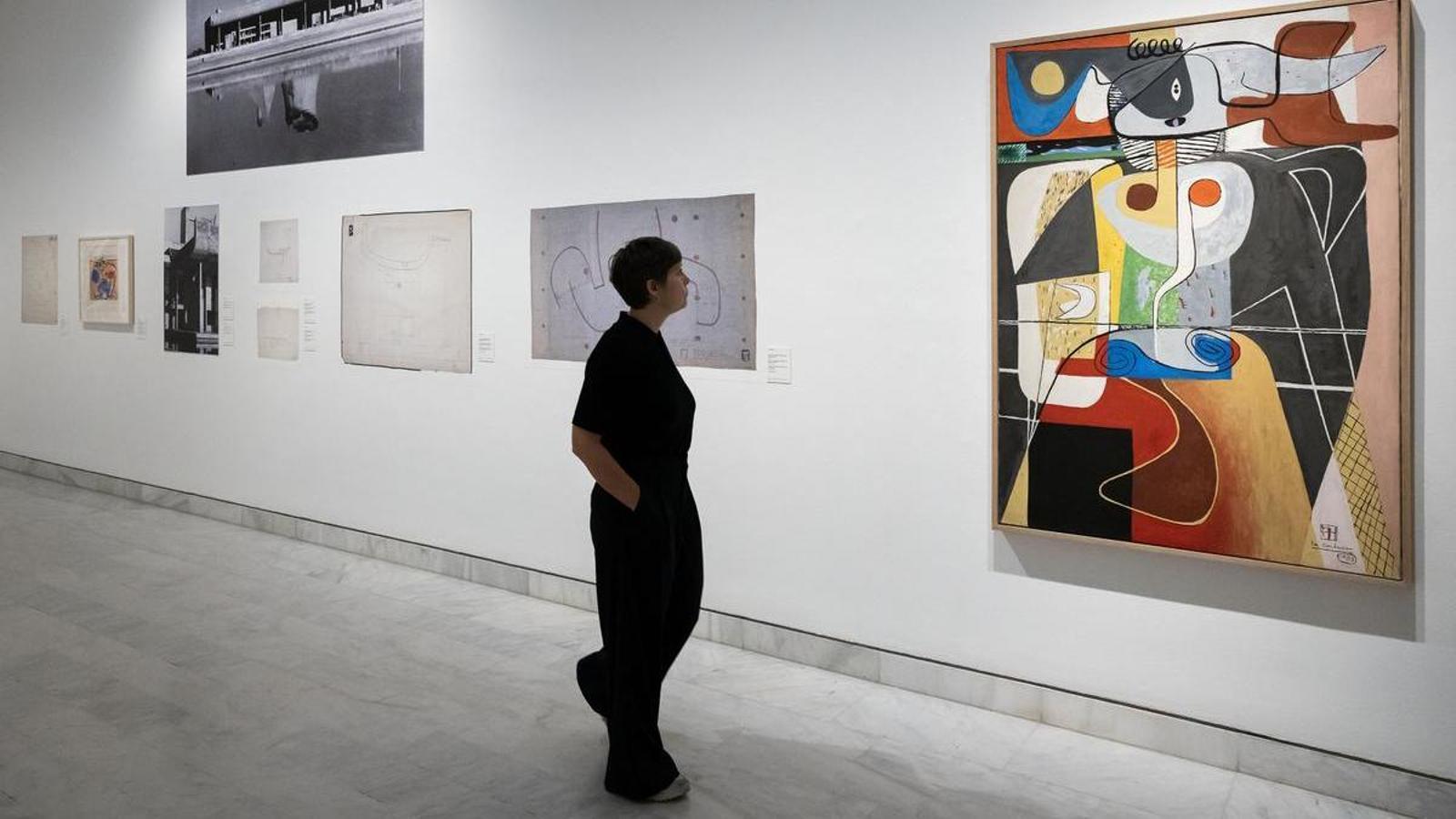
The most important architect influenced by Picasso is Le Corbusier. “His dual status as a painter and architect allows for correspondences to be established between his plastic research and Picasso’s, especially surrounding abstraction, geometry, and new conceptions of space,” explains Navarro. One of the most significant examples is the Unité d’Habitation in Marseille, which Picasso visited in 1952. The affinities are found in the still life on the roof, which dialogues with the Sainte-Victoire mountain, an icon of Cézanne’s painting that was fundamental for Picasso. But the curators also find influences of the artist from Malaga in earlier works, such as the headquarters of the Central Union of Consumers' Cooperatives of the Soviet Union and the Palace of the Soviets project, and in later ones such as the Ronchamp chapel, the Chandigarh complex, and the monastery of La Tourette. “Le Corbusier followed Picasso as if he were a spy,” notes Granell.
The interconnection of the arts
The exhibition includes about 150 works, twenty of which are drawings, paintings, and prints by Picasso, while the rest are plans, photographs, and documents. Among the works by the artist from Malaga, a self-portrait from his later years stands out, owned by the MoMA in New York, where the artist can be seen with a compass, a common instrument for architects. "We believe that Picasso was aware of his influence on 20th-century architects; he knew it perfectly well. Therefore, what he did with this self-portrait was to sign off on his presence," says Granell.
Two more surprises of the exhibition are the original drawings for the friezes on the facade of the Association of Architects of Catalonia, owned by one of Picasso's grandsons, which can be seen in Barcelona for the first time, and Landscape at Céret (1911), owned by the Guggenheim in New York. "The exhibition is proof that the arts are not closed spaces. We are always used to talking about painting and then about architecture, but the arts have always had an interconnection that for creators has been very evident, even if at times it has not been so much for the public. It is not true that architects only look at architects, it is not true that painters only look at painters. Historically, you can say that Bernini was an architect, but also a sculptor, and, therefore, you don't quite know where one discipline begins and where the other ends," explains Granell.
The trace of architecture in painting
The relationship between Picasso and Le Corbusier is the culmination of the journey, and the curators have focused the three previous areas on some of the “classic chapters in the history of painting”. “Picasso was very attentive to the tradition of Western painting: in a different way, he did what Velázquez, Rembrandt, and Vermeer had done, that is to say, he painted urban visions and interiors and, on the other hand, he was related to the theatre”, says Granell.
Regarding urban visions, Picasso transformed them during his stay in Horta de Sant Joan. “The views of Barcelona and the early Paris period are indebted to Toulouse-Lautrec and all the painters of the time. 19th-century French painting represents modern life with a sense of movement, and that is why it is full of carriages, cars, and trams. In contrast, in Cubist urban views, people disappear. Both in Horta de Sant Joan and in the Cubist works, what becomes important is how the architectural work is seen, that is to say, how it is stripped of all details, how it is always seen a bit from above, how the perspective of the Renaissance is broken, and how different points of view appear not only with vision but also with lighting”, explains Granell.
Another of the areas is dedicated to “space cages”, especially based on the project for a monument to the poet Guillaume Apollinaire that Picasso made with the collaboration of the sculptor Juli González. Picasso was inspired by The Poet Assassinated (1916), by Apollinaire, where the idea of a monument made of nothing, with the void, appeared, but the committee that had commissioned it rejected it. “Picasso and González made some models with iron lines, which is why we call them space cages; it is simply a space contained within a metallic structure –says Granell–. It is not an architectural structure in the sense that it can be used in an office building, but it surely had to do with the most famous building of the second half of the 20th century, the Seagram Building, by Mies van der Rohe and Philip Johnson”.

The exhibition tour continues with a reflection on the “synthesis of the arts”, concretized in the Spanish Republic Pavilion of the 1937 Paris International Exposition, for which Picasso created the Guernica, and the COAC headquarters. “The pavilion, where in addition to Picasso there were Miró and many other artists, is a perfect manifestation of what they understood by a synthesis of the arts, based on the fact that artists, architects, and urban planners intervened within a common framework. It is not about simply placing works of art in a building, but rather they were conceived for the place where they were to go”, says Granell. In the case of the façade of the Association of Architects of Catalonia, Picasso took into account that the Xavier Busquets building is in front of the Barcelona cathedral and he thought about the processions –such as those of Corpus Christi, but also those of the Three Kings and the popular ones with big-heads– that pass in front of it. “The friezes are the embodiment of what the space demands of the building”, asserts Granell.
The curators have dedicated a third area to the interiors of Picasso’s works, which are “a metaphor for his own interiority”. “The themes he worked on, such as his studio and the painter and the model, have to do with his life”, says Granell.
