Gabriel Ventura: "One must live life as if it were a fiction"
Poet

-
CAT -
CAST
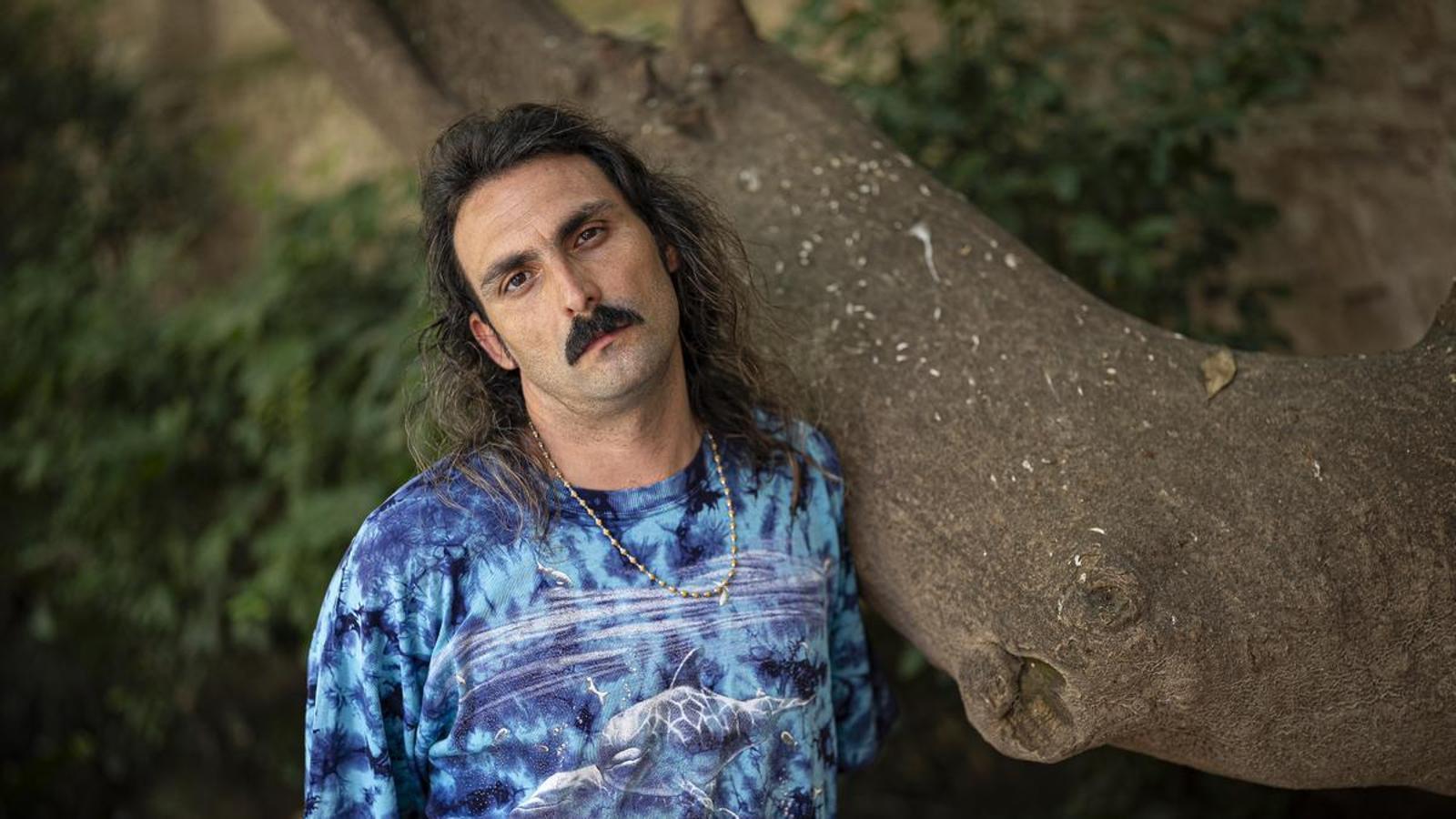
On his WhatsApp, he has a photomontage of the landscapes of Cappadocia, in Turkey, where the caves that served as a refuge for the first Christians are located. Gabriel Ventura (Granollers, 1988) is a poet, and although he has never had a mystical experience, or precisely because of that, he is drawn to the kind of practices that help to escape the weight of reality. This flirting with the beyond has led him to write books, curate exhibitions, and conduct a study on mysticism for Lux, Rosalía's album.The clothes, the hair, the performances, the rituals… what are we supposed to do, those of us who are too normal, when we are intimidated by an eccentric poet?
— It is important to take life as a game. This is perfectly compatible with knowing that we find ourselves in delicate moments. Eccentricity is being able to take a side and being able to play at the same time, so that they never take your imagination away.
How do you arrive at poetry?
— In adolescence, I began writing poetry and reinvented my identity through the act of writing. There are existential motives: following a family crisis, I wanted to be reborn through literature, to relate to the everyday sphere in a different way.
What does it mean to be a poet?
— I do not want to be a poet, I have always wanted to be a poem: one must live in a state of permanent creation, as if life were a fiction. Because, deep down, it is.
And what is the opposite of living in a fiction?
— An old friend told me recently: "Now I find myself in a higher place at work". For me, living in a fiction is the opposite of the idea of thriving, of ascending. Literature must serve to maintain the youthful spirit, which leads us to do things without being afraid of the consequences.
Is the idea to find a way to escape from an office worker routine?
— Not at all: there is a poetics of the office worker. Gurdjieff said that it is more difficult to clean a kitchen floor well than to write twenty books. Living with rigorous schedules can lead you to a more powerful imagination than a permanent spiral.
But you are not rich. You have to work to earn a living.
— I am lucky now, but perhaps at another time the pace will drop a lot and I will have to find a way to make a living otherwise. Well, I will do it, precisely because I do not think at all in terms of an artistic career. Living in a poetic state also means always having the door open to change everything.
In your world, living from what you do means, necessarily, working for the institution: are you not afraid of being domesticated?
— I am very surprised to be part of the masquerade, but I also feel that we are the institution, that they need us so as not to get bored. And within the institution I try to foster strangeness, but the truth is that I do not feel that my message is so pure that the institution corrupts it: coarsening is general, it is part of humanity.
How has it been working with Rosalía?
— I have felt very close to her precisely because she is a person who lives for art. We have worked reading texts by very radical mystics, and these texts have inspired the lyrics of the album.
Any anecdote to understand it better?
— The day we met. She could not have been even twenty years old, and she was interested in poetry. She came to find me leaving class, and began to ask me very technical questions. She sat on the floor right there, listened to the explanations, thanked me very happily, and left without saying anything else.
Despite your passion for mystics, you say that you have never lived a mystical experience firsthand
— The mystic does not relate to reality from a place of doubt. The mystic has seen, has felt, has felt themselves traversed by a transformative force. But I like the ambiguity of doubt, thinking that the things that cross my mind could be possible, but perhaps not.
Any trick to awaken the inner poet?
— The Taoists used to say "When you are doing something very serious, take it as if it had no importance. On the other hand, when you are looking out the window doing nothing, work hard on that gaze".
How do you write poetry?
— Usually when I write I start from a word, not from an idea or an experience. I do not see a sunset and think about how to explain it, but rather I work from the delirium of the language itself.
Open the notebook and read me the last poem you have written in it.
— "Aphonic, I have tied a butterfly to the page. And now, the antennae of the letters, shy and progressive, like a hypnotized child, tickle the fingers of my memory, the elbow of my thoughts, and grope, with a ridiculous strength, the limits of my non-existence".
Do you remember how you felt when you wrote it?
— I call it being in the zone, like in the Tarkovsky film. You enter into the language and you feel transformed, you feel that what you are writing is more real than the coffee you have just had. When you are in this territory, you feel the incredible possibility of being able to change your life. What hooked me on poetry is this sensation, and not the literary value that the poems may or may not have.
What should change in today's world?
— For an exhibition I am working on, I have just invented a story about a fictional activist group, some terrorists. I think a lot about Ulrike Meinhof, a German communist journalist who realized that writing was not enough and founded an urban guerrilla organization responsible for armed actions in West Germany. I believe reality is so bad that we need figures like that again, who propose a radical break with the current moment.
Can we dignify a cliché like poetry can change the world?
— When I read or write a poem I feel that other forms of existence are possible. The problem is believing that this is elitist. A psychic revolution is needed, to create imaginaries where certain people do not have so much power.
