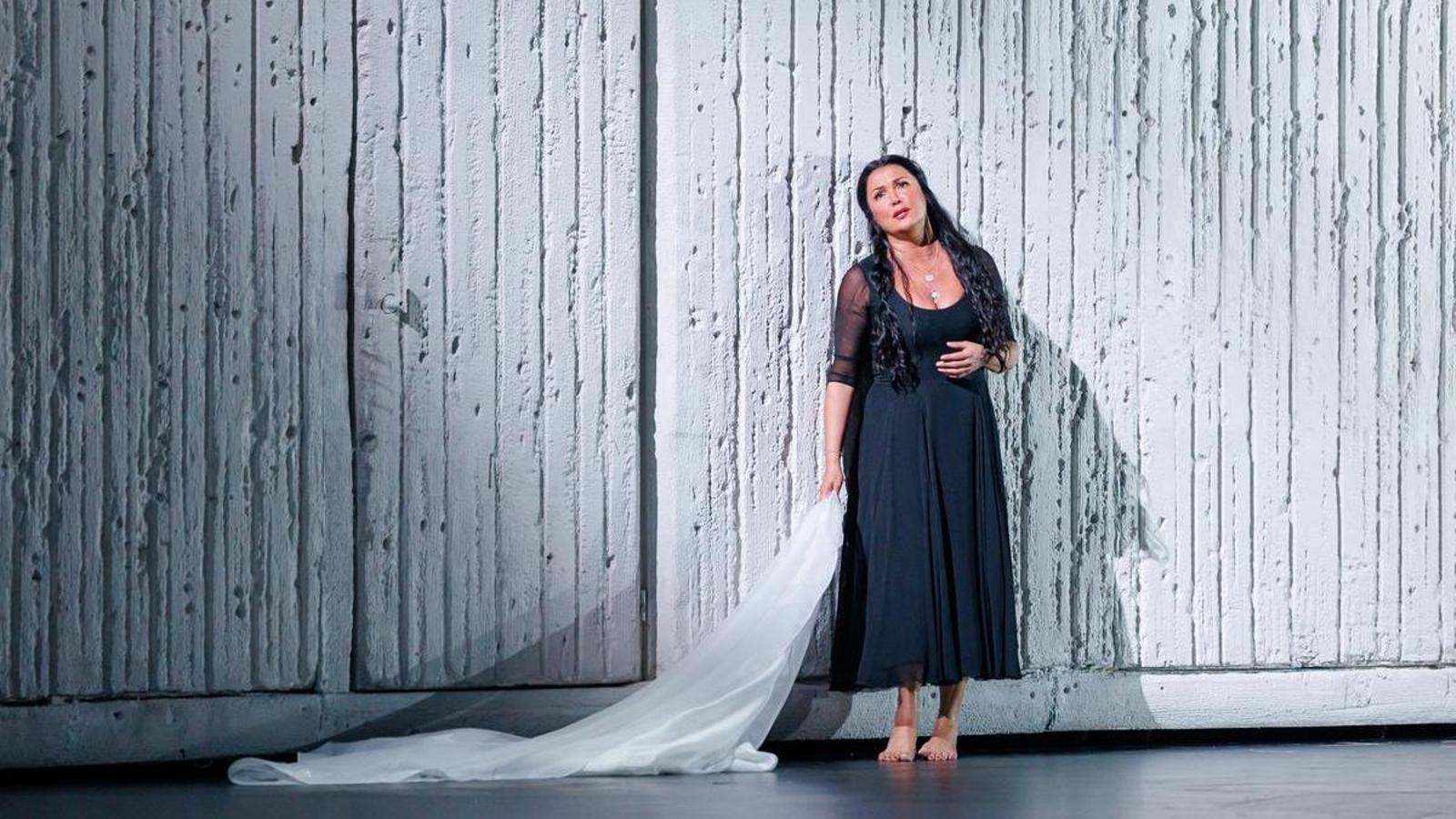
Performers: Anna Netrebko, Ekaterina Semenchuk, Ivan Gyngazov, Artur Ruciński, George Andguladze, Alexander Köpeczi, Moisés Marín, Carmen Buendía and the Orchestra and Chorus of the Gran Teatre del Liceu.
I highly recommend to anyone who goes to see the version of Aida signed by Shirin Neshat and that inaugurates the Liceu season, read the article "The empire in action: Aida by Verdi", by Edward W. Said, included in Culture and imperialism. Because it can help to understand the conceptual key of the show. Neshat interprets Verdi's opera based on themes such as decolonialism and feminism. And she does so with scenes without concessions to the gallery, but without discarding an undeniable poetic sense. In fact, Aida speaks to us about the abuse of theocracies, about militaristic savagery, and about the refugees who flee wars to end up in no-man's-lands. Nothing too far from the catastrophic spectacle that we from the West watch comfortably in front of the television, curled up on our sofas at home and with a remote control to change what is unbearable to our gaze. In this sense, the gaze of the Iranian Shirin Neshat is not at all compassionate, and for that reason, it can be uncomfortable.However, the problem with the show lies in the fact that the oriental artist masters the video-artistic language but not the theatrical one. And the result is excessively contrasted between some well-found performative and conceptual elements and a stereotypical and even dated stage movement of singers or—in the case of Anna Netrebko's gestures—downright ridiculous. Nor is it helped by some scenes located in the intermissions which, although personally I found them stimulating, may clash with the tradition of an opera that is the most watched and performed at the Liceu, always from a classical perspective and artificial historicism. Nevertheless, it must be said that the show is effective, risky, and of unquestionable scenic category.Aida is not a chamber opera, but it is intimate despite the most famous scenes (especially the second one of the second act), of great spectacularity. But the rest is concentrated on a story of loves and hates for which Verdi writes wise and subtle music. And it must be served with good taste and precision. And although Antonello Manacorda's direction is never messy, it does at least align well with the guidelines of the score and serves it with detail and good taste. The response of the house orchestra was up to the task, not to mention a simply capital choir, especially the male one (the scene of the temple of Vulcan is brilliant).
An image of the opera 'Aida', directed by Shirin Neshat, at the Liceu.Sergi Panizo / Gran Teatre del Liceu
Anna Netrebko, with anthology-worthy interventions
The three casts (four in some cases) scheduled throughout the eighteen performances (until October 25th) include a series of important and even benchmark voices. Having Anna Netrebko on opening night means inaugurating the season with the intention of making a big splash. And the truth is that the Russian soprano exhibits the ample means known to everyone, despite some slightly flat notes. More than in the arias, it is in the ensemble numbers when the performer grows, with anthology-worthy interventions like Fuggiam gli ardori inospiti in the third act.Ivan Gyngazov's Radamès went from less (his Celeste Aida was unconvincing, with a dubious attack on the B-flat) to more, although the overall performance lacks expressive nuances. For her part, Ekaterina Semenchuk displays a generous torrent of vocal carnality in the service of an Amneris that, while not top-tier, borders on excellence in expressiveness and musicality, even if the voice is not particularly large.In the role of Amonasro, Artur Ruciński proves once again that he is one of the best Verdi baritones of the moment, alongside the forceful Ramfis of the also Polish Alexander Köpeczi.It is incomprehensible that a role such as the king's should fall to a bass of such scarce vocal authority as George Andguladze, while Moisés Marín and Carmen Buendía defended with good arguments the roles of messenger and priestess, respectively.It cannot be said that the opening night was one of those that brings the house down, partly due to the attendance of invited guests, largely unfamiliar with the world of opera and applauding out of obligation. We will have to wait for the performances with subscribers and regular Liceu attendees. But I fear that this Aida will please few. And it is a pity because, apart from the elements of the production that are not always well resolved, its concept is not only interesting and risky, but brave and necessary in the face of a world that seems to be drifting.
An image of the opera 'Aida', directed by Shirin Neshat, at the Liceu.Sergi Panizo / Gran Teatre del Liceu
Helena Guardans Cambó, new president of the Liceu board of trustees
By Xavier Cervantes
The season opening coincided with the appointment of Helena Guardans Cambó (Barcelona, 1960) as the new president of the Gran Teatre del Liceu board of trustees, a position held for the last ten years by Salvador Alemany. Guardans' professional career, who since 2024 has chaired the Liceu's patronage council, includes roles such as director of foreign trade for the Compañía General de Tabacos de Filipinas and general manager of the communications group Grey. In 1994, she founded the company Singular, which she chaired for over 30 years. In 2019, she published the book Everything I learned from my children and was not taught at business school.
As is customary at the start of the opera season, the Liceu saw a wide representation of institutional, business, and artistic figures in the audience. Attendees included the President of the Generalitat, Salvador Illa; the Minister of Culture, Sònia Hernández Almodóvar; the Mayor of Barcelona, Jaume Collboni; the President of the Parliament, Josep Rull; and the Minister of Culture, Ernest Urtasun, and the Minister of Industry and Tourism, Jordi Hereu. Former presidents Jordi Pujol, José Montilla, and Pere Aragonès were also present.
In protest of Anna Netrebko's presence in the cast of Aida, dozens of Ukrainians gathered in front of the Liceu. "The Russian singer is a propagandist for the Russian empire" and "Shame on the Liceu, Putin is a terrorist" were some of the slogans chanted as guests entered the theater.
Helena Guardans Cambó, new president of the board of trustees of the Gran Teatre del Liceu.Pau de la Calle