The dresses of the designer who dressed Sara Montiel, Lola Flores and Carmen Sevilla
An exhibition at the Dhub vindicates the talent and legacy of the designer Asunción Bastida, the only woman who formed part of the most prominent core of Spanish haute couture
-
CAT -
CAST
BarcelonaThe whole scene gives off an unreal light. Four black men with bare chests and in precarious trousers hold candelabras and a clearly feminine figure rises imposingly at the top of some red stairs. In the gloom, the curve of a breast and the angle of a hip can already be distinguished, which the dress – champagne-colored, scaled, increasingly resplendent as the light grows – and the cape – green, perfectly straight – enhance with precision. The close-up finishes drawing a time and a country: the anti-gravity pompadour, the painted beauty mark, the watermelon-pink lips, the jaw-dropping neckline, the jewelry that wouldn't last half a stroll down the Rambla, and, above all, the face, so mythical, of Sarita Montiel.
Noches de Casablanca (1963) featured familiar faces, but also forgotten hands. In the film's credits, between the names of the choreographer and the tailor, one can read: “Vestuario Sara Montiel: Asunción Bastida”. The dressmaker, born in Barcelona in 1902, designed the costumes for more than thirty films over three decades and dressed Lola Flores, Carmen Sevilla, and Amparo Rivelles, among so many others. However, despite being one of the central figures of 20th-century Spanish fashion, her legacy has been sidelined. Precisely to "place her where she belongs" – recalled the director of the Disseny Hub Barcelona, Mireia Escobar – they have dedicated the first retrospective to her, Asunción Bastida. Barcelona i l’alta costura, which can be visited until March 14th.

Three years of research
The exhibition was born from the fortuitous meeting of a curious woman and some full boxes. Laura Ballarín Bescós knew details about the life of her great-aunt, Viky Ballarín: that she had spent a few years in Barcelona, that she had worked for Asunción Bastida, and that she radiated that light, as difficult to define as it is easy to perceive, of someone who has lived a free life. When her great-aunt died in her native Huesca, the family did the same as so many others: opened closets and sorted through belongings. What came out, however, is not so common: the basis of the—until now unpublished—Viky Ballarín collection. Photographs in Barcelona, but also in Cairo, Stockholm, and New York; news clippings and interviews—one by Maruja Torres, who speaks of Ballarín as “the dean of Spanish fashion models”–, and more and more dresses that belonged to a woman who worked side by side for thirty years with one of the “five greats” of the Spanish Haute Couture Cooperative.
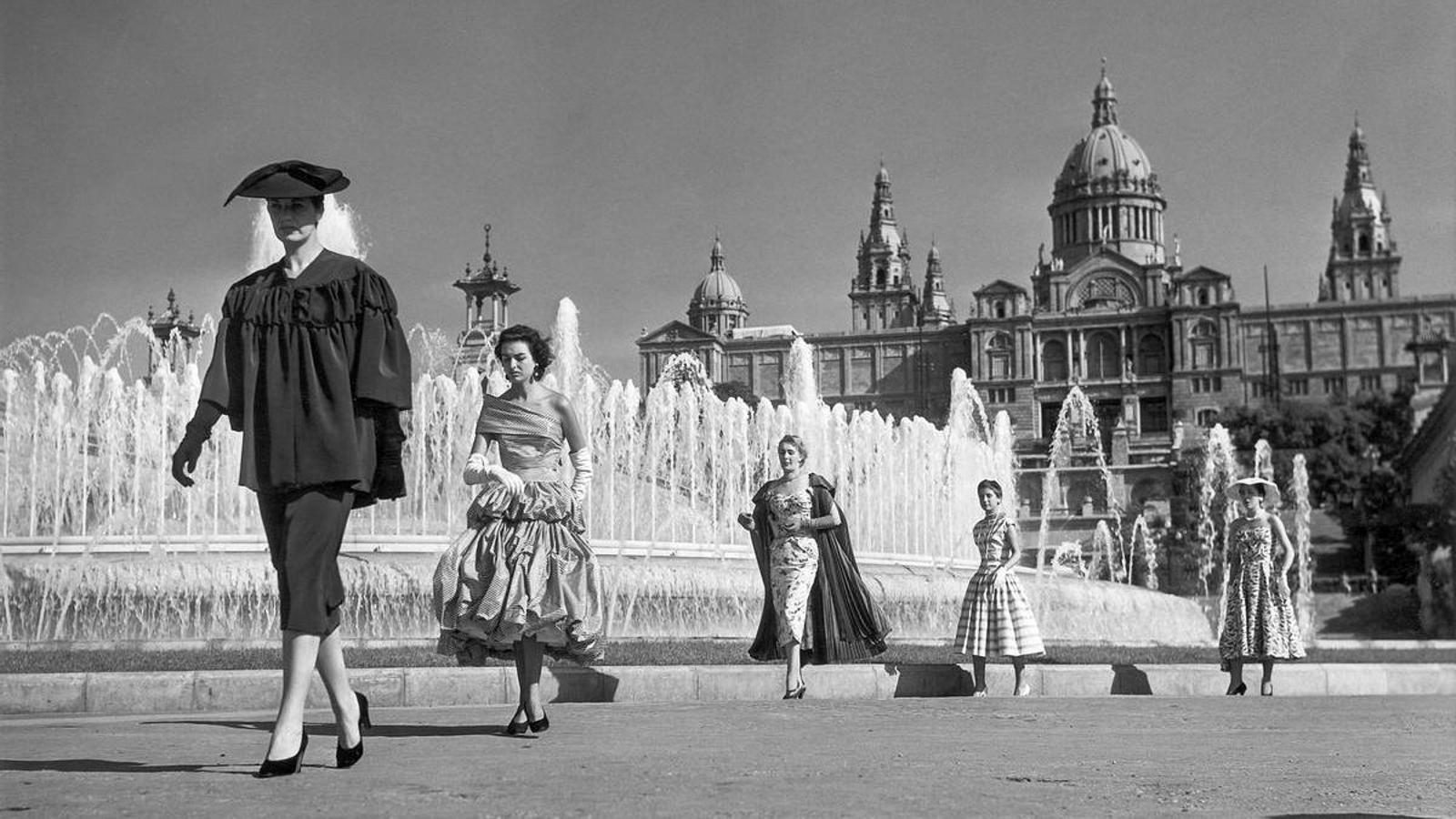
When she set out to organize this story, Laura Ballarín discovered that Asunción Bastida’s “textile legacy” was “dispersed,” she explains. So she began an investigation to rectify it: three years of collecting, dating, and cataloging documentation, of hitting the books, in a task that was at times thankless amidst the silence of paper in libraries, and of speaking with dozens of women who knew her. The result is the retrospective she is now curating, with more than thirty pieces – among them the famous dress from the wedding of Lola Flores to El Pescaílla –, magazines, photographs, films, posters, and sketches, in a staging that plays with lights and fabrics, and which forces one to walk through corridors that recall a fashion catwalk where the decades parade by.

Bastida grew up among fabrics. It might seem that everything was ready for her to end up becoming the successful dressmaker she became: after all, her father owned a tailoring bazaar on Passeig de Gràcia that brought the latest trends from Paris and London to Barcelona. But he “did not want his daughter to be a dressmaker,” explains historian Josep Casamartina, from the Antoni de Montpalau Foundation, which has loaned eight pieces to the retrospective.
So Bastida had to wait until she married to dedicate herself to it: in 1926 she turned her husband Marcelino Mases' knitwear shop into a dressmaker's shop. Eight years later, it was already at number 96 Passeig de Gràcia, in the old apartment of Ramon Casas and above the famous Vinçon shop. And she opened a house in Madrid. And from Madrid to heaven: she was essential in the so-called internationalization of Spanish fashion, derived from the thawing of the dictatorship's relations with the United States. Bastida would not leave haute couture behind until 1970, after the Treasury created a luxury tax for fashion houses that presented collections with models: "[Haute couture] It is no longer possible. Or, if it is possible, I do not want it for myself," she said.
The creator of an emporium
“Bastida was a star as a businesswoman: she touched all the bases,” states designer Teresa Helbig, who also explains that her mother drew much from the spirit of independence of the Barcelona dressmaker. The exhibition highlights this dual aspect of Bastida. “Not only was she a creative figure, but she was also a successful entrepreneur, capable of creating an entire empire,” asserts curator Ballarín.
His clientele were women of the aristocracy and high society, with a wardrobe for the hours: a tailored suit in the morning, a cocktail dress in the evening, a party dress at night. But not even they chose much. Charles Frederick Worth, considered the father of haute couture, explained it bluntly at the end of the 19th century. When F. Adolphus asked him if the women he dressed claimed the right to invent and choose, he said:
–Choose? Yes, but only between my proposals. And very few do: most let me do it. Invent? No. I don't want people to invent; if they did, I would lose half of the business.
From the aristocrat's dress, fashion trickled down to the rest. It is what theorists call trickle-down (trickle-down effect) since the sociologist Georg Simmel described it in 1905: the elite copies Paris, the bourgeoisie copies the elite, and when the middle classes catch up, the elite changes their dress again. Asunción Bastida understood the importance of controlling this trickle-down, and in 1952 she launched her own magazine, Boletín de la Moda, which for twenty years brought her fashion designs into Spanish homes.

This social-aesthetic dynamic extended throughout the country. While in the rest of Europe fashion was already being driven by new techniques and workers' and feminist demands, Francoism and autarky meant that "the solid social pyramid continued to impose the development of aesthetics", writes journalist Leticia García in Batallón de modistillas (Carpe Noctem, 2022). (Yes, Batallón de modistillas is also the couplet that Penélope Cruz sings in La bola negra.)
A key piece of that pyramid was the Spanish Haute Couture Cooperative, created in Barcelona in 1940 within the regime's trade union apparatus and in the image of the Parisian Chambre Syndicale. Bastida was a founding member: the only woman among the so-called "big five," along with Pedro Rodríguez, Manuel Pertegaz, Santa Eulalia, and El Dique Flotante. The trickle-down effect also acted in the Cooperative's fashion salons: dressmakers from the provinces attended the fashion shows, which were held first in Barcelona and later in Madrid, and brought the new trends to their cities, reaching even more of the public.
The fact that the Cooperative was born in Barcelona was not accidental: since the beginning of the century, Catalonia concentrated 80% of Spain's cotton production. But autarky did not impose the national production of fabrics only to regulate their quality, but also to control the aesthetic proposal, explains Lydia Garcia, director of the López-Trabado collection, who has also loaned pieces to the retrospective and who curated an exhibition on the Cooperative in 2019. The regime wanted to create “a national fashion that did not depend so much on global criteria”, that is to say, on France. The reality, however, was different: “If you place Bastida's dresses next to L’Officiel, the magazine of the Parisian Chambre Syndicale, you see that they follow its guidelines. Above that was the client's taste, and what the client wanted was to be the best dressed,” she continues.
An idea of femininity
And better dressed meant the French way. In fact, Bastida was the only designer authorized by Christian Dior to reproduce his models and sell them in Spain under her own label. This does not mean, however, that she held him in reverence. One only needs to read the interview conducted by Manuel del Arco in 1954, which begins with a slightly risky joke, considering only nine years had passed: “Christian Dior has launched the H-line from Paris and it has been the bomb”. While critics debated whether the H in Dior’s line stood for heavenly –celestial–, for horrid –horrible– or for haricot vert –green bean, for how straight and flat it was–, Bastida firmly expressed her rejection: for being “dry and hard” and “lacking coquetry and femininity”. And she continued: “If the H-line were to be imposed, all women would be the same, when what a woman aims for is to be different and to highlight her personality; the opposite is putting on a sheath”. A pod, exactly.
“Bastida liked the female body,” states Casamartina. And she acted accordingly: narrow waists, volume at the hips, enhanced chest. A “more Italian” line, at the antipodes of the “ethereal” Pertegaz or a “more geometric and abstract” Balenciaga, she continues. Of Bastida, she highlights the “structured” nature of her dresses, the work on the necklines and backs and, without a doubt, the embroidery, among which the pearly gray piece with which Lola Flores was married stands out. And also one of her great contributions: bringing “daytime materials” to evening dresses, cotton and especially linen, where until then only silk had reached; like the blue linen dress with cotton embroidery of modernist inspiration that can be seen in the exhibition. In 1947, the dressmaker included bikinis in her summer collection, just a year after the garment was introduced in France. Francoism did not authorize their use until 1953.
“Fashion is very political –says Lydia Garcia–, and one of the great mistakes we have made as a country is not giving it the importance it has”. One of the reasons for the lack of books, theses, and materials in general about Spanish fashion, asserts Garcia, is the country's difficulties in addressing its Francoist past. After all, the Bastida empire thrived under a dictatorship. But Spain is not the only one that has not known how to confront it. “The French have hidden under the rug the collaboration of the Chambre Syndicale with Nazism during the occupation”, she explains. Garcia, however, insists on a second factor. Fashion has remained within what is considered the female universe and has often been understood as a household obligation, and not as an object of study.
Bastida saw it from the inside. When Del Arco asked him if there was harmony among the big five, he replied:
–There should be more…
–What's up?
–That, since I am the only woman among them, they have not understood me.
The retrospective "is an act of poetic justice", states Ballarín: against the oblivion of Bastida, of her context and of the women around her. The curator has tracked down one by one the models of Bastida, among whom are Laura Valenzuela, Pilar Bardem, Alícia Borràs and Viky Ballarín herself. Now they appear with their names and surnames in the images and on one of the walls of the exhibition. In an exercise that she understands as a vindication of female memory, Ballarín has a recommendation to make: open the closets with our mothers, aunts, grandmothers, so that they can explain the story behind each object to us. A job that is not only within our reach, but that, she assures, also corresponds to us all.
