Photos against the abuse and the irresponsibility of power
The CCCB hosts more than one hundred images in the exhibition of the photojournalism contest World Press Photo 2026
-
CAT -
CAST
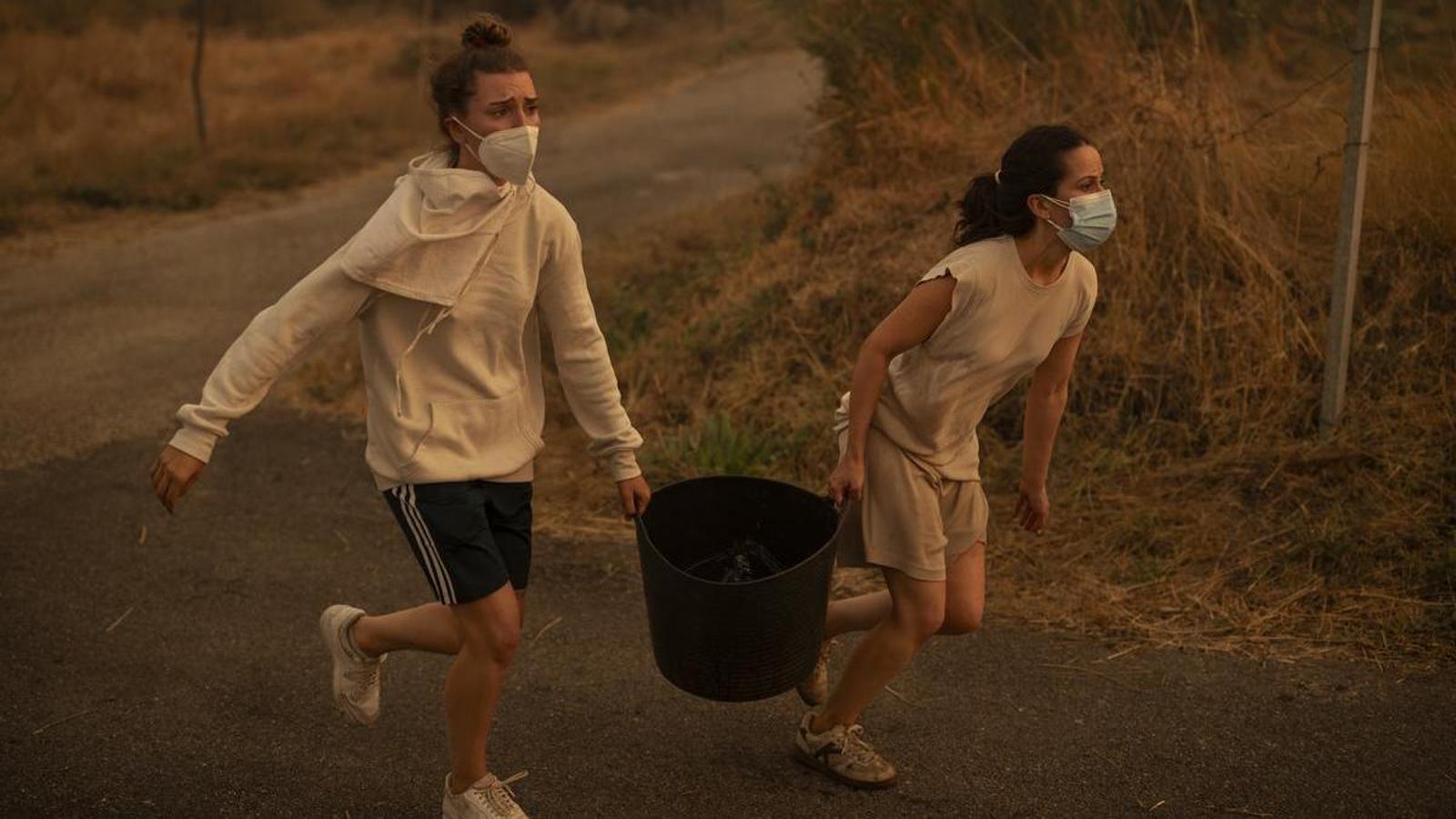
Barcelona"I document fires because I live in a place where there are fires," says Galician photographer Brais Lorenzo, awarded in the 2026 edition of the World Press Photo inthe graphic reportage category for the Europe region. In Lorenzo's words, there is resignation and rage. "I have been documenting them for fifteen years, and their destructive capacity increases every time," he adds, aware of the structural nature of forest fires, caused by the climate emergency but also by the progressive abandonment of rural human ecosystems. "It pains me to document what happens every year in my land," he laments.
Four photographs out of the ten that are part of the series Scorched Earth, by Brais Lorenzo, can be seen until December 13 at the CCCB in the World Press Photo 2026 exhibition. One of the images shows two girls carrying a bucket of water in Carballeda de Avia. In another, a man tries to put out the fire with a branch in Cualedro. The third is a panoramic view of the magnitude of the fire in Larouco. Finally, the fourth, also in the province of Ourense like the others, bears witness to the devastation left by the fire in the village of San Vicente de Leira. Because Lorenzo works to leave a record of the fire extinguishing efforts and to capture "the consequences on the population." In all of this, there is a denunciation of a structural irresponsibility, that of the political and economic powers that fuel the fire by disregarding the climate emergency, and that of society as a whole, pushed to abandon more sustainable models of living.
At the CCCB, Lorenzo's photographs are exhibited in an area shared, physically and politically, by other examples of photojournalism about the ravages of the climate emergency, such as César Rodríguez's photographs of floods in Mexico and Ethan Swope's taken during the fires in Los Angeles. There are also those from a series by Aaron Favila that documents a wedding in a flooded church in the Philippines: the poetics of resistance, or life making its way despite everything.

The critical humanism of Diego Ibarra Sánchez
Photojournalism explains what is happening, that is evident, but what is happening is not always explained in the media. War provides cover photos, but the more prosaic consequences are often left out. "What remains after the battle?", is the question that moved the Aragonese Diego Ibarra Sánchez to start a personal project, Kidnapped Education, which "documents the consequences of war on education" in Pakistan, Afghanistan and Lebanon. He has dedicated, for now, fifteen years to it, and the World Press Photo jury has rewarded him with the award for the best long-term project in the West, Central and South Asia region. Among Ibarra Sánchez's images exhibited at the CCCB, one stands out of some girls walking up a hill among ruins, a metaphor, perhaps, of the determination of a society that defends education as a possibility of hope. "Photography does not rebuild schools, we do not have that power, but it can make you think. It can be a visceral punch to take the viewer out of their comfort zone and make them think", says the Aragonese photographer, determined to spread the need for schools to be safe places in war conflicts.

Ibarra Sánchez's work requires time and perseverance. That is why he is so critical of photography that "manipulates and creates false scenes," as well as that which takes the easy way out with artificial intelligence (AI). "We defend photojournalism and ensure that information is truthful by verifying its sources," says Sílvia Omedes, director of the Photographic Social Vision Foundation and chair of the World Press Photo Europe jury. "In the contest, we have discarded many projects that included the use of technology that allows for image manipulation with AI," Omedes explains. A specific forensic team is in charge of verifying their authenticity.
In addition to time, perseverance, and authenticity, photojournalism is also about intention: knowing how to choose topics freely. The best example is the World Press Photo 2026 winning photograph, Separated by the ICE, by the American photographer Carol Guzy. For six months, Guzy photographed the scenes of pain that occurred in a New York courtroom when the abuse of power exercised by anti-immigration forces came into play. The choice is also fundamental in the photograph that welcomes visitors to the exhibition: an image from the series Farisat: Daughters of Gunpowder, a project by Chantal Pinzi about some Moroccan women who defied a male tradition.
The tour of the exhibition also allows us to see the work of photojournalists like Luis Tato and Narenda Shrestha, who have documented the Gen Z revolts in Madagascar and Nepal. And there is no lack of photographic testimonies of wars, such as those by Eugeniy Maloetka in Ukraine, Abdulmonan Eassa in Sudan, Yasir Iqbal in Kashmir, and Saber Nuraldin and Shaer Alghorra in Gaza. However, one of the most moving areas of the exhibition is the one dedicated to illness. For example, Tanner's Song, a series by Jahi Chikwendiu about a 25-year-old man with colon cancer who dies a few days after the birth of his son. Behind the affliction lies a question: why have cancer deaths among people under 50 increased so much in the United States?
