Neither Cambó nor Macià: the man who was almost everything without wanting to appear in the photo
Joan Safont reconstructs, in a book, the trajectory of the uncomfortable and radically independent Amadeu Hurtado
-
CAT -
CAST
If we were to read some of the political texts by Amadeu Hurtado (Vilanova i la Geltrú, 1875 - Barcelona, 1950) today, they might sound familiar to us. As the writer and journalist Joan Safont says, recalling the quote attributed to Mark Twain, "history does not repeat itself, but it rhymes." Hurtado defined Catalan political life as "a long complaint": "We have fluctuated between submissions and rebellions from the origin of our nationality until today, making Voltaire exclaim that, with Catalonia being the people most jealous of their freedom, it has always been subjected by another," wrote the jurist, editor, and politician in 1920.
"Hurtado said that we were great organizers of demonstrations and indignation but poor managers of proposals and political transformation. That we were a multitude but not yet a people," says Safont. Far from any romantic nostalgia, his was a modern Catalanism that trusted in the real strength of a country capable of building the Eixample, creating factories, and producing figures like Verdaguer and Guimerà, but which often consoled itself in lamentation. "We continue to be very good organizers of demonstrations, but in management and political transformation, we still have to improve," points out Safont.
The lucid and uncomfortable gaze of the lawyer, politician, and press man permeates Amadeu Hurtado, the gray eminence (Pòrtic), Safont's new book. The journalist and writer spent ten years investigating and searching archives, had access to family documents, and wrote a doctoral thesis on it in 2022. Now he has rewritten it and given it the form of a book to rescue the trajectory of a key but often misunderstood figure of contemporary Catalonia.
The trauma of Montjuïc
Despite his acute analysis of Catalan politics, Amadeu Hurtado did not like to be in the spotlight. He made this clear himself in a letter addressed to Miquel Utrillo –with which Safont’s book opens–, where he confessed bluntly that he had no party or followers, that he lacked the qualities to dedicate himself to politics, and that he preferred to go unnoticed. Carles Soldevila, in his memoirs From Gas Light to Electric Light (1951, reissued by Empúries), had already portrayed this temperament by appealing to the image of the men who make the giants walk in parades: “He defined Hurtado as an Olympic carrier of great qualities,” points out Safont. Although he felt a fascination for charismatic leaders capable of moving the masses with words and gestures –like his great friend Francesc Macià– and many saw him as “the Cambó of the left,” he tried (though not always successfully) to avoid the front line.
This resignation has its origin in a deep personal crisis experienced in the wake of the Montjuïc trial in 1896. After the Canvis Nous street bombing against the Corpus Christi procession, the repression not only struck at the anarchism of action but also at the intellectuals close to the working-class world. At that time, Hurtado and his intimate friend Pere Coromines (Barcelona, 1870 - Buenos Aires, 1939) were two young lawyers with advanced ideas who were trying to educate workers.
The arrest of Coromines, the request for the death penalty, and the loneliness in which Hurtado found himself while trying to save him marked a turning point. “Realizing that the city was turning its back on him and calling for repression affected him deeply and made him distrustful of the masses, who sometimes sway from one side to the other,” explains Safont. “From this disillusionment was born the commitment to enlightened minorities and working behind the scenes, as well as his theory –in line with the social psychology of the time– regarding the neutral mass, that non-politicized population which, when activated, can make a dictatorship succeed or fall, like that of Primo de Rivera, or proclaim the Second Republic.”
Hurtado bet on the power of the media. A defender of republican and Catalanist journalists, he began as a columnist for El Diluvio and made the leap as editor of La Publicitat during the First World War. In this medium, he promoted a brilliant period alongside signatures such as Eugeni Xammar, Josep Maria de Sagarra, Carles Soldevila, and Antoni Rovira i Virgili.
“He was always inspired by the French press and wanted to create newspapers that had ideology but were not party bulletins –points out Safont–. He applied this same criterion in 1933, when he returned to a La Publicitat that had already been Catalanized and reached its maximum expression with the weekly Mirador, conceived for an urban, Catalanist, modern and cosmopolitan public”.
Bridge between Catalonia and the state
This capacity for discreet influence proved decisive in 1931. After the proclamation of the Republic and the creation of the Generalitat of Catalonia, Hurtado returned to political activity to provide legal counsel to the Catalan government in the drafting of the first decrees. But Francesc Macià immediately sent him to Madrid to come to an understanding with the Spanish government.
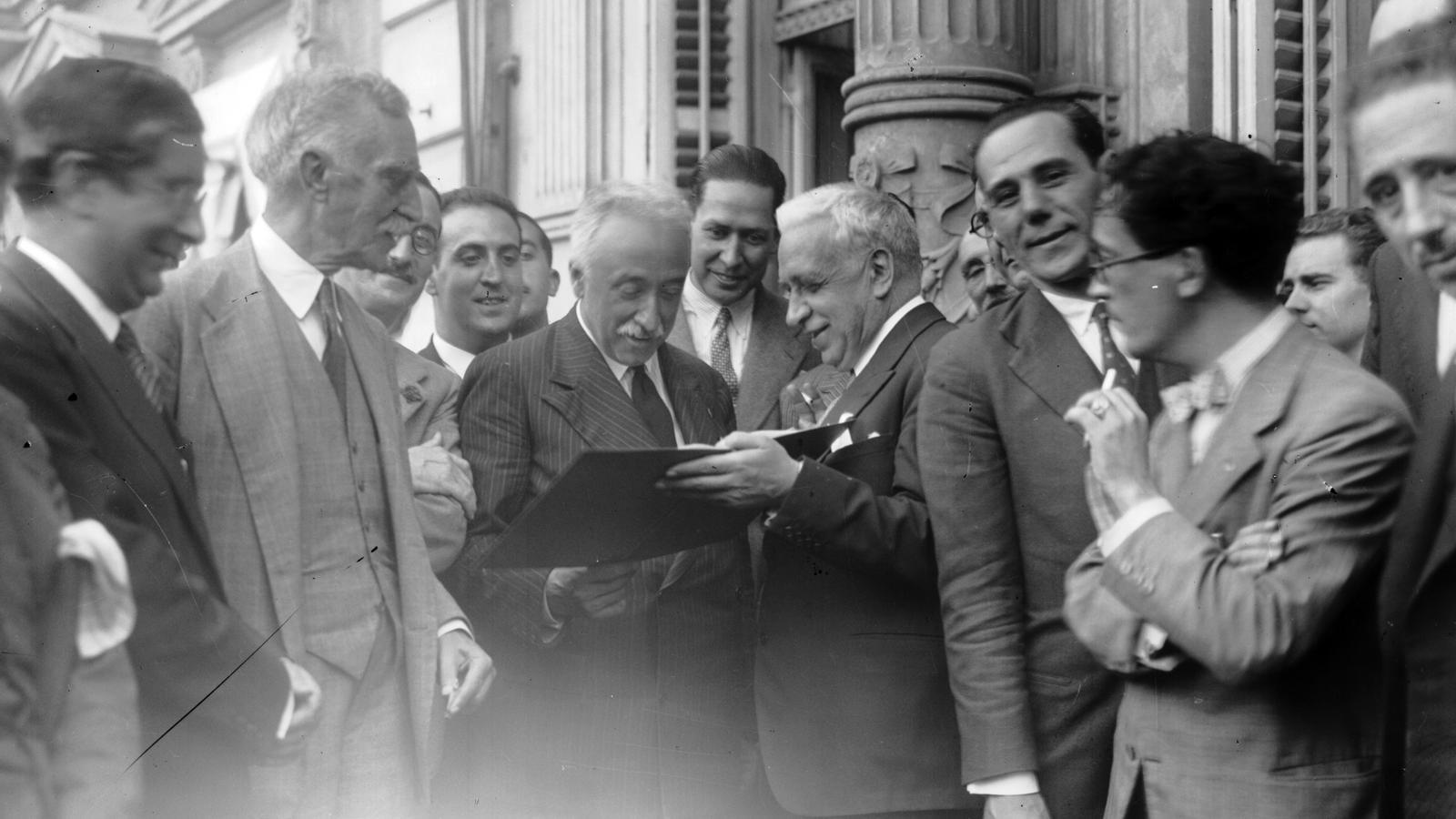
“This diplomacy between both governments is based on the good personal relationship between Niceto Alcalá-Zamora, the first president of the Second Republic, Macià and him,” points out Safont, which had to be added to the professional and journalistic contacts that the lawyer had cultivated in Madrid. The understanding with Alcalá-Zamora went back to a parliamentary anecdote that the Andalusian leader always reminded him of: “In the 1907 Cortes, in a defense of the autonomy of Catalonia and the program of Solidaritat Catalana, Hurtado said that they would not get along with the Spanish conservatives, nor with the liberals; only, perhaps among the latter, with a young deputy from Córdoba who had just arrived in Madrid and whose name was Alcalá-Zamora,” states the author.
The antithesis of Cambó
History has often contrasted Hurtado with the leader of the Regionalist League, Francesc Cambó (Verges, 1876 - Buenos Aires, 1947). They were a year apart; both were cultured, polyglot lawyers, well-connected with intellectuals, art lovers, and with international contacts, which must have fueled mutual respect. But they represented two opposite ways of understanding the country and power. "One is a conservative Catalanist, a monarchist accidentalist, and the other is a liberal Catalanist republican; one is a professional political animal and the other is a dilettante of politics, who enters it at very specific moments, as he did with Solidaritat Catalana or during the Second Republic," reflects Safont.
Fortune also separated them. Hurtado lived comfortably on Passeig de Gràcia, where he had his prestigious law firm, had a chauffeur, a box at the Liceu, and the capacity to finance a weekly newspaper, but he was not a millionaire like Cambó. An anecdote illustrates these differences: upon the outbreak of the First World War, Hurtado stopped being the lawyer for the German Transatlantic Bank due to his firm pro-Allied stance; he was replaced by Cambó, who made a colossal fortune with the operation of 'Spanishizing' the entity and avoiding its seizure.
This radical independence ended up taking its toll on Hurtado. He tried to lead Acció Catalana in 1933 to attempt to turn it into a second republican party of government that would act as a partner and counterweight to Esquerra, but it did not have enough support and failed electorally. The liberal tradition of the republican center-left disappeared with the Civil War and did not have continuity either in exile or especially during the Transition. Hurtado received criticism from all fronts. "For some republicans, at times he was too conservative and lukewarm; they found him elitist and arrogant, a plutocratic bourgeois from Passeig de Gràcia; and the right considered him an outcast who had financed the revolutionaries," summarizes Safont. Between 1933 and 1935, in the midst of Hitler's rise, the right-wing satirical press went as far as publishing virulent anti-Semitic jokes against him, accusing him of being a Freemason and projecting onto him all the tropes of the Judeo-Masonic conspiracy.
At the same time, as a lucid observer of the international scene, Hurtado detected the advance of totalitarianism in Russia, Italy, and Germany. This apprehension led him to also criticize the temptation of a single-party system within the Republican Left and the displays of force by the Estat Català squads with their green shirts, who even assaulted journalist friends of his such as Josep Maria Planes, who had ridiculed them in El Be Negre.
Utopian and “wasted”
Despite his reputation as a cold and pragmatic jurist –his close friend Francesc Pujols recalled that as a young man he did not go out partying “so as not to catch a cold”–, Josep Pla described him as “utopian and fanciful”. Safont agrees with him: “Being a republican in a monarchy, a Catalanist in a unitary state, a pro-European at a time when Africa began at the Pyrenees and a liberal in a country where liberalism has had little fortune was to be a utopian”.
That is why the historian nuances the cliché fueled by Gaziel that placed him as another victim of the “man-devouring Catalonia” and as a wasted talent. Son of a lithographer from Vilanova, Hurtado reached the pinnacle of Barcelona law –being a director of companies such as the Barcelona Water Company–, was a deputy, counselor, drafter of the Statute and the Constitution, delegate to the League of Nations and was offered to be a minister and president of the Supreme Court.
The final stretch of his life was marked by the bitter irony that a convinced francophile had to spend his old age in French exile, first in Paris (1936-1940) and then in Perpignan (1940-1949). After seeing his generation's companions such as Francesc Cambó, Niceto Alcalá-Zamora, Pompeu Fabra and Antoni Rovira i Virgili die in exile, he decided to return to Barcelona when he was very old to try to recover the assets looted by the political responsibility processes –paintings, documents and his apartment– and die at home. The looting, especially of paintings and documents, had been so commonplace that, as his grandson recalls, Hurtado's daughter passed through Passeig de Gràcia and recognized, on a balcony, a woman wearing her own dressing gown.
He barely had time to meet up with some old friends such as Pujols, Fèlix Escalas or Maurici Serrahima's father before dying, and he left the recovery of his estate in his wife's hands. That man who had arrived in Barcelona in 1888, in the middle of the euphoria of the Universal Exhibition, closed his eyes in a gray city under Francoism.

