Gabriela Galcerán: “If we listened more to artists, things would go better for all of us”
The book 'The voice of the artist(s)' gathers the reflections of 26 international artists on issues such as fear, the body and the environment

-
CAT -
CAST
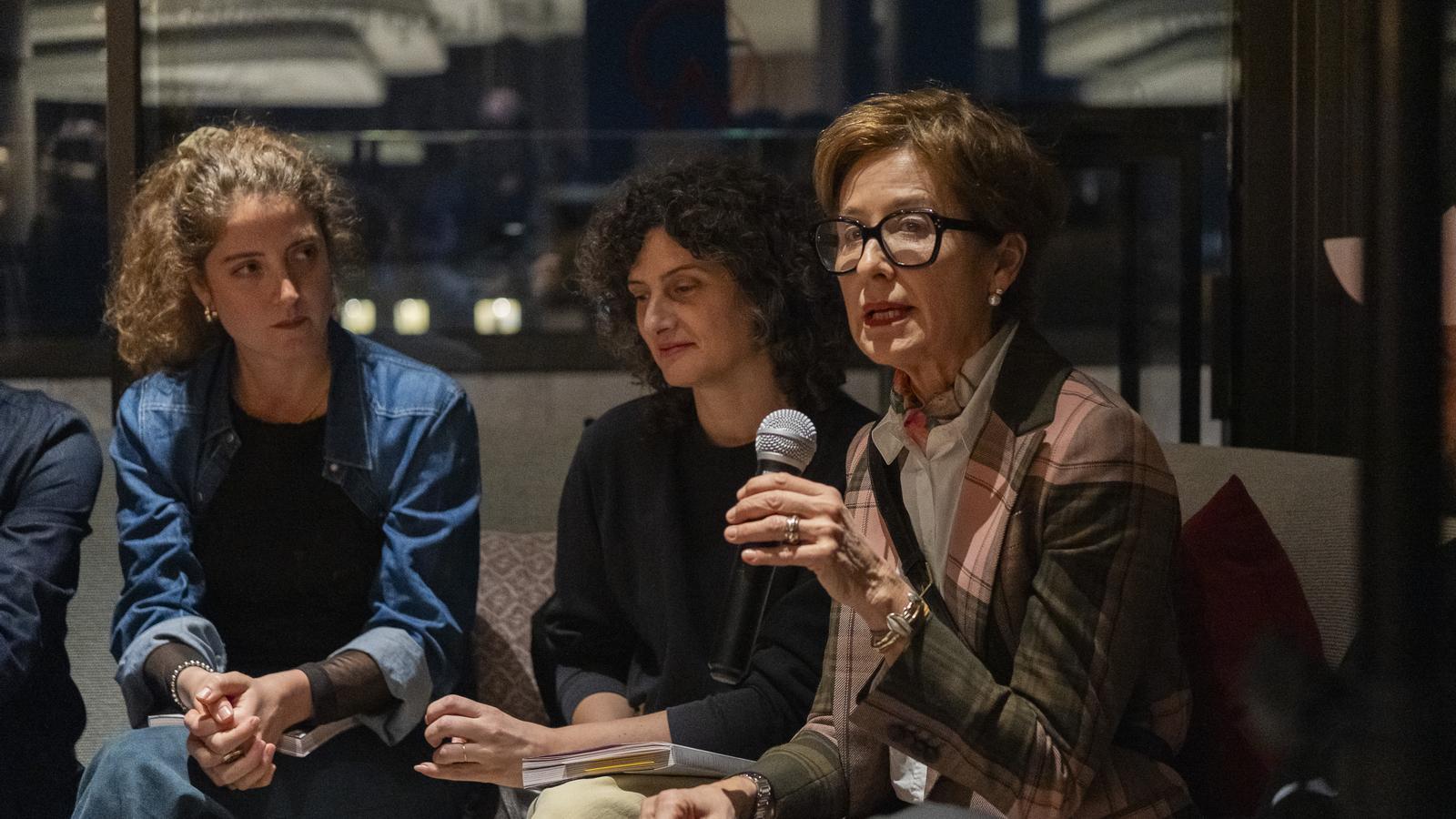
BarcelonaCultural producer and art project manager Gabriela Galcerán is known for her work on various initiatives linked to contemporary art between Barcelona and the international scene. In Barcelona, Galcerán has collaborated with the Loop festival and fair, and directed the fair in 2023 and 2024. Internationally, she is one of the founders of the Art\Collisions organization, which hosts meetings led by artists and designed for corporate executives. Later, following the COVID pandemic, Galcerán launched The voice of the artist, an open digital platform that invites artists to share their reflections on major universal issues, and on Thursday evening, she presented within the Loop video art fair at the Hotel Almanac Barcelona the book that collects these thoughts, The voice of the artist(s): another vocabulary , published by Sternberg Press.
“The premise is very simple: if we listened more to artists, things would go better for all of us,” states Galcerán, who was accompanied by the curator and director of the digital magazine Exibart, Carolina Ciuti, and by some of the artists featured in the book, such as Pedro Torres, who read his text on questioning. Also present were Lúa Coderch, who spoke about attention, and Arash Fayez, who spoke about being in liminal spaces like an airport terminal. “During this period, you check if you have all your documents with you and you remember that for a long time you have not had any documentation, for a very simple reason: you are a stateless person. You find yourself trapped between two territories, rather than being without a homeland or in exile,” says Fayez.

Against the tension
The voice of the artist(s) aims to be an antidote to tension. “In a moment marked by acceleration, political polarization, ecological instability, technological transformation and the exhaustion of public discourse, this project asks what artists can contribute that other forms of knowledge cannot offer,” writes Galcerán in the book. For the author, artists are not just “producers of objects, images, performances or exhibitions,” but they also produce “sensibilities, languages, relationships and ways of understanding the world.” “Artistic thinking, in itself, can expand the horizons from which society imagines and understands itself,” she says.
Galcerán invited the twenty-six artists who appear in The voice of the artist(s), of different backgrounds and generations, to choose a word, each of which had to start with a different letter of the alphabet, and to reflect on it in a video. The book is divided into five thematic chapters dedicated to the body and emotional life; systems of control and representation; the relationship with the land and the environment; speech and authorship; and the rituals through which people find meaning and bonds. “It is fundamental to study the voice of the artist in order to clarify not only what it says, but also to understand what we want to debate as a society, or what we want to silence,” states the director of the Institute of Art at the FHNW Academy of Art and Design in Basel and curator Chus Martínez. “The artist's voice usually coexists with other voices that amplify it or that, as is happening now, try to silence it: the voice of institutions, the voice of the media, the voice of the public…,” she explains.
In this vein, in the entry about fear, Antoni Muntadas speaks of the media as “a tool to generate these feelings of fear,” as also happens with architecture. “Borders protected by walls, like the one we saw with the Trump administration, which tried to build a wall between the United States and Mexico; also the borders of Palestine and other parts of the world, such as Gibraltar, are a sign of this,” says Muntadas.
The complete list of artists for The voice of the artist(s) is made up of Noor Abed, Daniel G. Andújar, Aleksandra Aroshvili, Tekla Aslanishvili, Cecilia Bengolea, Pablo Bronstein, Ana María Caballero, Musquiqui Chihying, Marcus Coates, Lúa Coderch, Hannah Collins, Elyla, Tim Etchells, Arash Fayez, Esther Ferrer, Regina José Galindo, Lawrence Abu Hamdan, Gary Hill, Lynn Hershman Leeson, Nicole L’Huillier, Nástio Mosquito, Antoni Muntadas, Ingo Niermann, Yiannis Pappas, Olivia Plender, Ana Prvacki, Ben Rivers, Ile Sartuzi, Marta Skoczen, Cally Spooner, Jonas Staal, Pedro Torres, Oriol Vilanova and Abbas Zahedi.
