"Nobody has gifted us anything": 50 years of LGBTIQ+ struggle at La Model
An exhibition by the FAGC collects its history and warns that no step backwards can be taken
-
CAT -
CAST
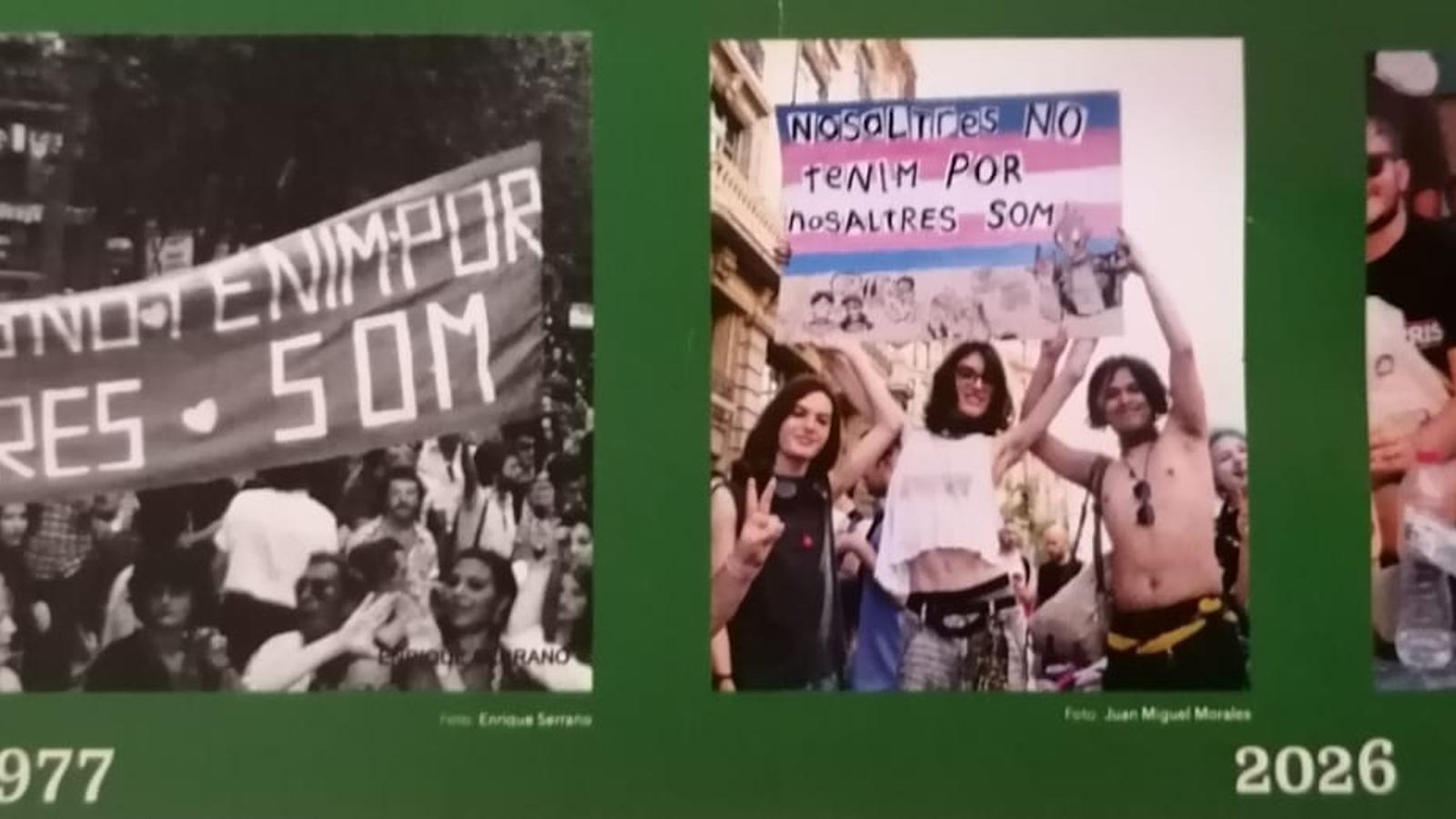
BarcelonaTwo images close the journey of the exhibition Love as you wish, which can be visited at the former Model prison in Barcelona until November 29. The first is from 1977; a group of protesters is holding a banner that reads: “We are not afraid, we exist”. The second is from this same 2026, and it shows dozens of young people holding up banners with exactly the same slogan. Almost half a century separates both photographs, but the cry remains fully valid. “Today’s young people feel like participants in a history and a past”, points out Jordi Muñoz, coordinator of the exhibition and historical activist and militant of the Gay Liberation Front of Catalonia (FAGC), the pioneering organization in the defense of LGBTIQ+ rights in Catalonia and the Spanish state.
The exhibition is born in a particularly delicate political moment. With the rise of the far right and the constant threat of a regression in civil rights, the exhibition functions at once as an exercise in historical memory and as a warning for the future. “Nobody has given us anything, everything we have achieved after years of struggle. Whatever happens in the elections this November 29, we cannot take a single step backwards”, warns Muñoz, who makes it clear that the collective will continue to stand up “against any involution of rights and freedoms”.
Far from having a nostalgic or inward-looking perspective, Love as you wish has been conceived with a clear pedagogical vocation and is open to society as a whole – in fact, once it closes its doors in Barcelona, it will begin a tour through different towns in the country –. “We did not want to make an endogamous exhibition, for our own consumption; on the contrary, it has a didactic objective and aims to make known the five decades of struggle of the FAGC and, by extension, of the LGBTIQA+ collective in our home”, explains Muñoz. Furthermore, the narrative places gay, lesbian and trans activism in constant and interconnected dialogue with the rest of the social movements that conquered democracy: the feminist, the neighborhood, the anti-militarist, the union or the student movement.
Victims of beatings and harassment
The fact that the exhibition was inaugurated precisely at La Model is no coincidence. The walls of the former penitentiary were direct witnesses to the Francoist persecution of sexual and gender dissidence. The exhibition gathers the moving testimonies of some of the protagonists who suffered the repression of the dictatorship and the Transition firsthand: from Antoni Ruiz, arrested at only 17 years old, to Estefania Vidal, imprisoned at La Model itself on two occasions and a victim of constant beatings and vexations.
The exhibition also breaks one of the most persistent silences of recent memory: the specific repression against lesbian women. “Sometimes it has been said that lesbians did not suffer as much under Francoist repression, and it is not true,” Muñoz emphasizes. At the Patronato de Protección a la Mujer and in other institutions of confinement and moral re-education, many women were exploited through labor, humiliated, mistreated, and even subjected to electroshock therapies to try to “cure” their sexual orientation.
“It is the visual genealogy of the FAGC. It is the collective that takes the floor, that narrates its own history, too often silenced and rendered invisible, frequently laden with stereotypes and mockery,” highlights Muñoz. The journey does not hide the trauma: “The scars are shown, yes, and there is talk of pain, but also of rebellion and transgressive joy. It is a story of struggle, of love and resistance, radical, insubordinate, and sensual, often lived from the margins and under the weight of repression and ostracism,” details Muñoz.
To build this narrative, the FAGC has relied on the complicity and the generous contribution of top-tier creators. The walls of La Model bring together the graphic work of illustrators such as Nazario, Meritxell Garriga, Ignasi Blanch, Dani Torrent, and Sebas Martín, alongside historical photographs by references such as Pilar Aymerich, Colita, Toni Catany, or Carlos Bosch. Everything dialogues with literary fragments from essential voices of Catalan culture such as Maria-Mercè Marçal, Blai Bonet, Biel Mesquida, Sebastià Portell, Ian Bermúdez, and David Moragas, who remind us that the freedom to love is always a collective conquest that must be defended every day.
