A working-class neighborhood club challenges the new transatlantic liners of Catalan football
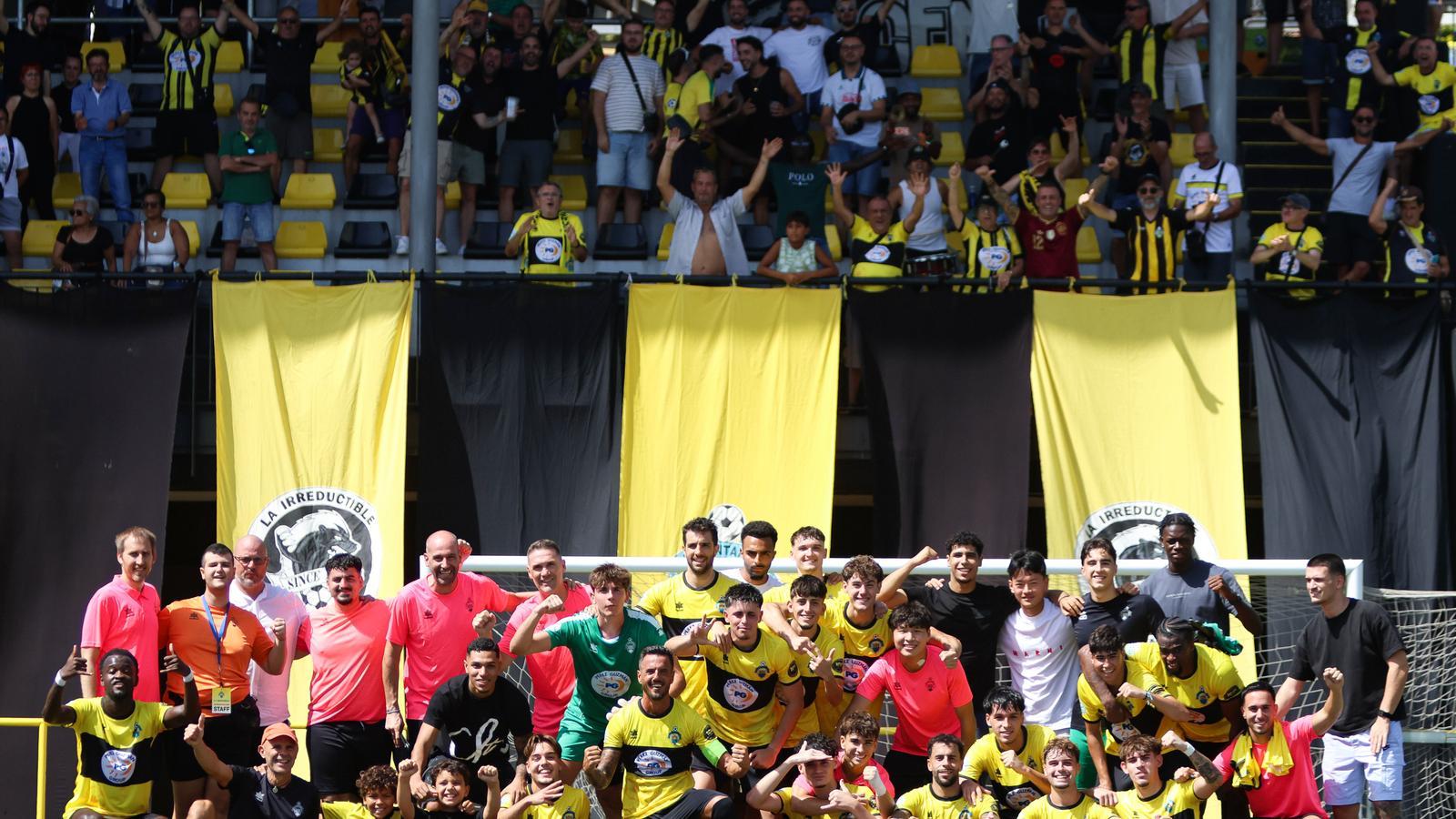
La Muntanyesa, leader of group five of Tercera, has become a symbol of popular football in Barcelona

-
CAT -
CAST
BarcelonaOn Sunday mornings, on Via Júlia, you can breathe football. From early in the morning, at the junction with Carrer d'en Tissó, the Muntanyesa social headquarters, known in the district for its daily menu, fills up with neighbors having their pre-match breakfast. From eleven o'clock, a string of yellow and black shirts lines up to enter the stadium, popularly known as the Nou Barris Bombonera, and to buy raffle tickets for the basket drawn at halftime. It is a ritual that is repeated every fortnight in La Prosperitat, a neighborhood with a working-class tradition and a long history of neighborhood struggles that has made its football team one of its symbols of identity.
“Here people are not from Barça or Madrid, they are from the Assemble”, says Pedro García with pride, president of the most modest team in the Catalan group of the Tercera Federación. When at 36 years old he took over the reins of the club, after a long career on the pitch during which he even coincided at Barça with Pep Guardiola and Pedro Rodríguez –“They call him Pedrito because there was already another Pedro. It was me”, he reveals–, la Monta was competing in Primera Catalana and was at risk of falling even further due to economic problems.
Five years later, with a budget of just 80,000 euros for the squad –many players barely cover their fuel expenses–, Muntanyesa is the leader of Tercera. And it is ahead of transatlantic clubs like the Cornellà of Leo Messi, the Hospitalet of Jordi Alba, Badalona, or Atlètic Lleida, the next rival in Nou Barris, with economic resources five or six times greater.
“An anecdote might be the first or second matchday, but after eleven games it is no longer a coincidence. In any case, the objective is to get 40 points and save ourselves,” claims their coach, Luis Gallego, who is from Alicante, but who identifies with Nou Barris, where his wife was raised. Since he took la Guineueta to Tercera, he has become an institution in the district.
The grandfather of Catalan football
The formula for success begins in the offices: the sporting management, led by Juan Diego Sánchez, bets on young, talented, and hungry footballers who see Muntanyesa as a springboard to make the leap to higher categories. Óscar Sierra, its captain, is the exception. He is a unique case in Catalan football: “I am 45 years old and my teammates could be my children. Well, the president is younger than me. Regardless, I am not considering quitting because I take great care of my diet and physical preparation and I maintain my passion for football. It is like the first day”.

Sierra works as a film and commercial actor and Gallego is a primary school teacher. At La Monta, people don't earn a living from football, which is why training sessions are at 7:30 in the evening. “It's a very humble club, more than I thought, but there are many people working voluntarily to keep it going,” explains the coach. Jordi Sánchez, known as Perico, is member number two and combines the position of board member with the tasks of equipment manager. Antonio Barrientos takes care of the maintenance of the field and the veterans' team. They are two historical figures of La Muntanyesa who have been dedicating hours selflessly for years, as do Luis Gutiérrez, the field delegate, or Dani Borrallo, head of communications. Without them, La Monta would not be understood.
There is life beyond Europa and Sant Andreu
The other great secret is their field, with small dimensions that condition the play of any team. “In Nou Barris, you play a different kind of football. It’s like going to the dentist,” say members of the coaching staff of one of the most powerful clubs in the Third Division. “Sometimes there is so much noise that it is hard to give instructions to the players,” reveals Gallego, who compares the atmosphere of the Bombonera with that of the Nou Sardenya and the Narcís Sala: “Europa and Sant Andreu have a larger social base, but there isn’t much difference from what is experienced at our field. At all three, you can breathe authentic, neighborhood football.”

Among the most illustrious fans of the Monta is the boxer Sandor Martín, who runs a boxing club under the stadium and has a mural behind one of the goals. The cheering, historically led by the Al Hueco supporters' club, is now in charge of La Irreductible, which with megaphones and drums is located at one of the ends of the grandstand, right next to exit 2 of the Ronda de Dalt and the iconic Torre Júlia, the 17-story white building that stands next to one of the stadiums with the most personality in Barcelona. At the foot of Collserola, where the Prosperitat, Verdum and Trinitat Nova neighborhoods converge, the Bombonera has been uniting three neighborhoods around the same passion for decades.
The deep-rooted connection to the district with the lowest disposable income per person in Barcelona is also reflected in the ownership model of Muntanyesa, which belongs to its members, something increasingly less common in Catalan football. “We proposed in the assembly the conversion into a sports public limited company, but it was rejected. The members do not want someone to come along who, two or three years from now, will sell the club to people who do not feel Muntanyesa”, concludes the president, who every season has to do the math to keep a football club going that is the pride of Nou Barris and which, in better health than ever, will celebrate its centenary in 2027.
