Munch and Picasso: an imaginary encounter that makes sparks fly
A great exhibition at the Picasso Museum in Malaga explores the artistic links and biographical coincidences between the two painters

-
CAT -
CAST
MalagaThe mature paintings of Edvard Munch (1863-1944) are often electrifying: it seems that the deeper the anguish that stirs him, the more he clings to vivid colors and the more energetic the brushstrokes are. This can be seen until February 28th in the magnificent Munch-Picasso exhibition, at the Picasso Museum in Malaga. Munch was born eighteen years before Picasso. He did not revolutionize 20th-century art, but sometimes his more academic works are more striking than the avant-garde ones of the man from Malaga, as is the case with a female nude on her knees on a bed that looks like a still from a love scene. Without leaving nudity behind, on a personal level, Munch would strip on the beach and paint groups of naked men. It seems that, although he was not a modest man, this masculine intimacy remains far from Picasso's universe.
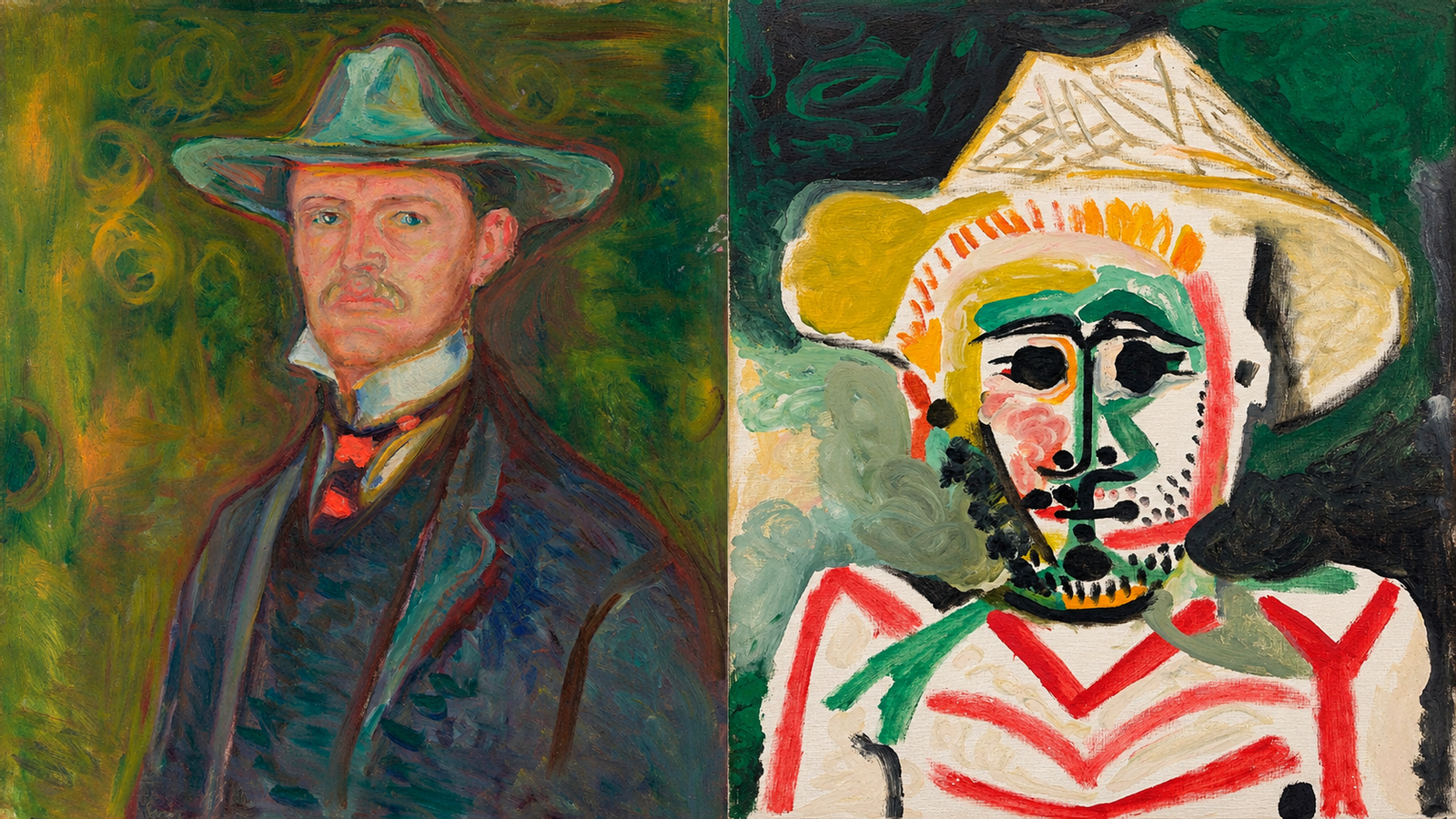
"Munch and Picasso never managed to meet or get to know each other, but they maintain a conversation in the universal language of art," states the exhibition curator, Paloma Alarcó, former head of the second half of the 19th-century and 20th-century painting collections at the Thyssen Museum in Madrid. "Through the language of art, Munch and Picasso share many life experiences and also artistic experimentations. I immediately realized that the works of one and the other expressed themselves with a mysterious and enigmatic resemblance," explains the curator. This eagerness to break the established limits of painting meant that, at times, both were rejected. On the other hand, both maintained romantic relationships that were sometimes destructive.
Picasso discovered Munch in Barcelona, before leaving for Paris, above all through Ramon Casas and Santiago Rusiñol, and also through Miquel Utrillo, who since 1889 had been working as a correspondent for La Vanguardia in Paris. Later on, it is very likely that he could have seen his works in the French capital. "For me, Munch and Picasso are the two great figures of art in the first half of the 20th century. It is true that they belonged to two very different worlds, that they had antithetical personalities and very different spirits. Southern, earthly, expansive, excessive and sensual, we already know who. The other, Nordic, spiritual, introspective, intellectual and problematic," says Alarcó. "Their styles and techniques are also different, although many of their concerns converge. Their intentions are, on many occasions, similar. Both questioned the artistic and social structures of their time, and shared the purpose of shaking the old beliefs. And they succeeded. Both created a new language, a distinctive and experimental visual language, and drove innovation in modern art," explains the curator.
One of the first exhibitions in which the works of both coincided was the Sonderbund, in Cologne, in 1912. Munch and Picasso were the only two artists who had their own room. Munch was able to see the Cubist figures of the artist from Malaga there, which left a subtle mark on him. "Neither was Picasso so far removed from the artistic movements of the North, nor was Munch oblivious to the historical avant-gardes, such as Cubism or Surrealism, which claimed him. In the exhibition, one can see Picasso emulating Munch, and on other occasions, Munch shows a subtle proximity to Cubism," points out Alarcó.
The Malaga exhibition, which is sponsored by the Unicaja Foundation, is the result of a special collaboration with the Munch Museum in Oslo. On Thursday evening, the inauguration was attended by Queen Sonja of Norway. The exhibition includes about 104 works, some of which are rarely seen, such as a Picasso drawing of a tablao flamenco in Barcelona, from the foundation of the Malaga native's grandson, Bernard Ruiz-Picasso, and a night view of the rooftops of Barcelona, deposited at the Zurich Art Museum. The latter is from the period when the Malaga native had his studio in a dilapidated building on the now-defunct Riera de Sant Joan street, demolished with the construction of the Via Laietana. Among the lenders are the Picasso Museum in Barcelona and other major museums, such as the Reina Sofia and the Thyssen in Madrid, the MoMA in New York, the Tate in London, the Picasso in Paris, and the Albertina in Vienna.
The links between art and life
Alarcó has organized the journey based on the idea that, in Munch and Picasso, art and life are deeply intertwined. Some experts do not agree with the biographical interpretation of the works, but in this exhibition it proves revealing. The first area is dedicated to the self-portrait, a subject that interested both of them from a very young age. "Both Picasso and Munch wanted to strictly control the image they wanted to project of themselves," says the curator. The self-portrait extends to the end, when Munch portrayed himself sitting on a bed, with a cadaverous face, and Picasso, yearning for lost sexual potency, appears among female nudes and a resplendent vagina. "At the end of his life, Picasso reinterpreted himself as if he were younger," says the curator. In this same area, one can also see how both worked on the theme of the painter and the model, with a more theatrical treatment in Munch's case.
The protagonists of the exhibition are the great themes: love, desire, and death. The journey continues with the impact of the illness and the losses both suffered. Munch was a child when his mother died of tuberculosis, and a teenager when his older sister died of the same disease. A few years later, his sister Laura was admitted to a psychiatric hospital while she was still a teenager. In Picasso's case, in 1895 his sister Conchita died in A Coruña, an event that caused him a permanent fear of illness, represented in the exhibition by a preparatory watercolor of one of his first great paintings, Science and Charity. In Munch's case, one can see an engraving of The Sick Child, which preserves the aggressive technique of the painting.
The following area is dedicated to nocturnality. "Both had a great fascination for the night; they worked at night, especially Picasso. They went out to the bohemian dens of Christiania, Paris, Barcelona, Berlin... And they associated with bohemian environments and the most radical literature," explains Alarcó. It is here that one can see the night view from the studio on Riera de Sant Joan street. Regarding Munch, one of the most prominent works is The Storm, in which one can see a group of women covering their ears from the deafening sound of thunder, outside the coastal hotel where they are staying. It is from 1893, the same year as the first version of The Scream.
Some angelic women and others monstrous
The female imagery occupies a prominent place, between the vision of the fragile woman and the femme fatale. And the repertoire is even more varied: there are everything from angelic characters to women with overwhelming hair, vampires, and others halfway between mythological creatures and monsters. "Munch and Picasso lived in a time of change; it is the moment when women began to take on a lot of prominence. They had a dual feeling of fascination with the incorporation of women into society and, at the same time, fear of losing their authority. Munch even said that he lived in a moment when man had become the weaker sex," says Alarcó, who then poses the dichotomy between love and pain in the sentimental relationships of the two artists.
The most notable aspect of this area are the versions both made of The Death of Marat, starring themselves. The Charlotte Cordays who assassinate them are, respectively, Tulla Larsen and Olga Khokhlova, represented as monsters. In 1902, during a struggle with a revolver at Munch's house, Larsen's gun went off and the artist was injured in his left hand, due to which he lost part of a finger. After years of a stormy and obsessive relationship, that fight caused them to break up permanently. Regarding Picasso, the origin of the painting is found in the moment he began to reject Khokhlova while Marie-Thérèse Walter was entering his life. There is also the hypothesis that the painting represents Khokhlova murdering Walter. "There are very prestigious authors who do not accept the biographical vision of Picasso or Munch, but I defend it, of course, with experimentation behind it. Here Picasso is experimenting with surrealism," points out Alarcó.
The end of the exhibition is dedicated to the evolution of the female nude: from naturalism to cubism, in the case of Picasso, and towards rather abstract details, in that of Munch. And, finally, to the joy of living, expressed through male nudes. While Picasso often uses faun characters and other Arcadian figures, Munch had his feet more on the ground and had documented his naturist days at the beach.
