Europe reaffirms support for Zelensky while Trump questions the cost of aid to Kyiv
Macron asks that the accession of Ukraine to NATO be reconsidered, while Zelensky confirms the European presence in any future negotiation
-
CAT -
CAST
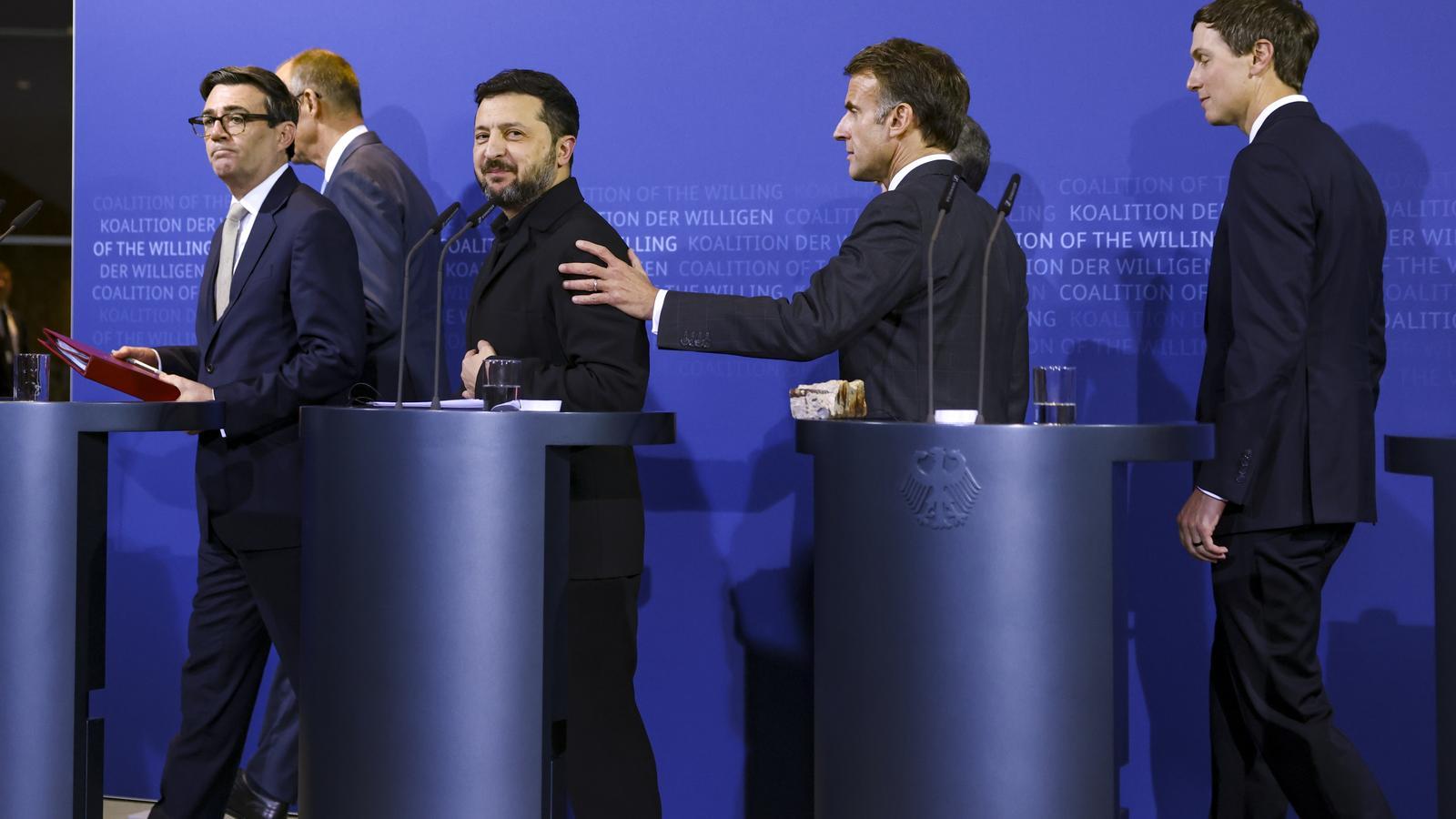
LondonThe so-called Coalition of Volunteers reaffirmed this Thursday in Berlin the commitment to maintain military and financial support for Ukraine, and demanded that Europe participate directly in any negotiation to end the war. The meeting aimed to demonstrate the unity of the allies around Volodymyr Zelensky at a time of uncertainty regarding the commitment of the United States.
This distance became evident during Donald Trump's phone intervention from Air Force One, during the return flight from the China summit. According to several participants cited by the British press, the US president questioned European plans to cover Ukraine's funding deficit, estimated at 70 billion euros by 2027. Two interlocutors described the intervention as a harsh reprimand of European initiatives, while a third claimed that Trump only highlighted the money that governments would save if the war ended. The US president argued that efforts should be concentrated on negotiations rather than sending more money to Kyiv, convinced that Vladimir Putin wants peace.
The call, which came through the phone of Jared Kushner, Trump's son-in-law and special envoy of the White House, was followed with concern by European leaders. The Polish Prime Minister, Donald Tusk, described Trump's statements after the meeting with Putin and Xi Jinping as "very optimistic," but ironically remarked that his faith in the Russian president's goodwill is "probably immovable." Tusk warned that he does not expect Moscow to sit down to negotiate seriously before the winter ends.
Despite Washington's reservations, European leaders have insisted that the continent cannot remain on the sidelines of decisions about its future. The German Chancellor, Friedrich Merz, warned that "a Yalta format will not bring peace," referring to the risk that major powers might decide Ukraine's future without including Kyiv or its European allies. He also noted that the outcome of the war will determine the continent's security architecture for years to come.
Volodymyr Zelenskyy has announced that American representatives have confirmed European presence in future negotiations with Russia. Five countries from the continent, in addition to the European Union and NATO, will have representation there. According to the Ukrainian president, any future meeting must include Ukraine, Europe, the United States, and Russia, information that Jared Kushner has corroborated.
Security guarantees
Security guarantees have been another central point of the meeting. In this regard, Kushner has assured that Trump is willing to study a protection for Ukraine inspired by Article 5 of NATO, which establishes collective defense in the face of an attack against one of its members. He clarified, however, that any commitment must take into account American interests. He also reaffirmed the role of the Atlantic Alliance in any postwar agreement.
In this sense, the French president, Emmanuel Macron, has defended that an eventual peace declaration agreed upon by Trump, Putin, and Xi Jinping in China does not imply a "reorganization of the world order." Faced with Moscow's maximalist position, he has called for putting Ukraine's accession to NATO back on the table and has asked countries with military capacity to contribute immediately to protecting the Ukrainian population, especially with anti-missile and interceptor systems.
For his part, the British Prime Minister, Andy Burnham, has assured that the allies are more united and determined than ever to maintain aid to Kyiv. He has also warned that it cannot be the aggressor who imposes the security conditions to end the conflict and that any debate on European security must be preceded by a peace agreement between Russia and Ukraine.
