“It is a pleasure to celebrate you, Paco (Ibáñez)”
The Liceu hosts a tribute to the singer-songwriter of the poets in which Joan Manuel Serrat, Maria del Mar Bonet and Bernardo Atxaga participate, among others

-
CAT -
CAST
- Gran Teatre del Liceu. November 24, 2026
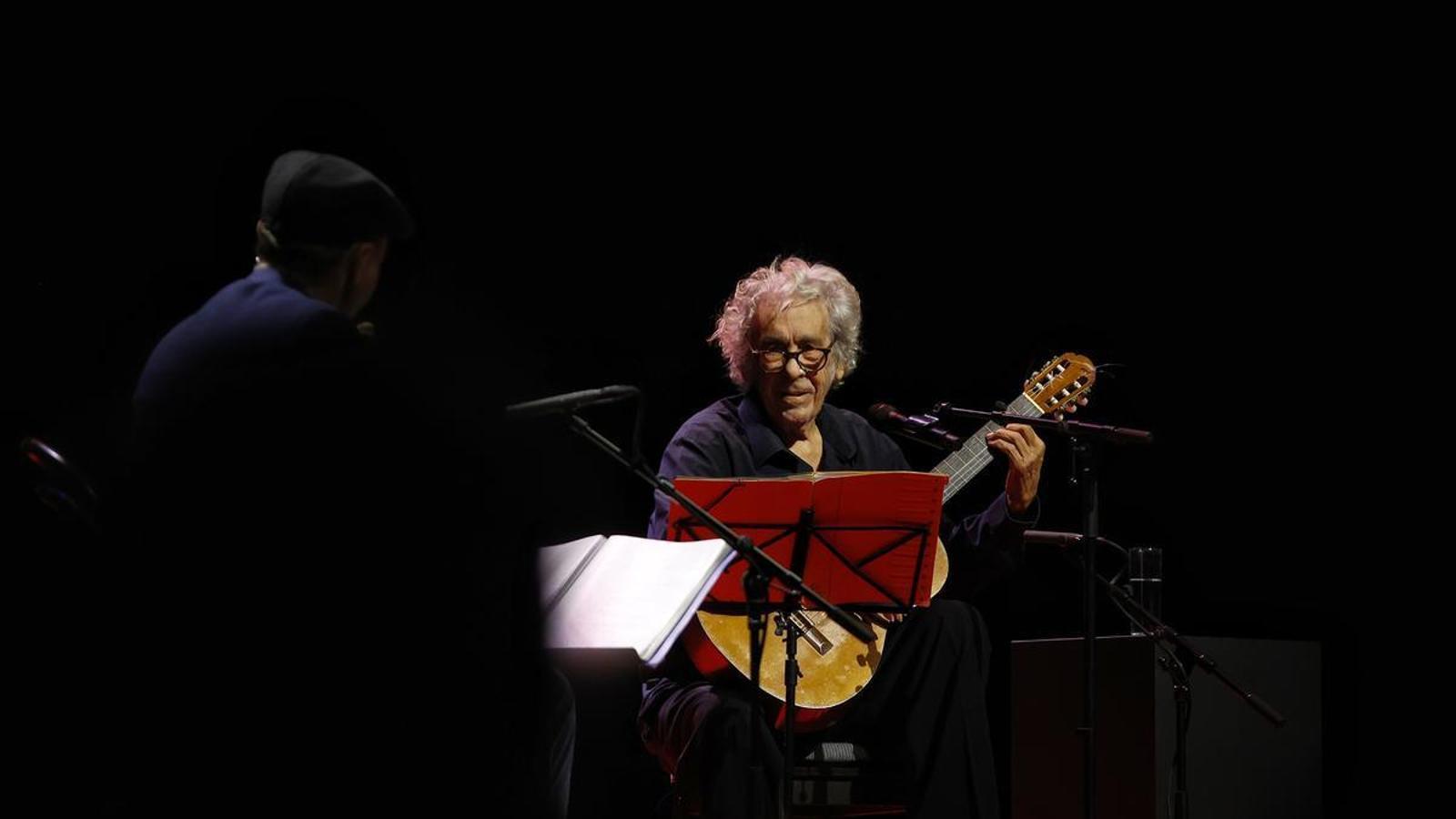
A Paco Ibáñez concert and a tribute to Paco Ibáñez at the same time. That was the celebration that brought together about thirty musicians and poets on Tuesday at the Liceu. For almost three hours, the admiration that many feel for him was evident, as well as the relevance of Paco Ibáñez as a benchmark for singer-songwriters and poets and, at 92 years old, still as a beacon of resistance against "the fascists," the exact term he uses to describe political barbarism.
The night began like others in recent years: Ibáñez dressed in black, accompanied and loved by guitarist Mario Mas. Together, and with occasional collaborations from accordionist Joxan Goikoetxea and the sonic magic of Pep Pascual, they unfolded seven songs of firm anti-fascist resonance: Un español habla de su tierra (based on the poem by Luis Cernuda); the version of Txoria txori, by Mikel Laboa, which he sang in Basque; an Andaluces de Jaén (Miguel Hernández) sung and applauded by the audience; Yo vuelo por mis alas and Canción de jinete (Federico García Lorca); Palabras para Julia (José Agustín Goytisolo), and the monumental La poesía es un arma cargada de futuro, words by Gabriel Celaya that Ibáñez always projects with intention, like when he recalls the verses in which he curses poetry conceived as a cultural luxury for the neutral and the poetry of those who do not take sides. In this half hour of vigor despite the fragility (with Mas helping him with the music stand and tuning), he achieved moments of very deep emotion that the audience generously reciprocated.
And then the rest of the night began: a choral show with Joan Font, from Comediants, as master of ceremonies, a more or less chronological script, good scenographic intentions, and all of it "under the single banner of friendship and utopia." Everything that happened in the following two hours was watched by Paco Ibáñez from a side box, "the Palco Ibáñez," just as he said himself with that apparently grumpy humor so characteristic of him.
“We will take a journey of memory, emotion, poetry, and music through the life of Paco Ibáñez,” announced Font. Thus, the singer-songwriter became a spectator of a tribute in life that ran the risk of walking the fine line between celebration and posthumous elegy. Fortunately, those involved in the event knew how to convey more celebration than lament by addressing the “Palco Ibáñez” and even engaging in dialogue with him (it would have been nice if the honoree had a microphone, by the way). “It is a pleasure to celebrate you,” said Maria del Mar Bonet, perfectly capturing the essence of it all.

The script included an attempt to illustrate the biographical notes with specific poems and music. For childhood in the Basque Country and the relationship with the mother tongue, Bernardo Atxaga and Jabier Muguruza, a magnificent versifier in Bizitza, bizitza da (Life is life), were invited. To explain the family reunification in exile in Perpignan, the troubadour tunes of Antoni Rossell and the Troubadours Art Ensemble were used. The first years in Paris, those of friendship with the Venezuelan artist Jesús Rafael Soto and the French master Georges Brassens, were glossed by the journalist Pilar del Río (widow of José Saramago) and the music of Hayley and Cristóbal Soto, who sang the witty El gavilán trabalengua.

Joan Manuel Serrat, who met Ibáñez in Paris in 1966, gave a speech of recognition to a benchmark, to a man who created “a new way of projecting poetry” and who, without a doubt, influenced him when facing challenges such as setting to music poets like Antonio Machado, Miguel Hernández or Joan Salvat-Papasseit. After performing Pare, the most current ecological call ever, Serrat thanked the generosity of Paco Ibáñez and celebrated “a sixty-year friendship”.
The narrative of the show, conducted by Font in Spanish although the guests also spoke, sang and recited in Catalan, Basque and Galician, continued by pointing out important dates in the biography of Ibáñez, such as his first concert in the country, in 1968 in Manresa, where he coincided with Maria del Mar Bonet. On Tuesday at the Liceu, Bonet shone again, this time raising the rage of S’aigo no, from the latest album of the Mallorcan singer. What a resounding way to clear the fog of nostalgia.

Censorship, the legendary record at the Olympia, the friendship with Rafael Alberti, the success in Latin America, and the difficult relationship with the Spanish Transition continued to trace the biographical profile. The music was provided by Marina Rossell, in top form with Le métèque by Moustaki, and Joan Isaac, who closed with A Margalida making a call “to vote on Sunday” after explaining that his legs still tremble before “masters and benchmarks like Paco and Joan Manuel who have fought so much for the poetry and the freedoms of this country”. In this segment, Luis Pastor recited Qué fue de los cantautores, the poem that best and with the least complacency explains the adventures lived and suffered by political and poetic song.
Víctor Jara in memory
Miro Casabella, Amancio Prada (proclaiming the freedom of Rosalía de Castro), the Coral Voramar (performing Érase una vez), the UAB Choir (Palabras para Julia) and the Cuarteto Cedrón also participated in a tribute that had an especially moving moment when Rodolfo Reyes, representing the family of Pablo Neruda, recalled that Paco Ibáñez sang with Víctor Jara in Chile in 1973, just two months before Pinochet's coup d’état and the murder of the Chilean singer-songwriter. In Chile, songs like Palabras para Julia became anthems of resistance for the women imprisoned by the dictatorship.
In the final part, and after noting the friendship with José Agustín Goytisolo, the moment for the poets arrived, with interventions by Bernardo Atxaga, Antonio García Teijeiro, Fanny Rubio and a Sussana Rafart who reminded everyone that “the fight does not end”; a video of the late Joan Margarit reciting Com les gavines was also screened.
A powerful performance of Escucha abandonada by Soleá Morente gave Paco Ibáñez time to come down from the box and return to the stage to lead, accompanied by all the participants, the hope of A galopar by Rafael Albertí. “Today we must gallop more than ever,” said Joan Font, thinking of the Spanish elections on November 29. “How much you want to gallop!”, exclaimed Paco Ibáñez before an audience that celebrated him with an ovation, everyone standing at the Liceu.
