‘An improbable shadow’ transforms the Joan Coromines square into a space for meeting and rest
The winning project of the TAC! 2026 Festival transforms the public space with a structure that invites one to stop and rest

-
CAT -
CAST
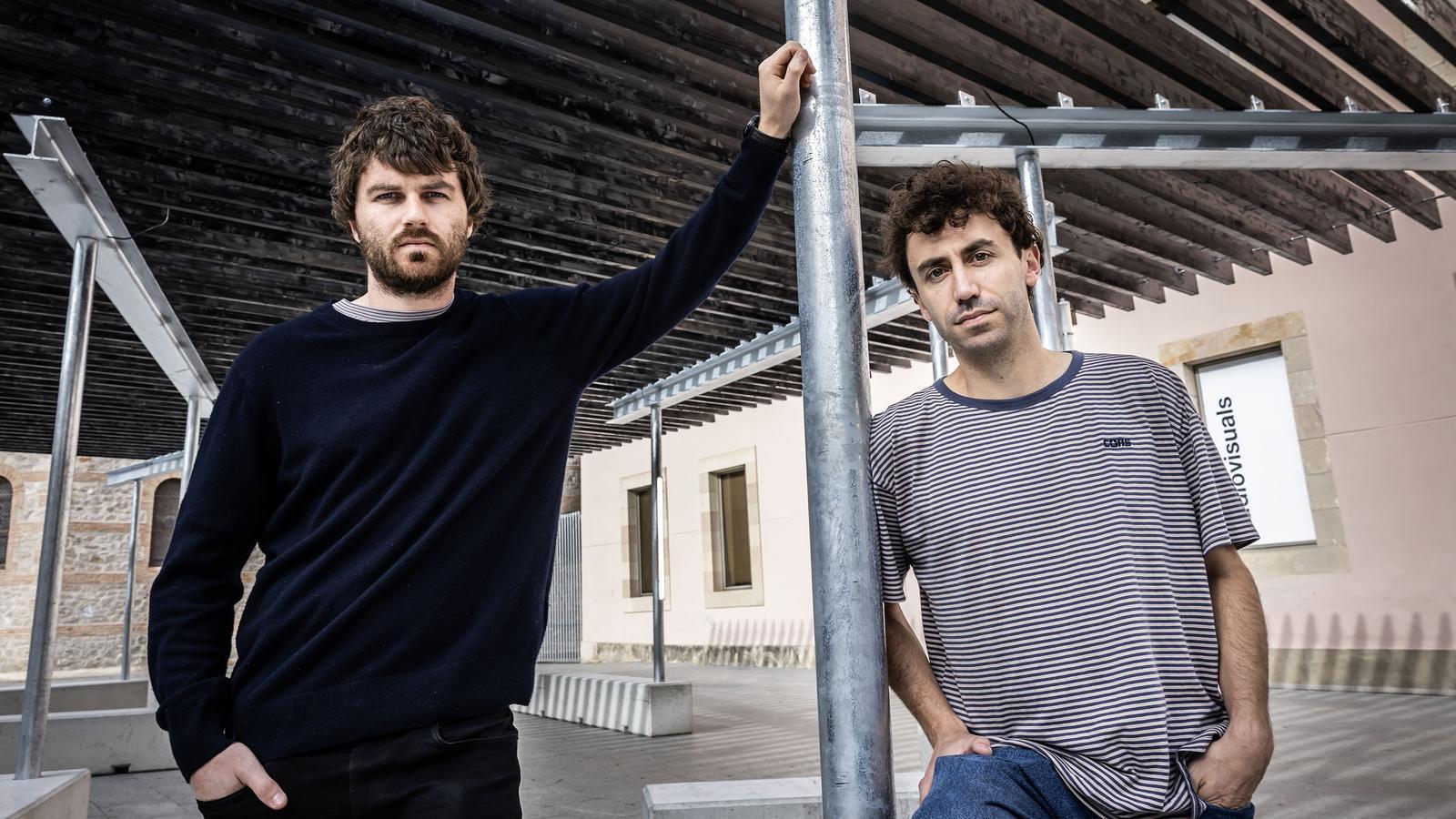
BarcelonaJoan Coromines Square in Barcelona is not usually a place where people stop, but rather a place of passage and circulation. But now, the installation of the pavilion An Improbable Shadow transforms the space into a meeting and resting point. In this case, a large-scale or particularly flashy architectural intervention is not necessary to achieve the intended goal: the pavilion is made with a modular structure of six removable elements, steel frames, wooden beams, and concrete bases that serve as foundations and also function as benches. There is no accessory element.
“The key is simplicity,” states Chilean architect Rodrigo Pérez Vásquez, the author of the pavilion along with fellow Chilean Pablo Schmidt Kamp and Santiago Rodríguez Prada, born in Buenos Aires and based in León. “The pavilion is quite versatile; it does not impose a very specific use. It has a somewhat disordered shape, but in the end, what it does is intervene a little in the flow of the square; it doesn't seek much more than that. Ultimately, it is a place that activates a shadow that slightly disorders the landscape, that builds its own landscape, that gives you a moment to sit down, and that transforms the place,” says Pérez.
An Improbable Shadow won the first prize in the ideas competition for the design of temporary pavilions to activate and transform public space for the TAC! Urban Architecture Festival 2026, convened by the Ministry of Housing and Urban Agenda, in collaboration with the Arquia Foundation. The project was selected from 156 submitted proposals. The pavilion will be installed until December 1st and could return next summer. Additionally, it hosts an exhibition on the latest edition of the European Prize for Urban Public Space, organized by the CCCB.
“Many times, in these cases, these are spaces that, although it may seem obvious, what is worth recovering a bit are the very arguments of architecture,” says Pablo Schmidt. “The pavilion is still made with beams and benches, but in the end, everything is public space, and public space is a subject in itself within architecture. That is why the elements of the pavilion are robust: they must withstand skateboarders, people walking by, and dogs. Also, the loads of students who arrive from the university in waves and then leave again. And hopefully, it will withstand the passage of time, know how to age, and, the day it is no longer there, adopt another form.”

The influence of Smiljan Radic
Rodrigo Pérez Vásquez and Pablo Schmidt met while working at the studio of Smiljan Radic, the winner of the last Pritzker Prize, the Nobel of architects. “We grew up in years when his work was growing very strongly. Whether you were close to it or not, he is a kind of inevitable mentor. He is a benchmark that today it is impossible not to take into account, beyond the fact that we really like what he does and that we have trained based on his work,” says Pérez.
As Schmidt explains, Radic has a “very complete vision of the architectural landscape and everything it implies.” “His projects have to do not only with architecture in the strict sense, but also with the recovery of architectural heritage, with the dissemination of architecture and with the promotion of a cultural vision of the country through architecture. And that is very, very powerful. It is a shadow under which many of us in Chile find ourselves. And I would tell you even far beyond Chile, for a long time now,” says Schmidt.
