Everything that wood reveals of 20,000 years of Neanderthal life at the Abric Romaní
Trays, screens and an extraordinary mace: the remains found during 40 years of excavations in Capellades demonstrate their sophistication
-
CAT -
CAST
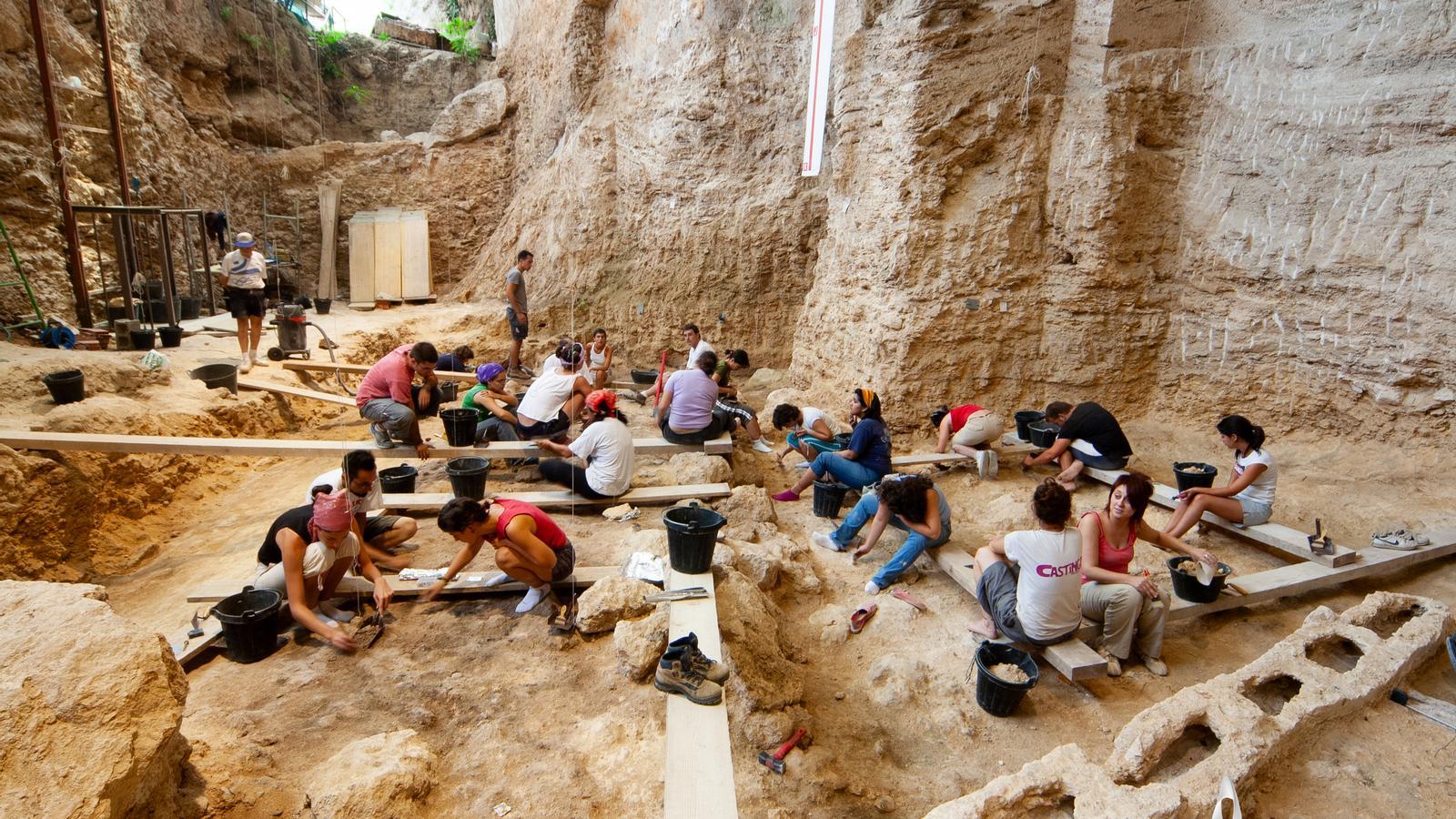
BarcelonaTaking a trip back in time, landing on a night fifty thousand years ago in a rock shelter in the current municipality of Capellades (Anoia) and observing how a score of Neanderthals live and sleep requires imagination, but archaeology can help a lot. And the Abric Romaní in Capellades is an exceptional setting for doing so, because during forty years of research it has been possible to study Neanderthal occupations from approximately 62,000 to 40,000 years ago. That is to say, more than 20,000 years of prehistory.
A study led by the Catalan Institute of Human Paleoecology and Social Evolution (IPHES-CERCA) in Tarragona and published in the journal Science Advances has analyzed the wood record recovered during these four decades of excavations. In total, 597 remains from 16 different archaeological levels have been analyzed. The analysis demonstrates that Neanderthals made recurrent, systematic, and enormously diverse use of this raw material: not only as fuel to keep warm, but to manufacture weapons, work tools, and household containers, and even to build or condition the spaces they inhabited.
The collection offers a very unusual image of a material that, due to its organic nature, is almost always erased from the archaeological record. Wood is ephemeral, but in Capellades it has been able to survive for thousands of years due to the geological singularity of the Abric Romaní: water rich in calcium carbonate that dripped constantly through the rock shelter quickly covered the trunks, tools, and structures abandoned by the Neanderthals. When the organic matter decomposed, the mineral had already consolidated an exact imprint in the form of a calcareous tuff mold. The impression is of such extraordinary precision that it allows paleobotanists to analyze the structure of the trees used.
How did they manage space?
Until now, most of the Neanderthal wooden remains found in Europe were limited to isolated discoveries at hunting or resource-gathering sites, such as the well-known German sites of Schöningen and Lehringen, where digging sticks and some spears predominated. At the Abric Romaní, however, a great diversity of objects with very different functions has been found. "We have the hearths, the stone tools, the processed animals, and also the wood. When we put it all together, we can understand not only what they did, but how they organized the space, how they managed fire, and how they carried out their activities," highlights archaeologist Palmira Saladié, a researcher at IPHES-CERCA and coordinator of the study.
For some time now, various investigations have shown Neanderthals to be very far from those crude and brutal beings that 19th-century historiography painted in the collective imagination. This study confirms that they were a community with extensive technological knowledge that organized its environment. They had a space reserved exclusively for sleeping, equipped with small hearths that served as individual braziers to maintain body heat during the night. To protect themselves from drafts, they erected wooden windbreaks. This is demonstrated by one of the remains found by the archaeologists: a rectilinear piece 5.10 meters long, completely stripped of branches and worked, which would have served as a main pole to support tripod structures and protect the inhabitants of the rock shelter from the elements.
Among the hunting tools found, two exceptionally well-preserved wooden spears stand out. One is 2.45 meters long and has a specific design for short-distance thrusting (thrusting spear). The other preserves 1.99 meters and has clear marks of intentional cutting and shaping work. This second projectile appeared directly associated with deer remains, stone tools, and combustion structures, which offers a snapshot frozen in time of a day of hunting and meat processing.
Food trays and windbreaks
But the find that causes the most fascination among the research team is a mace carved from a single block of wood. The object has a defined handle of 16 centimeters and an asymmetrical, half-moon shaped head with a widened and pointed end. The surface shows grooves from having been meticulously scraped to shape it. "It is an extraordinary piece," points out Saladié. The researcher proposes different hypotheses about its use: from it being a tool to finish off hunting prey or a hammer-like utensil, to an object with a certain symbolic value. "If we look at ethnographic parallels in hunter-gatherer communities like the Australian Aborigines, we see tools of this morphology that serve both for hunting and for granting social prestige to certain people in the group. It is a hypothesis that is impossible to prove one hundred percent, for now, but it proves that they had pieces much more elaborate than we could have imagined," explains the researcher.
The study has also identified four pieces of charred and flattened bark, located around the hearths, which would be similar to a tray. "These containers served to isolate food from the dirt on the ground, collect vegetables or honey, and perhaps even to transport babies," explains Saladié. Likewise, small tools such as wooden pellets and awls designed to pierce soft materials such as fabric, leather, or animal skins have been documented, as well as a structure of crossed sticks over a hearth that could have functioned as a grill or elevated platform for smoking and preserving meat.
The technical mastery of wood at the Abric Romaní extended to all kinds of daily needs. The Neanderthals knew how to choose the ideal raw material for each function: while Scots pine wood was preferred for burning in hearths and making resistant tools, for domestic containers they opted for juniper bark, which is much more flexible and fibrous.

