Clementina Arderiu, a poet in backlight
Now that the fiftieth anniversary of the author's death is being celebrated, it is worth trying to rectify the wrong that has been done to her work, on which reductive judgments have weighed, for social and biographical reasons
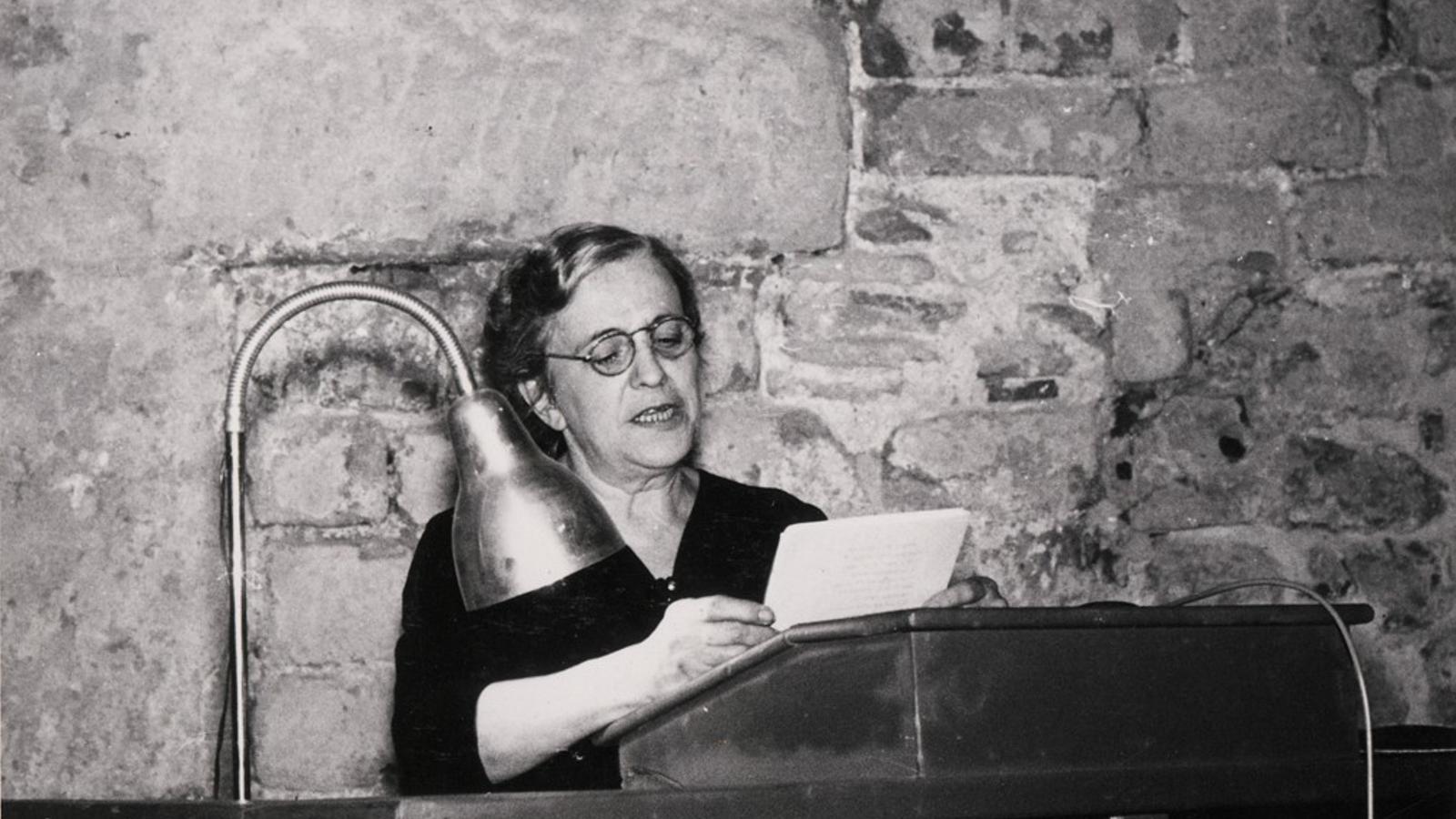
-
CAT -
CAST
Barcelona"Clementina Arderiu Voltas is surely one of the Catalan writers who has had the easiest and most difficult time leaving a work in the history of Catalan literature". With this forceful statement begins the profile that Marta Pessarrodona outlined the poet in the volume Donasses. Protagonists of modern Catalonia (Destination, 2006). Now that the fiftieth anniversary of Arderiu's death is being celebrated, it is worth asking what the reasons are for this contradictory situation – in the light and in the shadow at the same time – and trying to correct the wrong that has been done to his work, on which reductive judgments have weighed, for social and biographical reasons.
Clementina Arderiu was a poet. It is interesting to present her like this because, even though she had a very interrupted creative life – crossed by long periods of silence attributable to the war, exile, and the post-war period, on the one hand, and raising children, on the other – the celebration of song and singing is a recurring motif in her work, a pillar of self-affirmation in a poetics that rather dallies with doubt. "Fidelity I will always find / to my own singing," she asserts with a sure stroke in Always and now, the composition that concludes the eponymous volume. His poetic production, although it was quite brief – he published six books in more than half a century – is compact, personal and very well constructed, made of verses of apparent simplicity and accessible language that, however, say "much more than they appear at first glance" – as "}D. Sam Abrams to the prologue of I was in the corner, the complete works of the poet that he himself has curated and that Edicions 62 has reissued, expanded and corrected, this February.
"Oh, Princess Street, / from before I entered myself!"
Born in Barcelona on July 6, 1889, and died on February 17, 1976, Clementina Arderiu was born into a family of silversmiths, but refused to continue the family trade to dedicate herself to art. She learned the trade and worked in it as a young woman, while studying languages and piano at the Municipal School of Music. She recalls these years of training in the Barcelonian Born district in a delicate poem from old age, dated 1963: "Through Princesa street / –cinnamon, cumin, and anise– / I still smelled the scent / that my fifteen years harvested. / Through Princesa street, / the street of my sighs. / Oh, Princesa street, / before I entered myself!"
She published her first poems in the late 1900s, and in 1912 she won the Flor Natural at the Jocs Florals of the Barcelona hiking group Déu i Pàtria with the poem A un llibre oblidat – fifteen years after Caterina Albert won the Jocs Florals of Olot with the poem Caterina Albert won the Jocs Florals of Olot with the poem Lo llibre nou, with a concomitant bookish theme, and with the verse monologue "La infanticida," which caused the scandal from which she adopted the pseudonym Víctor Català. In the valuable interview that Montserrat Roig conducted with Arderiu for Serra d’Or in 1972, the poet recalls the day of the award ceremony: "They told me: 'The president will be a university boy who is very good.'" Here is the acquaintance with Carles Riba, whom she married, despite family opposition, four years later. And here is also the reason for the shadow in the reception of her work: the marriage to one of the greatest intellectuals of 20th-century Catalan culture, which undoubtedly facilitated Arderiu's poetic cultivation and must have privilegedly illuminated her path of reading and writing, but which at the same time, due to the decisive weight of his figure in the (re)construction of the country's literature, eclipsed Arderiu's verses and relegated the woman to a secondary role – that of the attentive wife who occasionally cultivates letters as a decorous pastime for a lady of the house.
Caterina Riba Sanmartí, granddaughter of poets and one of the main scholars of Catalan female poetic genealogy, speaks of it in terms of cryptogyny, that is, the systematic invisibilization of women in culture. Proof of this situation in relation to Arderiu is the fact that throughout the forty-six pages that constitute Riba's portrait by Josep Pla in the first series of "Homenots" – a book that Pessarrodona attempts to balance, about fifty years later, precisely with the "Donasses" we mentioned at the beginning –, her wife's figure is not mentioned once. It has often been pointed out that Arderiu's poetry draws little from her husband's and, on the other hand, is much more indebted to Josep Carner – and it must be said that looking for male references to account for a woman's artistic exceptionality is an exercise not without certain mystifying tics, too –; it seems that the possibility that Arderiu influenced Riba's work in some way, however, is an extravagance that neither Pla nor anyone else has yet considered. Taking advantage of the anniversary of the poet's death, we would do well to ask ourselves, however, if in Riba's songs from the fifties there isn't more than one powerful Arderiu influence. Due to the doubling with the amazed childhood self and the concrete rhythmic and musical resources it employs, Riba's poem "Dins la nit, els meus anys…" could be a good example of this influence.

"Two lives are in me"
Maria-Mercè Marçal wanted to dedicate her doctoral thesis to Arderiu's work; she finally did not undertake the endeavor, but she did prepare and publish the Arderiu anthology Contraclaror (La Sal, 1985), with a very valuable prologue that has marked a change of direction in the attention and approach – rather scarce, it must be said – to her poetry that we subsequent generations have given. In this clear-sighted text, Marçal insists on the idea of the vital contradiction in which Arderiu found herself, a singularly intelligent and creative woman who was led, by the social conditions and the era, to choose – "to choose consciously, which does not mean freely", Marçal precisely states with lucidity – a life model "of a woman like the others, like so many others" – as Arderiu hastens to emphasize in the text that heads the collection of poems from 1936 –. And that this woman strives to subject herself to a feminine ideal that constrains and restricts her.
Surely, however, it has been the reviews of Arderiu's first two volumes of verse, Cançons i elegies (1916) and L’alta llibertat (1920), that have most determined the general idea of her poetry that we readers have formed. Particularly significant, in this regard, is the one Joaquim Folguera wrote about her first book, published in Les noves valors de la literatura catalana: «Clementina Arderiu's work is a most pure case of literary emotion: elegiac without weakness, joyous without outburst, pious without disturbance. It reveals the perfect model of the Catalan woman who laments little, loves quietly, spreads joy in a smile, and asks for virtue at the price "of pain for all its breadth"».
As Marçal already pointed out, rather than talking about what Arderiu's first volume was, Folguera seems to be talking about the model of femininity proposed in his eyes – a model with which, it must be said, Arderiu must have been in full agreement–. Thus, the tracing of the presumed marks of an ideal woman who seems to need to be defined or reduced to a still essence is a constant in the reviews of Arderiu's first books, needless to say, always made by men. "Woman, mother, watchful eye, provident hand, who does not forget to remain, at times, strangely indolent, strangely unrestrained, capable of revealing, like a pythoness, magnificent and terrible arcana, or of whispering into the ear of the storm the feeble things that she would not dare to say to anyone at all", points out Josep Carner with a mystifying halo in the article "La dolça consirosa", from 1921; "it is an indefinable poetry, perhaps, so feminine", concludes Josep Maria Capdevila in a review from 1927.

Beyond discretion and subtlety
According to the critiques from the turn of the century, this model femininity finds its maximum expression in Arderiu's verse in the ideal of good sense and restraint. Thus, it has been emphasized many times that discretion and subtlety – as counterpoints, it is understood, to the male prototype, of broad and theatrical gesture – are the two main virtues that emerge from her verses, in an edifying reading exercise that aims, rather than to describe Arderiu's poetry, to propose it as an example of the model woman considered good and to reaffirm the stereotyped notion of what women can or should write. Anthologies and academic curricula have also contributed to this, as when they have focused on Arderiu's poetry, it has been to almost always select the same poems, those that underpin this same image. As an example of this, consider what is, most certainly, one of Arderiu's best-known compositions, El nom: "Clementina I am called, / Clementina they called me. // In another time I was / a bit fearful; / my name was long / like a complaint / and it hurt my heart / when my little friends / to annoy me / often reproached me for it". This is how the well-known song begins, and from this onomastic discordance the verses move to a happy identity settlement by the grace of the male figure: "No name is so beautiful / on earth / as the one my beloved / sings to me in my ear", she concludes.
As Maria-Mercè Marçal and Caterina Riba Sanmartí have insisted on highlighting, however, in this approach to Arderiu's poetry the focus is decentered. Without denying that there are poems that reaffirm this more known vision of the poet, the truth is that there are many others that, in inverse proportion to the effort of containment that so pleased Noucentista criticism, explore the failure of this will to control. Indeed, within Arderiu seethed what she herself calls "dark things": they are those contained, for example, within the chamber that she feels is "at the very bottom" of herself, where even for "a few seconds" neither her husband nor she could enter, because "the turmoil would strike / more than a rock", as she expresses in Cançó de la bella confiança. Thus, a good part of her poems deal with the internal struggle to silence these gloomy voices, with the desire for rectitude in the face of the assaults that seek to bend her: "Because I feel that a no / that came to me from you through the air / would break this will / which is strong but not very strong", she asks of a sea laden with ambiguous desires in the poem Imprecació.
And it is here where Arderiu's poetry becomes more interesting, complex, and current for us, where she speaks to us more directly and is capable of exploring themes as fashionable as the ambivalence of desire (for example, in the johnbergerian game of glances in Veí que sotja) or split identity (as she explores in the magnificent Cançó del voler i del no voler, in which the escaping self only settles in doubt, in the possibility that it does not lean towards either of the two options that open up before it), or as unusual for her time as childbirth (recreated as a dangerous and solitary ascent, culminating in a great leap and with "only Death for company / that fans me with a thousand fans"). May the fiftieth anniversary of her passing, then, serve to bring out of the shadows verses that explore, with a singular musicality and with intelligence and poetic intuition, the complexity of human identity.
