Between parks, trains and three languages: growing up in Tokyo with Catalan roots
Teo grows up in Tokyo between Catalan, Japanese, and English. His parents, Neus Modoro and Kiyofumi Kurata, see in the double cultural heritage an opportunity for him to build his own identity with freedom
-
CAT -
CAST
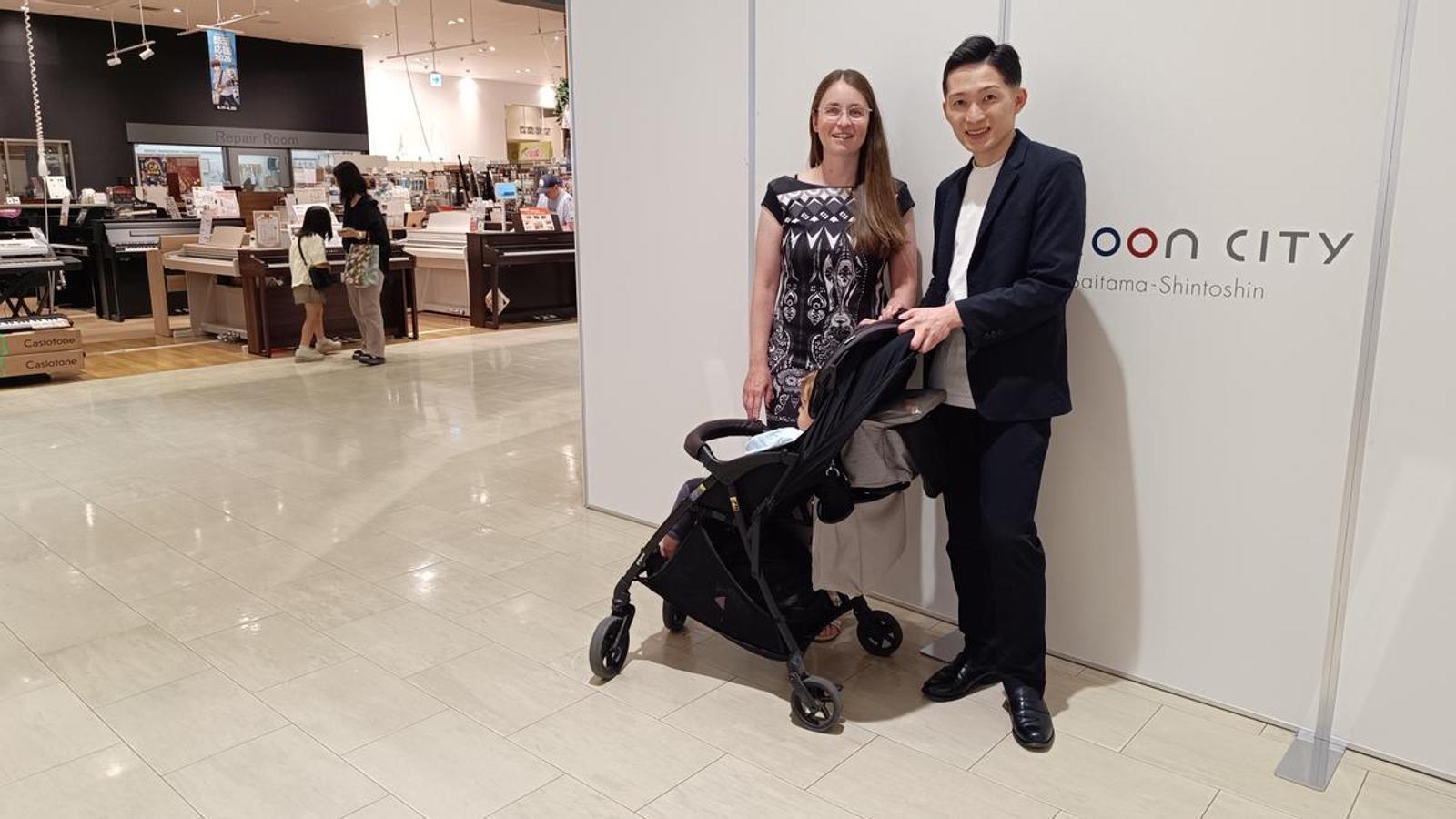
TokyoTeo's weekends are usually spent among parks, slides, and trains. At almost two years old, any outing is an adventure, especially if it includes a visit to a train station. Neus Modoro and Kiyofumi Kurata try to make the most of their free days to spend time as a family, whether playing in one of Tokyo's many green spaces, visiting a zoo or museum, or occasionally taking a trip to Osaka to see his paternal grandparents. Theirs is an apparently ordinary family life, but marked by a reality that combines languages, references, and customs from two ends of Eurasia.
Settled in the Japanese capital, the couple is raising their son among Catalan, Japanese, and English, in a city that exceeds thirty million inhabitants and is often perceived from the outside as a frenetic and impersonal environment. For them, however, Tokyo is above all the setting for daily life: the home where Teo makes his first discoveries and where they try to build an education open to the world. "We want him to have more than one way of looking at things," they explain, convinced that growing up between different cultures can be an opportunity to learn to understand diversity naturally.
At home, languages coexist naturally. Neus addresses Teo in Catalan, while Kiyofumi does so in Japanese. English, for its part, is part of the school and the international environment in which he will grow up. Far from presenting it as a rigid educational project, the parents experience it as an extension of their own family history. "We don't want to impose a specific identity on him," explains Neus. "We would like him to feel comfortable with all the parts that are part of his life and that over time he will be the one to decide how he defines himself." For the couple, the most important thing is not how many languages he ends up speaking, but that he learns to move naturally between different realities.

The school where he/she will go
This same philosophy also conditions the decisions about his education. Although they live in Japan, they plan to enroll him in an international school because they believe it better suits the type of education they envision for their son. "Japanese schools have many positive aspects, but we want to follow our own educational guidelines," explains Kiyofumi. Rather than choosing between a Catalan or Japanese model, their approach involves combining diverse influences and offering him an environment where curiosity, autonomy, and cultural openness play a central role. Deep down, they assure, it is simply about helping him grow with enough tools so that he can build his own path.
Although the family lives in Tokyo, an important part of Teo's life also takes place in Osaka, where his paternal grandparents live. Family visits are part of the year's routine, especially during Obon, [a festival to honor ancestors celebrated in mid-August] when many Japanese families reunite with their relatives and close friends.
Daily life, however, is mostly made up of small shared routines. Weekend trips to the park, occasional excursions to the zoo, fascination with trains, or family game time build a childhood that, beyond cultural differences, shares many elements with that of any other child of his age. Perhaps it is precisely here that Neus and Kiyofumi find the balance they were looking for: allowing their son to grow up connected to two cultures without turning this duality into a burden. "We don't want him to feel like he has to choose," they explain.

The Sant Andreu neighbourhood
If Osaka represents the daily bond with the Japanese branch of the family, Catalonia also maintains an important space in Teo's life. When circumstances allow, the family travels to the Sant Andreu neighborhood in Barcelona to reunite with his maternal grandparents and Neus's friends. These are visits that allow the child to become familiar with another language, other landscapes, and another way of understanding family relationships. "We like him to have references in both places," explains his mother. "That Catalonia is not just a story we tell him, but a reality he can live and remember."
The couple admits it is still too early to know what kind of relationship Teo will ultimately have with each of the cultures that are part of his life. For now, they observe with curiosity how he incorporates words from different languages, how he establishes bonds with relatives living thousands of kilometers away, and how he discovers a world that for him is not divided by cultural borders. "He will decide what he wants to keep or enhance from each place," they explain. Their priority is to offer him the tools so he can do so freely.
