Marta Pessarrodona: "The only thing that scares me is Alzheimer's"
Poet

-
CAT -
CAST
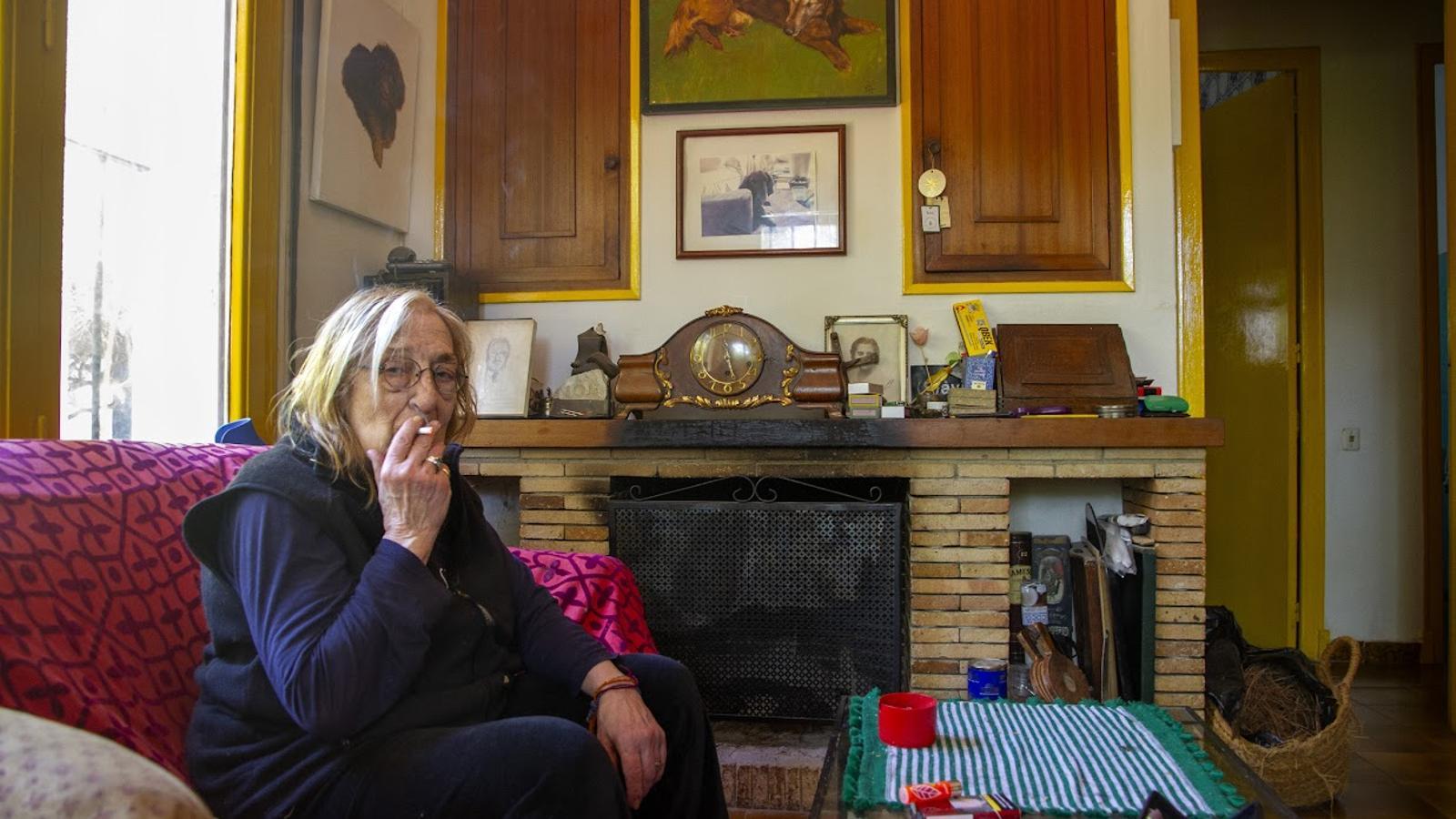
ValldoreixAlthough she has to use crutches due to a recent fall, Marta Pessarrodona (Terrassa, 1941) retains the energy and enthusiasm that have accompanied her for decades. She opens the door to her home in Valldoreix once again to ARA for a double reason: she has been chosen as the opening speaker for the new edition of the Barcelona Poesia festival, which takes place from May 14 to 21, and she is presenting a new poetry book, Re(visions), which is about to hit bookstores. Published by Viena five years after Tot m'admira (2021), it revisits the author's family members, friends, and loves, including her last dog, Queta, who died in an accident just over a year ago.
After a brief visit to the studio where she works every morning on a new poetry collection and a highly anticipated book about Gabriel Ferrater, with whom she was a partner for four years, Pessarrodona invites us to sit in the garden to open the box of memories and bring them back to life during an intense hour, sprinkled with unsuspected revelations.
You describe poetry as "an absolute and radical jewel" in the Barcelona Poesia opening speech.
— I really like that they asked me for this intervention. I will start by explaining that the first edition of Barcelona Poesia was held at the French Lyceum, and that among those who participated were José Agustín Goytisolo, Jaime Gil de Biedma and Àlex Susanna.
Álex is one of the friends to whom you dedicate a poem in Re(visions).
— His illness and death upset me greatly. It reminded me of the cancer that took my friend Marià Vancells fifty years ago. I told both Marià and Àlex that they should fight to get ahead, but it was no use, the illness ran its relentless course. Àlex would have been an excellent Minister of Culture, he had a very broad repertoire. But he was not utilized.
In this same poem dedicated to Àlex Susanna you write: "Catalonia has very serious problems with its great figures".
— These words were told to me a long time ago by an editor from Destino who was not from here. "You have problems with the big names", she warned me. And she was right. In Catalonia, you cannot be a big name.
In the book you also write it in relation to Ricard Salvat.
— He made Catalan theater travel abroad at a time when it didn't even go to Matadepera. He was a difficult man, yes. So what? He was very cultured. He did a great job. That's what counts. It makes me angry that he is not sufficiently recognized.
We started at the end of Re(visions). If we rewind to the beginning, we find Letter to the father I never wrote. You dedicated a poem to your father Florenci more than fifty years after his death, because you still remember him and miss him.
— I bring him back to life a little. I reproach him for dying so soon. He was only 59 years old. I always say that dying is bad manners. The father was the most animal lover in the family. His name was Florenci, but unfortunately he left me no inheritance, unlike the father of whom we know [Jordi Pujol]. My current dog, Florence, is named after him, but I named her in English, because what works with dogs are two-syllable words.
Before Florence you had Queta. You also dedicate a poem to her, Inteligencia natural, which you wrote while watching her sleep. "It has taken me many years / to see that animal, in definitive, / comes from the word soul", we read in it.
— Queta's death made me very sad. She spent her last days in intensive care due to a hit-and-run right here in front of the house. The motorcyclist couldn't have expected her to dart out from here like lightning... I prefer not to think about it too much.
Dogs accompany you wherever you go.
— With a painter friend, Lluís Ribas, we are preparing a book about dogs. He portrays them and I write a short text to accompany the images. A coincidence that unites us is that we have both had dogs named Darling. The last German Shepherd named Darling, like the previous one, died not long ago. Mine was the first dog we had at home. My father named him Darling after some candies that were called that.
Do you remember when it was?
— I must have been two years old. It must have been, therefore, 1943, in the midst of the postwar period. At that time I refused to eat. The father had been a republican lieutenant and the mother came from a simple family. They despaired that I didn't want to eat. Then it occurred to me to tell them that if I had a little dog, I would eat. The father saw the opportunity to bring a dog home.
You say that having a dog prolongs your life thanks to the happiness the animal gives you every day.
— People who have dogs live at least two years longer. I, who have had a pack since I was 2 years old, will live to be 200.
It is a difficult wish to fulfill, but we hope you live many years.
— Whatever God wants. Forgive me for becoming Catholic on this matter, but it's something I can't choose. The only thing I fear is Alzheimer's. I've made an advance directive because, if I were to get it, I want to be able to end it.
Reasonable finding, this fear, considering that in everything you have written memory has a fundamental weight. To scare away the ghosts, you continue working every day.
— I wake up very early and get to it. I have a new poetry book practically done, Geographies, but I'm in no hurry to finish it.
Will some of the important places in your life come out here?
— Yes, of course.
In Re(visions) we find London, Berlin, Barcelona...
— I have fallen in love with people as much as with cities. I am decently married to London and have an adulterous love affair with Berlin.
And with Barcelona?
— It's my big city. It's the place where I imagined, since I was little, that everything happened. We used to come with my mother. Even now, the escalators in Plaça Catalunya move me.
You left the city in the late 90s.
— I have been living here, in Valldoreix, since 1999. But I still own the apartment in Barcelona, in Guinardó, where a friend of mine's niece, who is an architect, lives now. At the time I didn't want to buy it because I felt it tied me down too much. I wanted to move. I would have liked to settle in the United States, but it couldn't be. Then life changes everything for you.
In the poem L'important c'est d'aimer, dedicated to Guillermina Motta, you write: "Together we have lost our Barcelona". What was that Barcelona like?
— The difference between London and Barcelona is that the former knows how to preserve the past, even as it constantly transforms and renews itself. Between the first time I went, in 1967, and the last, which was in 2023, only one pub I used to go to, the Jack Straw's Castle, has disappeared. They turned it into apartments. In Barcelona, so many things have changed that I don't know where to start. La Punyalada, Oro del Rhin... now, more recently, El Apeadero. I had studied at the Maragall institute and had worked at Seix Barral, which were very close. I've been losing all my reference points. Only Set Portes and Giardinetto remain for me.
In Re(visions) there are several poems featuring Gabriel Ferrater, who was your partner between 1968 and 1972. You started the relationship the same year you debuted as an author with Primers dies de 1968.
— When Gabriel died I made the decision not to mention him for 25 years. And I kept that promise. Then I dedicated an article to Serra d'Or that Jordi Sarsanedas, who was its director at the time, asked me for, and also a lecture that Margarida Aritzeta proposed to me for the Universitat Rovira i Virgili.
You write: "When you left (...) I cursed you for your lack of civility".
— I found him lifeless and was devastated, but it seemed to me that my pain was a trifle, compared to what his mother Amàlia would feel when I told her. I took it upon myself. I owed her. She was a very intelligent woman, Amàlia. We got along very well. I always told Gabriel that we should go to Reus to see her, but it was very difficult for him.
You dedicate the poem Cobrefoc to it. L'Amàlia taught you that, "if we have loved, we will be able to love time and time again".
— I had very funny conversations with Amalia. Sometimes she would call me at the publishing house and say: "Why are you with my son?". And I would answer her that it was because I loved him. She would reply: "But, listen to me, he is much older than you. He has no money. He drinks a lot".
Gabriel ended up committing suicide shortly before turning 50 years old.
— One afternoon when I thought that Reus surrealism was taking center stage, Gabriel said to Amalia: "Mother, the wolves are already gnawing at my heels." He was announcing what would happen shortly after. Amalia ended up doing the same as her son. When they say she fell from a skylight, they are insulting her intelligence.
Are you still working on the book about Ferrater?
— Yes. I have it quite advanced, but I find it difficult to write.
Why?
— Perhaps I waited too long to get started. The title will be Of Such Good Remembrance. And the subtitle, Four Years with Gabriel. It is the four years before his end.
