The revelation writer who has transformed the absence of her husband into a vocation
Laura Autonell has placed herself for weeks among the bestsellers with 'The bookstore of the dead hours'
-
CAT -
CAST
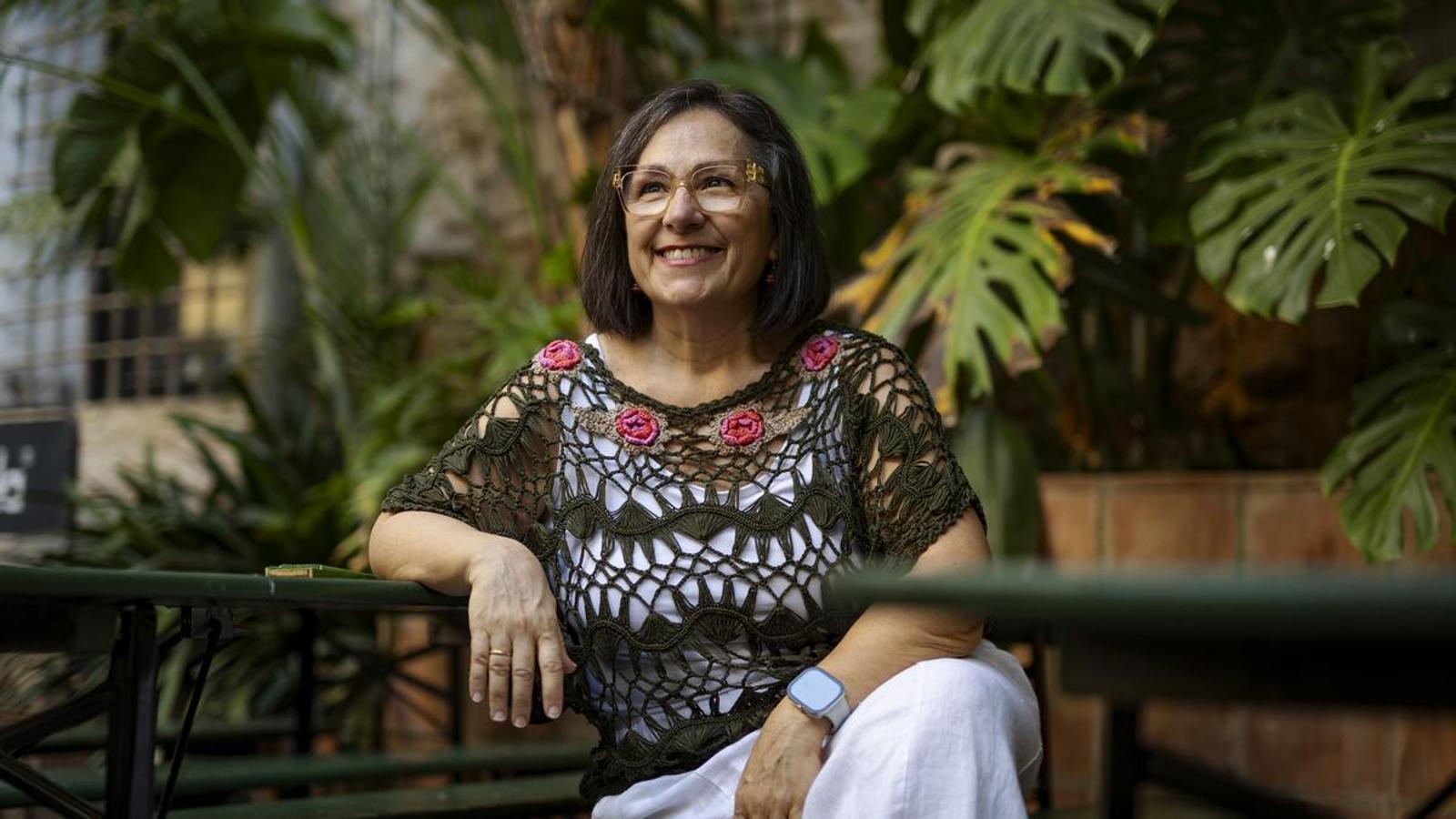
BarcelonaLittle did Laura Autonell (Taradell, 1963) imagine when she started writing, convinced that her vocation would not extend beyond her immediate circle, that she would have to eat her words. "At the time, I thought: 'Which publisher will want me, if I have no literary career and I'm 62 years old?'", explains the writer. The path her second novel, The Bookstore of Dead Hours (Columna), has taken has shattered all her preconceptions. The book was published in May and quickly became one of the top 10 best-selling fiction titles in Catalonia. It hasn't left the list since. Columna has reissued it and put more than 5,000 copies into circulation, which have moved through the publishing market, mainly thanks to word-of-mouth.
"With this book, what every editor dreams of happening has happened to us. Without a promotional campaign behind it, the novel has had an excellent reception," explains Columna's editor, Glòria Gasch. She received the manuscript through the Pontas literary agency and saw its potential. "We decided to publish it in May so it wouldn't be buried by the flood of new releases for Sant Jordi. It's a true marvel to see how Laura has made a grand entrance into Catalan literature. She writes out of vocation, she doesn't come from the publishing world, and she has no prior career. All of this confirms the emergence of a new voice in Catalan narrative, a revelation author," Gasch emphasizes.
The Bookstore of Dead Hours is inscribed within realism and is a story of personal reconstruction after a tragedy. The protagonist, Etna, sees how the privileges and luxury that have accompanied her all her life disappear overnight when her father dies and, upon opening the will, she realizes he has disinherited her. What begins as a dramatic episode transforms into a search for her origins and a radical life change: Etna will move to the Raval and there she will open a bookstore, following in her mother's footsteps. "My protagonist had to fall from very high to very low. In Barcelona, the contrast between the upper, affluent part and the Raval can be monumental. That's why I decided to set the story precisely here, on Elisabets street," explains Autonell from the La Central del Raval bookstore, which served as her inspiration.
The secret to the book working as it is is due to a multitude of factors. Precisely, the fact of setting the story in a bookstore is one of them. "It has been published at an ideal time, coinciding with the campaign by bookstores to assert themselves as cultural spaces —highlights Gasch—. The novel is nothing more than a great tribute to bookstores. It connects with the idea of valuing the book as an object and with the transformative power of reading, which appears here as a way to understand the past, reconstruct identity, and open oneself to new opportunities". The editor also points out that novels with a bookstore on the cover tend to attract attention. "If you also make the story local, everything fits", says Gasch.
Contact with writing
For 46 years, Laura Autonell's professional career has had nothing to do with literature. The writer has run a sports goods shop in Taradell for decades — which she will leave in the coming months, as she plans to take early retirement—. Six years ago, however, she experienced an unexpected absence that led her to write: her husband died of cancer in the midst of the pandemic. Shortly after, Autonell self-published her first novel, Un polsim de sal (2021), and began working on La llibreria de les hores mortes. "If he were alive, perhaps I wouldn't be writing, but life has led me here. I feel that the hours I would spend with him, I now spend with writing," points out the author.
After that first novel, Autonell felt she "needed training," so she enrolled in the School of Writing at the Ateneu Barcelonès, where she had writers Albert Jubany and Melcior Comes as professors. The classes also brought her closer to the Raval, a neighborhood "unfortunately degraded, but with good people who want to move it forward," says the writer. One of the novel's characters, a homeless man named Santiago, she discovered through Google Street View: "I went to Elisabets street, in front of La Central, and I saw a man depicted who was very similar to my character. Seeing him was a shock, a sign that he had to be important in the novel," explains Autonell.
With leading authors such as Maggie O'Farrell, Jaume Cabré, and Nora Ephron, the writer will continue to grow her literary path with various projects she already has in hand: she wants to rewrite Un polsim de sal, she has finished a crime novel set in a flour mill in Taradell, and she is also working on another story. All of this, fueled by the reception of readers of La llibreria de les hores mortes. "People write to me and tell me they couldn't stop reading it. That fills me up a lot — the writer affirms —. To experience this is fabulous, a dream".
