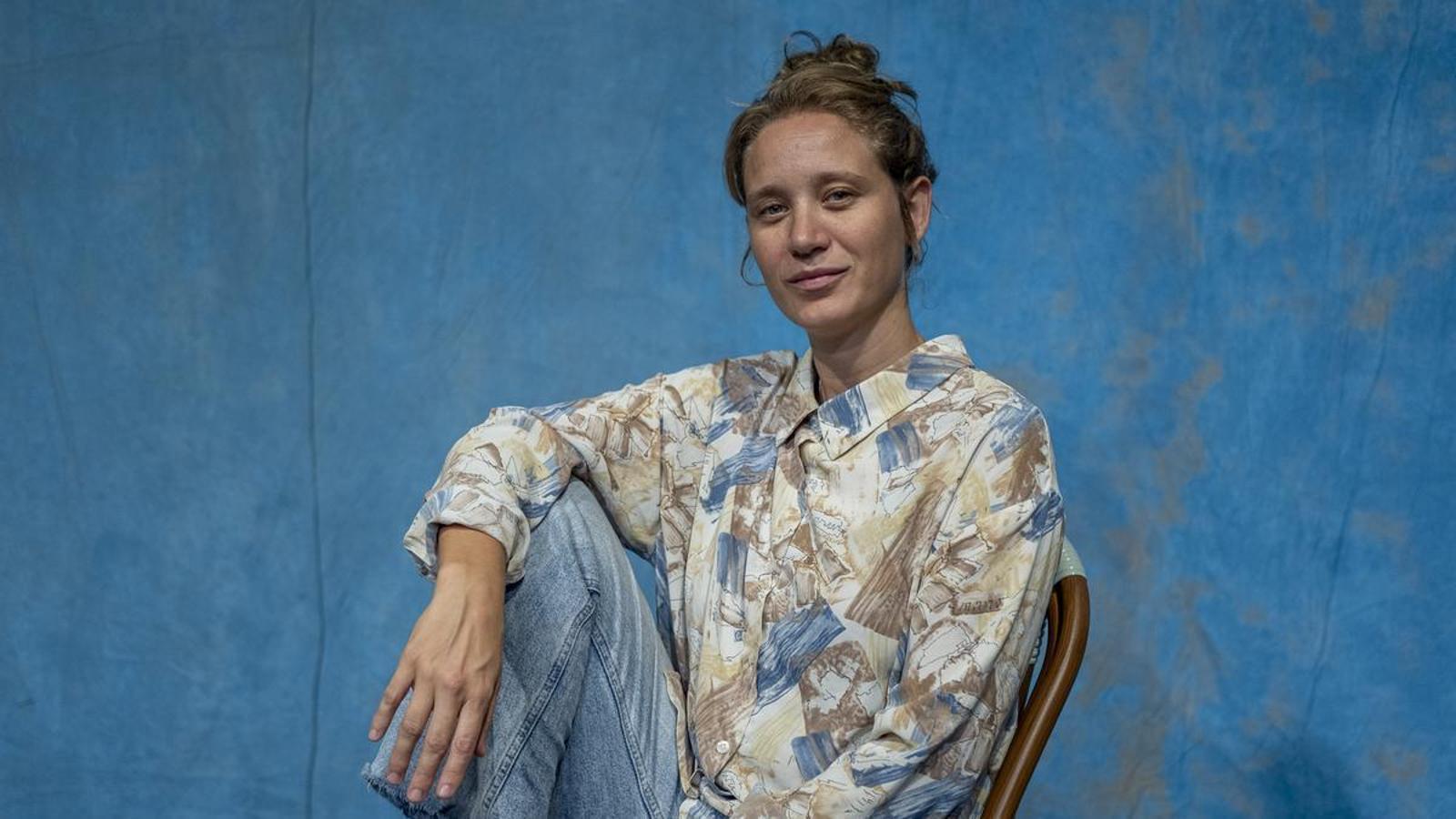
Raquel Ferri: "I am happy with the Raquel that I am now, with all the fears and the experiences"
Actress, premieres 'Morning sun'
-
CAT -
CAST
BarcelonaActress Raquel Ferri left the audience moved two years ago with Les mans at La Villarroel. Now the performer returns to the venue with a new show, Morning sun (from October 9th to November 8th), directed by Pau Roca and accompanied on stage by Míriam Iscla and Anna Güell. Together they bring to life the story of a grandmother, a mother, and a granddaughter over more than a century. In between, Ferri has starred in the TV3 series Delta on TV3, has been part of the macro-production The Walking Dead: Daryl Dixon and has also participated in the film El ser querido by Rodrigo Sorogoyen.
On stage, you play a granddaughter who accompanies her mother during a difficult moment. How did you build the character?
— The show explains a bond between mothers and daughters from the grandmother's life, which begins in 1925 and reaches until the granddaughter dies, in 2059. It is emotional and has touches of comedy. To build the granddaughter, with Pau [Roca, the director] we have started from ourselves and we have intentionally given her little identity. We rely on the word, because it is a play where movement is very limited. This gives the character a very serene and calm entity, as if all the pain and discomfort were going on inside her.
You studied social education. How did you end up working as an actress?
— I come from a very small town in Valencia, Montaverner, where there wasn't much cultural choice. I didn't go to the theater until I was older. In fact, I remember that when I entered the Theatre Institute I didn't quite know who Shakespeare was. But I have always carried the craft inside me. I was an active girl who wanted to sing, dance, be looked at, be the center of attention. I finished my social education degree in Barcelona and saw that they were holding auditions to enter the Theatre Institute. I read three of the five books that appeared on the theoretical test, hoping they wouldn't ask me about the other two, and I applied.
Was it the first time you did theater?
— Montaverner is a wonderful village and I am who I am thanks to having grown up there, near the mountain, the river, the terrace, the olive trees, and all that environment so rural and so harsh. But it felt small to me; I was a restless soul. Since I could no longer stay in the village, I went to study for my high school diploma in Cheste, in an educational complex that Franco had built many years ago. There was a theater group there, and we did small things.
How do you remember the Institut del Teatre?
— I was a bad student, all I wanted was to have fun, meet people, be out on the street. Theoretical classes felt tedious to me, I struggled to finish a book, I went to the theater very little. I was young, with energy and a desire to live. Later, I had to read all the things I hadn't read.
Have you changed much, since then?
— Yes. I am also a mother. But I have not lost my essence, and I hope I never lose it. I am very enthusiastic, I watch over happiness. My motto, which I always tell my son, is: “The most important thing in life is to have fun”. I am happy with the Raquel that I am now, with all the fears and experiences that have happened to me. Now I am in a beautiful, bright moment.
You were part of the Kompanyia del Lliure. What memories do you have of it?
— It was crazy, but it also made me who I am. Just like the bullying I suffered as a child. The psychologist told my mother: “Don’t worry, they are giving her a master’s degree in life”. I suffered a lot, but I was such an enthusiastic girl, so eager to discover things that I would go off to play on my own. I would put on my skates, head out to the fields, or go to the next village and make friends there. With the Kompanyia, at the beginning, it was amazing: 2,600 euros a month in salary—I would have done that for free! I saw those facilities, the whole history of the Lliure, and I would have stayed there forever. Later, everything got messy because of the racket they had going on. I think they wasted us. They had all those young people, full of energy; we could have done a thousand things. I went there with so much excitement, and it all fell apart. But I learned from it and had the good fortune to work with Pablo Messiez and Kelly Hunter.
Has your career been easy, until now?
— In this profession you have to work very hard, you have to have talent and you also have to have luck. I have been fortunate and I have always tried not to be afraid, to be clear about what I want and to go and get it. I have also received many no's, some for things that I was very excited about. It is important to know how to accept them, just like the fact of always being under the judgment of others. As Emma Vilarasau said the other day in an interview, you need to have a clear head to be on stage. Experience has led me to put everything into perspective a little bit, to have security as an actress, it has given me confidence.
You have worked on large productions. What have you gained from it?
— Above all, I have seen that there are people there with the same passion and strength as me. I remember seeing [Rodrigo] Sorogoyen focused 24 hours a day on the project, in all areas, and that gave me hope to keep going. There are more people like me, with such great aspiration and commitment to our work. Isaki Lacuesta has taught me to work from friendship, always from the commitment to tell a story with all my heart.
What guides you when choosing projects?
— They must be things I enjoy, because that is my motto. But beyond that, they must bring new things to me and also to society. They must have a meaning. I like working on projects where there is an identity behind them, an authorship, they have a cultural and social weight. In a few months, I will perform in a play at the National Theatre, Roig i violeta, directed by Magda Puyo. It is about Montserrat Roig and I play a character, Norma, who is told: “You want to be everywhere. You want to be a mother, you want to be an artist, you want to be the protagonist, you want to be with friends, you want everything. And in life, you cannot have everything”. And she says: “Yes, you can have everything”. I think I am a bit like Montserrat Roig’s Norma.
