The centenary sailboat that sails the Mediterranean thanks to an old telephone pole
Emili Armengol prepares his last great crossing with 'Sa Rata', a lateen sail boat built in 1926

-
CAT -
CAST
Where the Pyrenees plunge into the Mediterranean Sea, some rocks resist submergence. The water reaches great depths close to the coast, and yet, some islets protrude, like perennial icebergs. Two of these islets are found at the tip of Cap de Creus, near the lighthouse: s'Encalladora and the Massa d'Or (or Maça d'Oros).
The name s'Encalladora says it all: ships already know they should not approach it, especially when the sea is not calm at all. The one called Massa d'Or needs an explanation: it is called that because the island shines like gold when the sun hits it, thanks to the mica embedded in the rock. However, the Massa d'Or is popularly known as sa Rata, since it has the shape of this rodent lying placidly on the water, with its ears and tail clearly visible.
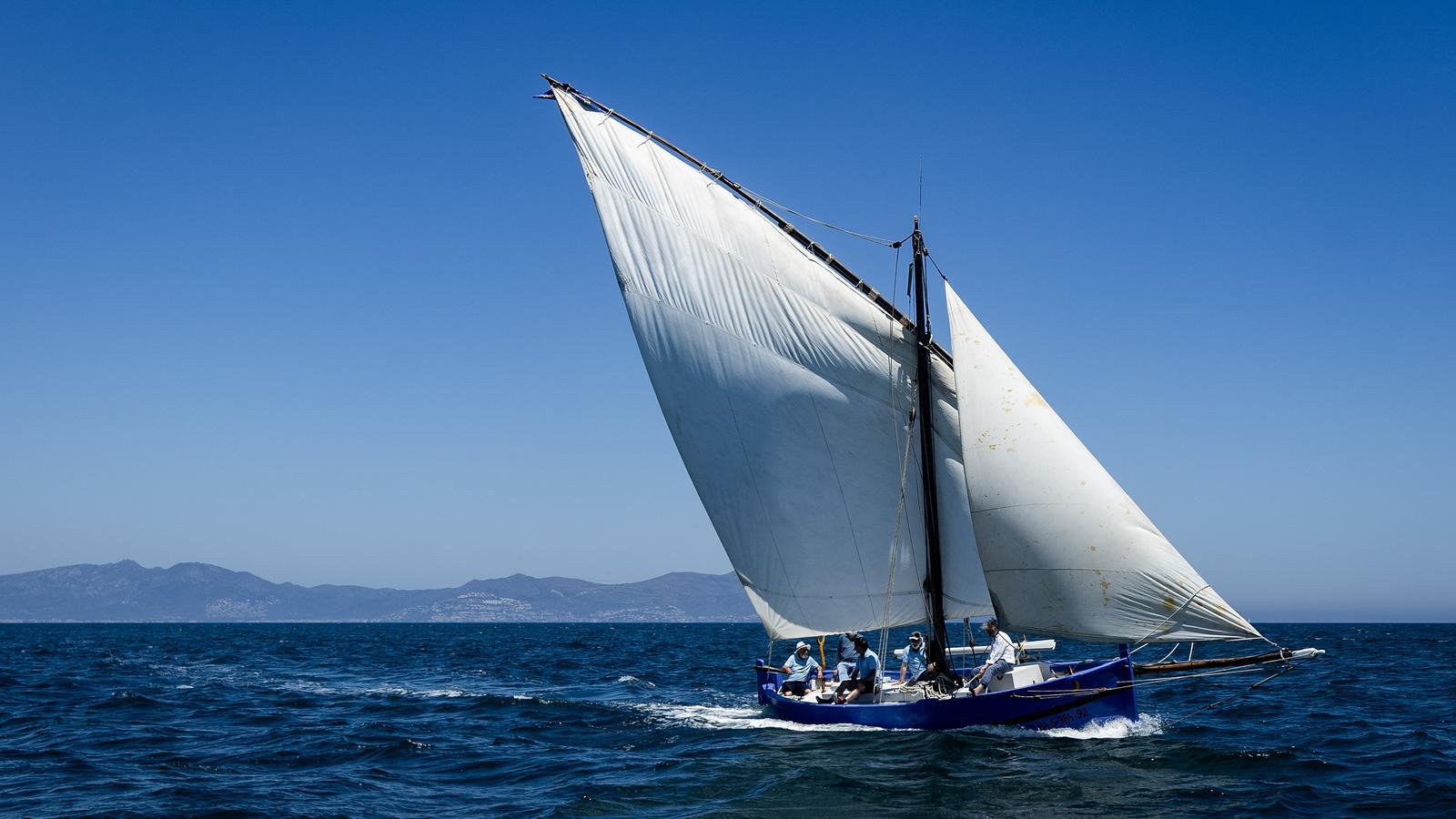
Emili Armengol did not hesitate to name the llagut he acquired many years ago after this islet; it was built a century ago, in 1926, in Banyuls-sur-Mer, by a renowned boatbuilder. Sa Rata was for many years a sardine boat (it fished for sardines), and when it ceased to have that function, it became a leisure boat. Emili has "sailed" it many times along the Catalan coast, and out to sea, as far as Corsica, Sardinia, the Balearic Islands... And he has not only gone –and returned– to these islands, but he has also sailed around them.

Today I have the privilege of going out with this wooden jewel with a triangular sail –suspended from the mast– that has not stopped sailing for a single year throughout its century of life. Sa Rata is part of the small and valuable fleet of lateen-rigged boats that exist in Catalonia, which have survived thanks to a few romantics of the sea –and of navigation–, who have prevented them from being abandoned, burned, or sunk.
The sea is Emili Armengol's natural habitat. As a child, he went out fishing practically every day with his father, also named Emili, from Vilassar de Mar. They caught good fish with nets, traps, and longlines. Emili Armengol the father was a renowned goldsmith and painter. Passionate about the arts, he enjoyed participating in cultural gatherings, such as the one called Penya dels ximples. He was one of the founders of the Tossa de Mar Municipal Museum, where painting is the great protagonist. The son –my host and skipper today– also cultivated goldsmithing. But he gradually leaned towards sculpture. The sea and sculpture converge in the motif that Emili sculpts the most: fish. Fascinated above all by their shape, he loves to reproduce fish. But Armengol is above all known as an author of monumental sculpture. Some of his pieces are located in prominent public spaces in the geography of the country and the world. Thus, we find the Porta dels Països Catalans, in Salses; the Porta de Sarrià, in Barcelona; and the Porta de la Llibertat, created on the occasion of the 80th anniversary of the retreat, in Le Barcarès. One of the unique features of this sculpture is that it contains numerous footprints of the descendants of exiles.
Full sail
Today in the bay of Roses there is a good wind –a southerly–, which is growing little by little. It is the sea breeze, which gets stronger throughout the day as the land warms up. We have all the sails deployed: the mainsail and the jib (the one at the front). The first one is 50 square meters and the second one is 20. Altogether, 70 square meters. The surface area of a small apartment, I think. The speed that Sa Rata reaches is so considerable that the great bay of Roses seems smaller to me than it is. Since we are going fast we need to keep our eyes at a certain distance so as not to collide with some vessels completely different from ours: the kitesurfs.

Until now we have headed towards Sant Martí d’Empúries, where the Greeks arrived for the first time in these lands –sailing, of course–, but we turn and set a course for Montgrí. How good it is that Sa Rata –like every lateen-rigged boat– does not have a boom, which in other vessels causes quite a few bumps, or more serious consequences: fractures and falls into the sea. Some, after having been thrown into the sea by this cursed horizontal bar located just under the sail, have not been able to be rescued. The simplicity of Sa Rata has advantages.
We have the Montgrí massif to starboard. So many urban planning outrages have been committed on the Catalan coast that there is a perception that the entire coastline is lost. And fortunately, that is not the case. One of the miracles is Montgrí, a barren territory, completely uninhabited, full of cliffs –which in some sections reach a hundred meters in height– and caves. This is for me one of the most enchanting areas of Catalonia. With strong wind it is better not to get too close, especially if the tramontane blows, since you have nowhere to take shelter. But today there is a light breeze coming from the sea, and furthermore, Emili masters the helm.
Suddenly some plastic cups appear on board. They are brought by one of the two crew members accompanying us, who have a key role especially in the tacks. They are faithful crew members, who never have a no for an answer to Emili when he asks them to sail with Sa Rata. It is cider! And very fresh! Emili took care to put two bottles of cider yesterday in the small fridge of Sa Rata to serve today.
Emili Armengol explains to me that long ago many sailors on long voyages died of scurvy, and the Basques, who drank cider, did not get sick. On Sa Rata a crew member from Euskal Herria joins from time to time and never forgets to bring a few bottles of cider. And Emili adopted the "healthy habit" of drinking cider on the high seas.
Now I have the privilege of taking the helm. The wind is blowing harder and the first whitecaps are forming, white brushstrokes that match the –few– sailing boats that are there. I try to beat to windward, and it is not easy. Lateen-rigged boats primarily sail with following winds. They sail best running downwind, on a broad reach or beam reach. "The fishermen who went out in lateen-rigged boats always carried clothes stored in some place on the boat where they wouldn't get wet: if they had the wind against them on the way back, they had to stay over to sleep," explains Emili, dressed in different shades of blue –pants and T-shirt–, but neither of the two colors is the blue that surrounds us –that of the sea and the sky–. He moves like a cat around the boat, with youthful agility (and he is 83 years old). "Thanks to Sa Rata I save myself the gym," he says, wryly. If any halyard gets tangled, he does not hesitate to climb to the top of the mast, with the help of the tackle (a system of pulleys that are part of the antenna hoisting apparatus).
Prudence is essential at sea. Emili follows this motto, of course. The summer we have already left behind, he had planned to go to Fornells (Menorca), for a lateen sailing gathering, but the event had his absence as its protagonist. The state of the sea did not invite one to go there.
A risky crossing
Emili remembers as if it were yesterday –though it was a few years ago– the crossing he made from Catalonia to Menorca, during which he suffered greatly. "We left with a 'tight' forecast," he recalls. "There was a north wind, force 5. But it grew to force 7. My companion was going from one side of the boat to the other. I tied him up with ropes so he wouldn't be thrown into the sea," he explains. "We only drank water, we didn't feel like eating anything. When we arrived at the port, we found a squid stuck to the anchor chain."
"There were only two of us going to Menorca," Emili tells me. "Are two enough to steer the boat?" I ask him. "Yes, it's the minimum. Especially at night, when one sleeps and the other takes the helm and watches the sea with four eyes," he explains while I dodge a sailboat, which has a number on the sail and a drawing. It contrasts with the sail of Sa Rata, completely white.
Emili's mind remains absorbed in that risky crossing. "There were waves of up to 4 and a half meters. The mast would at times be below the wave. The mast is 9 meters long, like the length of Sa Rata. When it is said that a wave is 4 and a half meters, in reality from the lowest point to the highest it is 9 meters, since you have to count the wave that rises and the one that falls," he points out.
The one on Sa Rata is a very robust mast. It is a recycled telephone line pole. It has a natural elasticity that allows it to tilt when there are strong gusts of wind without breaking. It must have come down to the sea during a flood. A small crack runs from the top to the bottom of the mast. Emili has taken advantage of it to pass the high-frequency radio cable and the wire for the little light at the very top. He is ingenious and has made Sa Rata to his own measure: the sail area that would correspond to it would be much smaller, but he has put much larger sails on it, which allow him to make crossings and enjoy the sun and the immensity of the sea. And the solitude.
We enter the port of L'Escala, from where we left a few hours ago. With the help of the crew, Emili performs the rudder change operation: he replaces the large rudder –essential due to the fact that the boat has no centerboard: it allows it to maintain its course–, with the small one, with which the vessel does not touch the bottom.
Emili tells me that he is already thinking about having a smaller boat, before, while sailing with Sa Rata, the sea he loves so much plays a bad trick on him. Years ago he had owned boats of smaller dimensions, among which was that of the poet J.V. Foix. But he still has enough strength for next summer to go with Sa Rata to Sicily, where this beautiful lateen-sail boat has never arrived. And to return from there and be able to recount with the enthusiasm he radiates his new adventure.
