The anarchist who patented a dirigible and called it 'Catalunya'
Baldomero Oller, tortured in Montjuïc during the process for the anarchist attack of Canvis Nous, devised a balloon that could be steered: his plans are today Catalan heritage
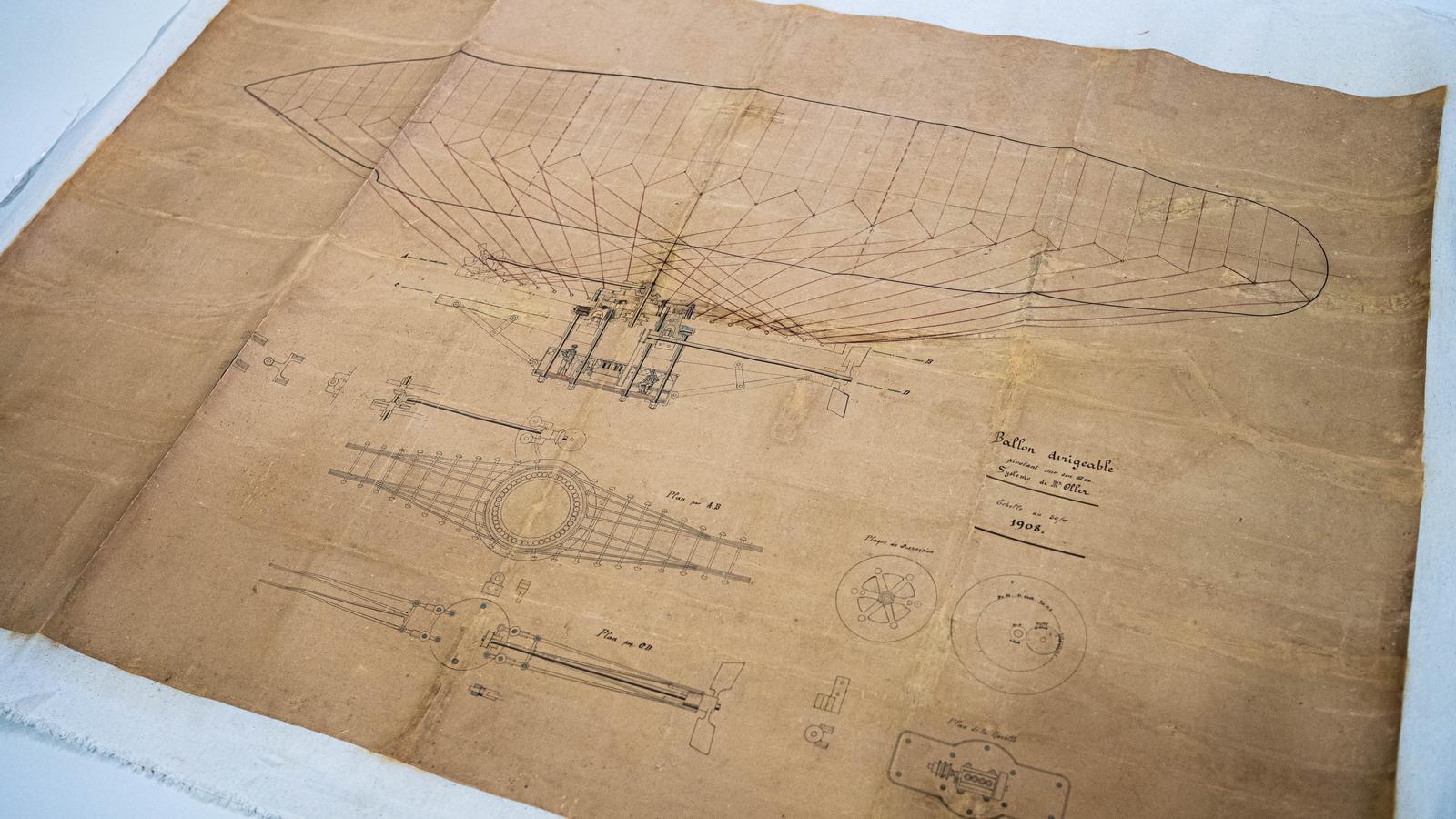

In 1874, Jules Duruof and his wife got lost while trying to cross the Atlantic by balloon. At that time, balloons – and airships too – had no maneuverability and were often at the mercy of the wind. They fell into the water, but a fishing boat was able to pick them up. Other aeronautical daredevils were not so lucky. All this led Baldomer Oller, an aeronautics enthusiast born in Calaf and exiled in Paris, to want to devise a device that would allow the balloon to be directed where its crew wanted, and from this came the patent for the airship Catalunya. But the story of this Catalan exiled in Paris is much more interesting and goes beyond technological entrepreneurship. It is a story of trade unionism, anarchism, imprisonment and torture, exile and return, with the culmination of a surprising invention that was never built.
Now, the Department of Culture of the Generalitat has acquired the plans for the airship Catalunya, along with other documents from the personal collection of Baldomer Oller (1859-1936) that were in the possession of the antiquarian bookstore Delstres in Canet de Mar. There are up to nine original plans, some of them cyanotypes, with all the details of the invention. The bookstore acquired them from the family, who contacted them to sell various documents by Baldomer Oller in two batches, in 2014 and 2018. "What surprised us the most was the extraordinary state of preservation they were in, they were perfect," explains Esteve Domènech, from the Delstres bookstore. A Generalitat archivist visited the bookstore a few months ago and discovered the plans.

, which was patented on May 11, 1909 as "Catalunya, which was patented on May 11, 1909 as "a new class of dirigible balloon". According to historians Antoni Dalmau and Josep Maria Solà in an article in the Revista d'Igualada, the Spanish Congress approved an allocation of 250,000 pesetas to build Oller's device, "but finally there was a change of government and the allocation was taken by the famous engineer Leonardo Torres Quevedo". This Cantabrian inventor had patented his own dirigible in 1905 with other different innovative characteristics, which allowed for a lighter casing.
What was the invention?
But Oller's invention, which never saw the light of day, also brought an important innovation: a system that allowed the boat to turn independently of the balloon and thus direct the direction of travel without the enormous elongated balloon having to rotate. The mechanism consisted of a plate attached to the balloon with a groove into which a disc attached to the boat was inserted, as well as two rudders – one at each end of the boat – with propellers located on the sides above the small boat that could rotate 135°. "It would be the bold equivalent of the helicopter, it was a very important innovation that allowed the engines and the small boat to be oriented," explains Xavier Álvarez, professor of mechanical engineering and deputy director of the UNESCO Chair of Sustainability at the UPC.
"The airship models made later have not had either the rotating boat or maneuverability systems to change direction as brilliantly as Baldomer Oller had devised, I know this because I have studied all the existing airship models," adds Álvarez, who is himself designing a medical airship. Although he admits that Torres Quevedo's patent predates it and that his invention was also important, the expert believes that the fact that Oller's airship was named Catalunya, at a time of significant social and political conflict, "was probably a factor" that influenced the government's decision to withdraw funding for its construction.

Accused of terrorism
Perhaps the trajectory of Baldomer Oller himself also influenced it, because the inventor had lived many lives in one and his past included imprisonment in Montjuïc in a terrorism trial. Born in Calaf on November 2, 1859, Oller learned the tailoring trade and worked in Barcelona, where he became involved in the trade union movement from the anarchist side, to the point that at 29 years old, in 1889, he participated in a congress of the Second International in Paris. But the most significant moment of his biography is linked to the terrorist attack on Canvis Nous street on Sunday, June 7, 1896, which left twelve dead and about fifty injured by a bomb that exploded during the Corpus Christi procession heading to Santa Maria del Mar. Baldomero Oller and his wife had been arrested the day before the attack, but after this event they became part of the accused in the case, along with dozens of other detainees.

he dedicated his high school research paperLa Publicidad, a task he continued from Paris, where he moved to live in 1905.
The events of the Tragic Week, in 1909, and the execution of Francesc Ferrer i Guàrdia, with whom he had been in contact, marked a turning point in his career, as he progressively moved away from anarchist circles, according to Dalmau and Solà. It was then that he delved deeply into his aeronautical pursuits. At that time, the Gordon Bennett Cup, a balloon race from Paris to London, was famous, and Oller began to frequent those circles. The former tailor and anarchist revolutionary threw himself into the task of solving the unmanageability of balloons and airships, and according to experts, he succeeded. He also conceived a device to harness the force of sea waves to generate electricity, a pioneer of an idea that would eventually be implemented (without relation to him) in the 1960s.
Oller and his family eventually returned to Barcelona, where he died at the age of 77, in September 1936. He never saw the Catalunya built. Only his great-granddaughter, Martina Bou Tàpies, built a model of it in 2013 and dedicated her Baccalaureate research project to it. But today, Baldomer Oller's plans and idea are already cultural heritage of the Catalan government.
The Generalitat de Catalunya acquires funds or documents following criteria of uniqueness, exceptionality, singularity or their exclusive character, antiquity or risk of loss, among others. Documents over 100 years old produced by individuals (private citizens) and documents over 40 years old produced by legal entities (companies, associations, private institutions) are part of the documentary heritage. As Joaquim Borràs, Director General of Cultural Heritage, points out. "Incorporating documentary heritage such as Baldomer Oller's plans into the National Collection strengthens the collective memory and narrative of Catalonia for future generations".
