Beyond binoculars: why women are increasingly taking up birdwatching
More and more women are discovering birdwatching as a way to create community, gain role models, and reconnect with nature
-
CAT -
CAST
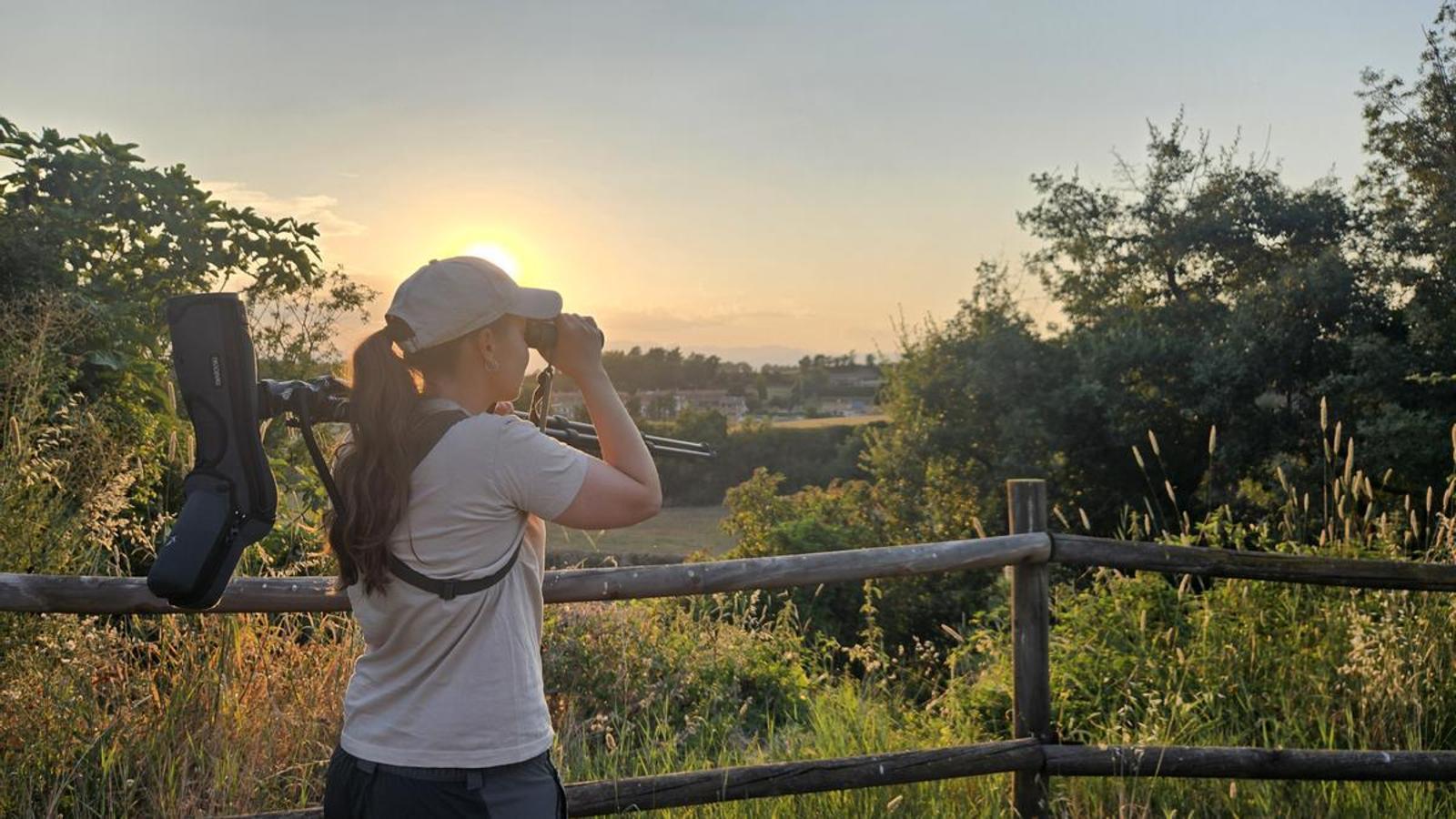
"A poem should always have birds in it," wrote the North American poet Mary Oliver in 1990. A lover of nature, and especially of birds, the winner of the Pulitzer Prize for poetry in 1984 spent decades carefully observing how cardinal eggs break or how chicks chirp demanding food. In her book Devotions she explains how she waited for hours for the arrival of the water thrush. Today, however, birdwatching has become an activity that, far from being practiced only in solitude, is also experienced in community.In Catalonia, more and more women are approaching ornithology through organized groups, collective outings, or small learning networks where, in addition to identifying species, they find a way to share knowledge and build community outdoors."At first, you learn much faster when accompanied, because someone can guide you and make you see details that you would overlook on your own. But it's also important to look at it yourself in the guide, internalize it, and then put it into practice," explains Jaroa López Carrasco, a conservation biologist and technician at Paisatges Vius, where she works to protect endangered species.López, an ornithologist since she was thirteen, became fond of it thanks to a bird guide she had at home and her first outings to the Llobregat Delta with her uncle. But, once immersed in this world, she realized that most of her hobby companions were men. "It continues to be a field in which men predominate, that is evident, but I increasingly see more girls and women interested in this hobby," assures López.A historically masculinized hobby
It's quite curious. All of us, or almost all of us, know the name of Félix Rodríguez de la Fuente. On the other hand, we struggle to remember the names of researchers, scientific illustrators, or conservationists who also dedicated their lives to birds and nature. For a long time, the main obstacle has been invisibility. Precisely to combat this lack of role models, Lechuzas Pajareras was born in 2019, an organization that brings together women dedicated to the study of birds, research, conservation, and the dissemination of nature."In some associations, women make up nearly 60% of members, but this is not always reflected in decision-making spaces. Many times we are more present in administrative or support tasks, while positions of responsibility continue to be occupied mostly by men," explains Uca Díaz, spokesperson for the organization.What began as a group of twelve women is today a network of more than 350 members throughout the State. "Creating community is very important. One of the most beautiful things is to share experiences and hear other women say: «It has happened to me too». This allows us to feel accompanied and to talk without paternalism".

The initiative arose after its promoters saw a documentary about birdwatching in which, coincidentally, no women appeared. "We realized that there were many women doing extraordinary work, but they continued to be invisible in talks, festivals or conferences. We wanted women birdwatchers to be known both for their work and for the circumstances in which they carry it out," summarizes Díaz with more than thirty years of experience in this practice. Although she assures that she has never had problems with the companions with whom she has gone birdwatching, Uca Díaz acknowledges that paternalism continues to be present in this hobby. "Sometimes it is taken for granted that you are a beginner and never that you can know more because you are a woman. It is a form of mansplaining" that also happens in other areas," she explains.However, the history of birds has not been written solely in a male key. Díaz prefers to focus on the role women played in the origins of their protection: "The National Audubon Society and the Royal Society for the Protection of Birds were founded in the 19th century to protect them, at a time when the killing of birds linked to the feather trade for clothing and hats was massive." More than a century later, the need to preserve bird populations remains very much alive. In a world marked by the exploitation of the natural environment, some species have adapted to the changes we cause, while others have disappeared. Birds, explains Jaroa López, are great indicators of the health of ecosystems: when something goes wrong, they are usually among the first to show it."Birds teach us a lot about adaptation and survival. They also remind us that conservation works: there are species that were almost extinct and have returned thanks to the effort of many people," explains Uca Díaz.
- What do you need? Curiosity, patience, binoculars and a bird guide. That's enough to get started.
- Where to go? The Ebro Delta, the Empordà Wetlands, the Llobregat Delta and the Pyrenees are some of the best places in Catalonia.
- When is the best time? There are birds to observe all year round, but spring and autumn, coinciding with migrations, are the most spectacular seasons.
Observe to stop
But the act of going out birdwatching, which has gained traction since the pandemic, is not solely explained by the desire to reconnect with nature. For many people, it has also become a way to build connections and inhabit the territory in a different way. This is how, last March, Bolleres en Ruta was born, a collective that organizes excursions in natural spaces aimed at lesbian women, trans and non-binary people with the aim of creating a safe space to build community and advocate for other forms of leisure away from consumption and nightlife. In the same vein, initiatives like the Club de Pajareras have also turned birdwatching into a shared experience. "It is very important to know our environment in order to care for it and understand that we are part of interdependent ecosystems," explains Cinta Tort Cartró, founder of Bolleres en Ruta.Mental health benefits
Beyond contact with nature, this hobby has also sparked the interest of the scientific community. "Right now, studies are being conducted on the benefits of birdwatching for mental health. In Scotland, there are even doctors who prescribe going out to observe them. Birdwatching involves staying still, concentrating, connecting with your surroundings, and enjoying yourself. It has many physical and mental benefits," points out Uca Díaz."You can spend a lot of time without seeing anything. But, suddenly, an unexpected species or an unusual behavior changes everything. That's what hooks you," explains Jaroa López, a photographer and also a member of the jury of the Delta Photo Contest, an event that is part of the Delta Birding Festival, the major annual event for birdwatching and nature in Catalonia, which this year will celebrate its twelfth edition from September 18 to 20 in the Ebro Delta.

In a fast-paced world, taking time to observe a bird is also a way to recover what we often miss: our attention. "Slowness allows you to appreciate more what you observe and, consequently, to love and care for it," summarizes Cinta. Sharing this process with other people, he adds, is also a way to build community. "There is increasing fragmentation and it is more difficult to find each other and build connections. Therefore, being able to create an affective and supportive network is very important." For many lesbian women, trans and non-binary people, these spaces also offer a place of belonging, role models, and a way to enjoy nature safely.Perhaps birdwatching consists not only in identifying species, but also in relearning how to look. Mary Oliver already said it, and she wasn't wrong: "To live a life is enough with three things: pay attention, wonder, and tell it". Perhaps today we could add a fourth: do it together.
