Searching for extraterrestrial life on the magical mountain of Montserrat
The monthly meetings of ufologists who want to spot UFOs is one of the star outings for university students of anthropology of religion
-
CAT -
CAST
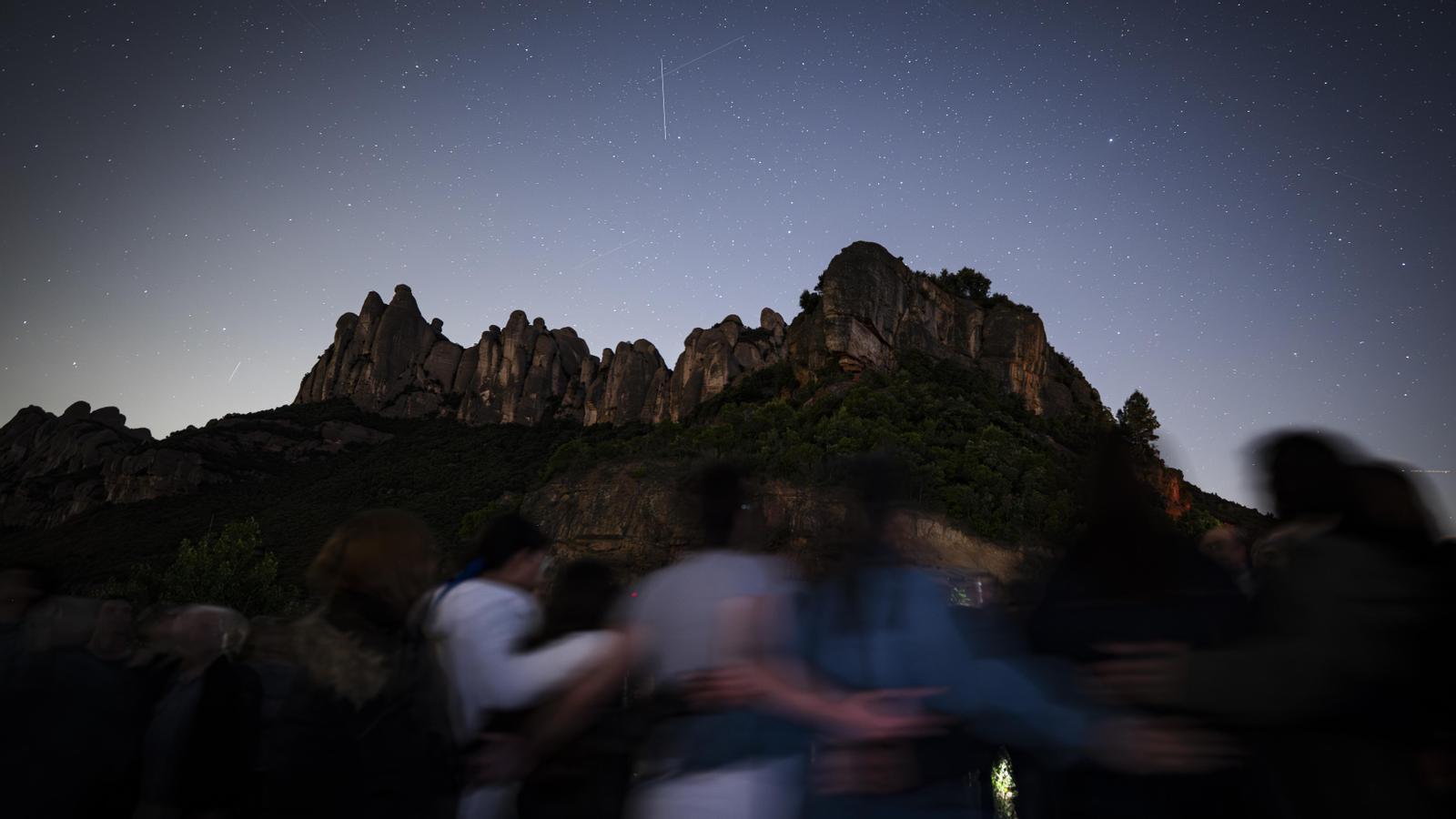
On the eleventh day of each month, at eleven at night, a small community gathers at the Hotel Bruc, at the foot of the Montserrat mountain. The establishment has recently become popular for its appearance in the series La Mesías, but the meeting is much older. For over forty years, a group of people has been punctually attending before heading towards a discreet spot in the mountain range. Once there, they observe the dark, starry sky with the hope of seeing something: a strange light, an inexplicable phenomenon, some sign of extraterrestrial life.
Once a year, anthropology of religion students from the University of Barcelona join this gathering. They do so under the guidance of Professor Manuel Delgado, who has turned the visit into one of the most unique field trips for the course. This year, however, the day had a special significance. It was the last time Delgado would attend as a tenured professor before retiring. And it showed.
Different groups had arranged to meet at ten in the evening at the hotel. I arrived with Professor and anthropologist José Mansilla and some students, after having had dinner in the town of El Bruc. In recent years, the ufological issue has been gaining prominence in this municipality, which holds a prominent place in the history – and also in the myth – of Catalan identity. El Bruc gives its name to the legend of the Timbaler del Bruc: that boy who, with the beating of his drum amplified by the echo of Montserrat, would have made the Napoleonic troops believe they were facing a much larger army. History, myth, or fiction? Perhaps it is irrelevant. Beliefs, when shared, can produce real effects.

The conversation during dinner inevitably turns to UFOs: what do you expect to encounter tonight, I ask them. The answers are varied.
—The people who gather here have an Instagram account where they post videos of things they observe. I expect to see something similar, says Judit.
—I don't expect to see UFOs – says another student, also named Judit–. Maybe, who knows. But what interests me is to see what the people who expect to see UFOs do.
—It's not our job to determine if they are real or not – adds Roger–. What interests us is to understand what all this means to those who participate.
At the bar, the same question sparks less academic opinions.
—I live in the village and see Montserrat every day from my home. I've never seen anything strange – she pauses–. However, I have a friend from Sant Hilari who recorded some very strange lights with his phone. When you see it, you think: “That's strange”.
—Caty did see something – intervenes the waitress–. A kind of presence rising from the ground.
Before he can continue, a third person, a regular climber of the mountain, interrupts the conversation:
—Those are the joints they smoke when they get to the top.
Laughter provisionally closes the debate.
After dinner, we head towards the hotel. Little by little, the students gather on the stairs. Delgado takes advantage of the last few minutes before starting to finish the sandwich he brought from home. It's a good time to talk to him.
There are two main field trips for the course –he explains–. One is the Holy Week procession of L'Hospitalet by the Confraria del 15+1 and the other is this one. Here we study UFO cults, a phenomenon that appears especially from the forties and fifties onwards. The central idea is that the traditional notion of supernaturality is replaced by an idea of supertechnology. But, fundamentally, the logic is very similar.
He takes a bite of his sandwich before continuing.
—These movements must also be placed in the context of the Cold War. Collective fears take on different forms depending on the era. At that time, the threat came from outside, from the unknown. Extraterrestrials became a way of expressing these concerns.
—And Montserrat? – I ask.
—It was almost inevitable that it would appear here. Places that already accumulate legends, mysteries, and stories about other worlds tend to attract new narratives of the same type. There is a certain continuity.
For Delgado, the real object of study is something else: in the course, we are interested in communication with the invisible. The idea that there is a reality parallel to ours and that, in certain places or circumstances, bridges can be established between the two. Montserrat brings together many of the characteristics that facilitate this kind of imaginary.
When I ask him what he expects students to observe, he replies without hesitation.
—The entire course revolves around one question: what exactly is strange? And to what extent is it our responsibility to decide whether these phenomena are true or false? Many people find it extravagant that someone dedicates time to studying issues associated with irrationality or delirium. But that is precisely why they are interesting.
Beside him, anthropologist Gerard Horta, also a professor of the course, adds:
—We aspire to understand. We are interested in knowing the social basis of credibility. Why do certain experiences seem convincing to some people? What makes them plausible within a certain cultural context?
—There are people who even believe in democracy –interjects Delgado, provoking some laughter.
His irony is well known. When I ask him about the recent declassification of documents on unidentified aerial phenomena in the United States by the Ministry of Defense, he emphasizes: It doesn't interest us at all. Whether aliens exist or not is a secondary issue for us. What interests us is that there are people who believe in it. We want to understand how they interpret the world, how they construct meaning, and how they incorporate these ideas into their daily experience.
He pauses.
—The fundamental issue is that humans have always imagined invisible realities. Gods, spirits, ancestors, aliens. The forms change, but the need seems persistent.
And he concludes the reflection with one of his usual provocations: the mystery is not that people believe in aliens, he says. The mystery is that there are people who dedicate their lives to defending and promoting something called Catalan culture, which no one has ever been able to explain exactly what it is, where it is, or how it is.
The sandwich is finished, and the staircase full of students awaits his words. When he finally gets up, Gerard Horta and José Mansilla accompany him.

—Hey, let's see: do you believe in love?
After the applause-filled intervention, the retinue of young anthropologists heads to the indicated place. The emotion is palpable among the students. The night is clear, the moon waning, and hundreds of visible stars accompany the unique profile of the mountain. The temperature is pleasant, although the strong wind chills the bones as time goes by.
Once there, I take the opportunity to do a job similar to the one assigned to the students. I listen to people, trying to understand. Among the crowd, I meet Lucho and Gali, from Uruguay. He has been living in Barcelona for over twenty years, but she has traveled from Israel.
"I've always been a science fiction fan," explains Lucho, "Star Wars, all that stuff; I've always thought we're not alone, there are so many stars, so many galaxies, so many worlds."
Gali recalls a childhood experience in Uruguay: "There was a woman who said she communicated with people from space. It was the first time I had heard people talk seriously about these things."
He also mentions the conferences of Sixto Paz, one of the best-known figures in Hispanic contactism. "He said that to communicate with them you needed special preparation. Not everyone is ready," he says.
A light on the horizon
As I walk among the people, I spot a man equipped with a powerful laser pointer following a visible light on the horizon, moving among the stars. Several people observe, attentively, in the same direction. Suddenly, the light disappears. A collective "oh" is heard, followed by a few seconds of tense silence, which, I interpret, is read in the following way by some: what if...? Then, normalcy returns with the same speed with which it had disappeared.
What was that light? I also wonder, but I have no answer. It could be anything, I tell myself. An airplane, a drone, or all the other things it could be and that I don't know.
A little further on, I find José and Rosi, who are accompanied by their son and daughter.
—This is the third time we've come, but we haven't seen anything yet –explains José–. But Rosi has seen something –he adds–. Rosi shakes her head and says: it was my uncle who had the experience.
The story is a family one. Years ago, walking in the mountains, he claims to have seen something strange. According to the family, he arrived home completely upset after a light illuminated him. "It was such a warm light," she explains, "that he ended up peeing himself." For a long time, he preferred not to talk about it for fear of being thought crazy.
“But things have changed now. This topic is no longer taboo,” she says. The rest of the family agrees.
Some people explain that they feel an extraordinary energy associated with Montserrat. Others speak of vibrations, intuitions, or spiritual connections that are difficult to describe. But not everyone goes there looking for transcendence.
Marc is part of a group of friends who, just over a year ago, joined the community of Hotel Bruc. Consequently, every 11th of the month, they meet in this place where we are now.
—I had heard about it many years ago because I live near here and almost by chance we said, damn, let's go and see it. And we've been coming ever since. It's more of a social gathering for us. There's curiosity, but each person has different ones, like in any group of people. Oh, and we also sing, but that's a longer story to explain...
—It's a kind of community ritual –says a second person, also part of the group–.
—We would love to see something, but so far all this looks more like fantasy than anything else.
—Well, we have seen something, haven't we! –he replies. And he refers to the sightinga few minutes ago–. I had never seen this intermittent light in a space where there is nothing and that suddenly disappears.
With a more serious tone, he looks at me and says: I also find it funny that people say they come here just to laugh and have a good time... because if they come here, it's because they want to believe something, right?
—Montserrat has magic –says another.
—And you can meet people without downloading an app –adds a fourth.
Back in the car, I comment with one of the students on what their experience has been. "It has been very interesting – he says–. To be able to be in that place, see the stars and observe the atmosphere that is generated..., but I regret not having seen anything else. I had a little hope".
As in love, in democracy, in Catalan culture, I think.
