A Ukrainian drone attack leaves at least thirteen dead in the Russian region of Tatarstan
The accumulation of air defenses in Moscow increases the vulnerability of the rest of the country
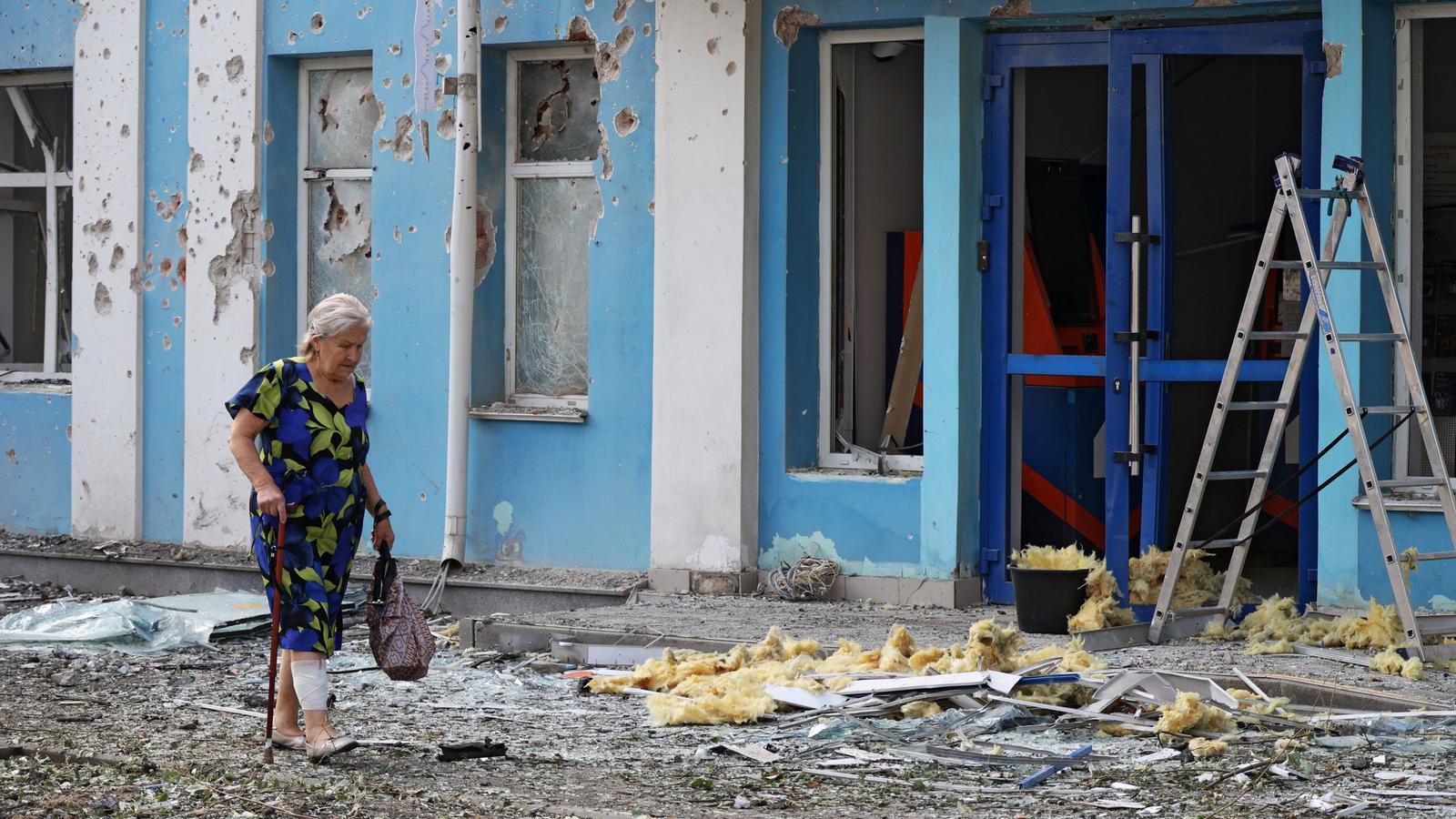

MoscowThe escalation in aerial attacks in the Ukraine war has once again resulted in civilian casualties. Following last week's deadly bombings against Kyiv, this Monday Ukrainian drones attacked the Republic of Tatarstan, in the center of European Russia, killing at least thirteen people and injuring 75 more. The unusual magnitude of the attack's consequences, one of the deadliest on Russian territory since the start of the invasion, reveals the difficulties Vladimir Putin faces in protecting the country's immense expanse, beyond Moscow, an almost impregnable city.
According to images circulating on Ukrainian channels, the target of the bombing was the industrial complex of Nizhnekamsk, where one of Europe's largest petrochemical plants and two refineries are located, accounting for 8% of the total oil distillation capacity in the initial stage of the process. Nine of the victims were housed in a dormitory that was hit by one of the drones. The head of the Republic of Tatarstan, Rustam Minnikhanov, limited himself to describing it as "another barbarous attack" against "civilian targets," reported that a child was among the dead, and declared a day of mourning.
One of the spokespersons for the Russian Foreign Ministry, Rodion Miroshnik, also believes that Ukraine is carrying out "a deliberate escalation" and is resorting to "terrorist methods" to strike civilians. From his point of view, Volodymyr Zelensky's purpose is "to intimidate the civilian population through assassinations and mutilations." He also takes for granted that the West is blessing these kinds of actions in order to alter the mood of Russian society and politically "weaken" the regime.
This is the third deadliest bombing on Russian territory since the beginning of the war. There were only more deaths in two attacks on the Belgorod region, in 2023 and 2024. Belgorod, however, borders the Ukrainian regions of Sumy and Kharkiv and was the scene of incursions by Kyiv's troops. In contrast, Tatarstan is about 1,200 kilometers from the Ukrainian border and, therefore, it is much less common for drones to be able to cause so much damage there.
Much of Russia, unprotected
That this is happening precisely now is not by chance. Ukraine has increased the waves of drones it sends daily to Russia and, in fact, on Monday morning it launched more than 450. Faced with this scenario, the Kremlin has opted to exceptionally reinforce the anti-aircraft batteries of the Russian capital, one of the most frequent targets of Ukrainian unmanned vehicles. For this reason, it has increased the number of protection systems around the city: it currently has three rings with between 120 and 150 positions to repel drone attacks, a fourth ring is being deployed, and launchers are being installed on the roofs of skyscrapers.
The data provided by the mayor of Moscow, Sergei Sobyanin, shows that, although Ukrainian aircraft are capable of threatening the capital, its defenses are very effective. In July, it is estimated that Kyiv's air forces sent more than 6,200 drones against the city. Of these, only one was able to penetrate all the protection rings, that is, 0.07%. As for the rest, just a hundred, approximately 6%, managed to reach the third defensive ring, located on the ring road that surrounds the city, about twenty kilometers from Red Square.
The collateral effect of this concentration of anti-aircraft batteries is the lack of protection for a large part of non-urban Russia and that the number of civilian casualties breaks all records. While Zelensky struggles to resist the waves of Russian missiles and sees civilians losing their lives with each bombing – out of 124 projectiles received in August, Ukrainian defenses have only been able to intercept one – Putin cannot prevent drones from causing havoc within his country, even though they are a less destructive type of weapon. Not long ago, on Sunday, Belgorod suffered the deadliest attack in the last two years, with six deaths and about thirty injured.
