The evacuated Afghans: their life, five years later
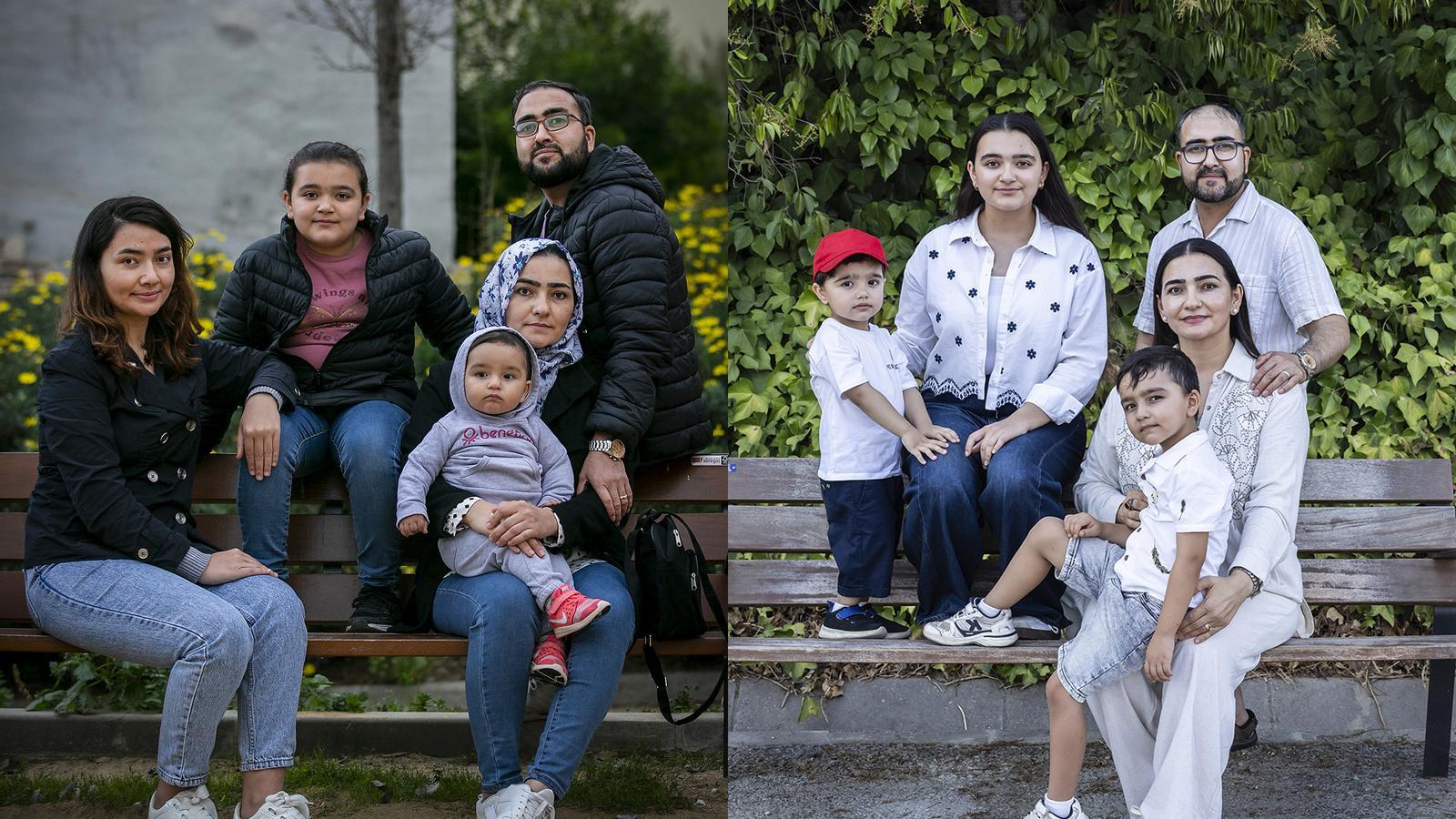
The ARA Diumenge follows the trajectory of four Afghan families that it already interviewed in 2021, when they arrived in Catalonia fleeing the Taliban
-
CAT -
CAST
Barcelona"Every day that Asra goes to school, I am very happy…", says Anita with a broken voice, and she can no longer continue the sentence because she bursts into tears. Asra is the 13-year-old daughter who this year has completed the second year of the secondary education. If they had stayed in Afghanistan, if they had not been able to flee, Asra would now be confined to her home and would not have been able to start secondary education, because the Taliban have prohibited girls from studying from the age of 12. “In Afghanistan I have my sister, my nieces, my sister-in-law… They are there, unable to do anything”, laments Anita, who tries to compose herself while wiping away her tears. “Here we are fortunate”. That is why she does not miss any opportunity to work, study, get to know new places or even play football. She wants to enjoy every moment of her freedom. Because that is what she values most about being here: freedom.
Anita Rafat is one of the many Afghans who arrived in Catalonia in 2021, when tens of thousands of people were evacuated from Afghanistan in a hurry by international troops, after the Taliban entered Kabul without firing hardly a single shot and took power of the country. Almost five years have passed since then and the Taliban, instead of weakening, are getting stronger.
Spain welcomed a total of 2,475 Afghans, 2,206 of whom arrived on evacuation flights and 269 obtained visas in the following months, according to data provided at the time by the Spanish Ministry of Foreign Affairs. Two hundred ended up in Catalonia. More Afghans have arrived since then, but in dribs and drabs. What has happened to all these people?
The ARA Diumenge spoke with four Afghan families whom it had already interviewed in 2021 to find out what has happened to their lives five years later. Curiously, throughout this time, for all of them their lifeline has been anonymous people who have helped them selflessly. What will happen if Vox wins the elections? Or if the European Union finally reaches an agreement with the Taliban for the deportation of Afghans?, they also wonder. That is why their main goal now is to obtain Spanish nationality as soon as possible.
Rafat-Shirzay family

Anita, 42, arrived in Barcelona with her husband, her daughter, who was then 9 years old, her 17-month-old son, and her sister. “It was an emotional shock to leave my family, my job, and my friends behind, and to arrive in a place where you have to start from scratch and you know absolutely nothing,” she recalls. She didn't know a single word of Catalan or Spanish, and it can be said that she landed in Barcelona with just the clothes she was dressing. In Afghanistan, she graduated in biochemistry, worked as a teacher, but also for the Spanish Agency for International Development Cooperation in the small town of Qala-e-Naw, in the northwest of the country, where everyone knows each other and it was easy for the Taliban to identify her.
Initially, Anita and her family lived in a reception center in the Nou Barris district of the Catalan capital, managed by the Apip-Acam Foundation, where they shared the space with other refugee families. Having a rented apartment seemed like a pipe dream to them then, but they were very lucky that a family from the parents' association of the school where her daughter Asra was enrolled in the Horta neighborhood offered to rent them part of their house at a more economical price than they could find on the market. It is an old two-story house, one of those traditional houses in the neighborhood. The family lives on the second floor, and they have been given the first floor.
They have already learned Spanish and are also starting to loosen up with Catalan, but what is costing them the most is finding work. For a few months, Anita has been a lunch monitor for children with special needs in a school, and she has even dared to give some demonstrations to the students in the laboratory, taking advantage of her knowledge as a biochemist.

At the end of 2022, however, she became pregnant, and on September 10, 2023, she gave birth to her third child, Arsh, at Vall d'Hebron Hospital. "In Afghanistan, I had my children in a small city where I worked as a teacher and everyone knew me. That's why the midwife and the nurses at the hospital treated me well," she explains. Here she was surprised that, even though no one knew her at the hospital, she also received exquisite treatment. But what shocked her the most is that her husband could be with her during childbirth, something unthinkable in Afghanistan. "Since then, he respects me more. The birth impressed him so much that he even got dizzy and cried," she states.
The husband, Abdul Wasi Shirzay, also 42 years old, looks resigned while listening to her. He currently works as a forestry assistant for Parks and Gardens, within an occupational program run by Barcelona Activa. He prunes, thins, waters... "I'm happy because in a way it's a job that's related to what I studied in Afghanistan," he says. There he graduated in agricultural engineering. His contract lasts until December and he hopes they will renew it.

“It was a foul, it’s a red card!”, exclaims Ahmad in Persian, mixing words in Catalan and Spanish, while watching a football match on television. He is one of Anita and Abdul’s sons, he is almost 6 years old, and he speaks the three languages indistinctly. His sister, Asra, 13 years old, also speaks the three languages perfectly. She says that when she grows up she wants to be a doctor, although she also loves to draw. She has whole notebooks of drawings made in pencil by her. Her favorite is a portrait of her grandmother, who is still in Afghanistan, and whom, she assures, she misses so much.
Rafat-Toukhi family

Fereshteh Rafat, 32 years old, also misses her family very much, she says without being able to avoid getting emotional. "In Afghanistan I worked and had no financial problems. I was much better off than now. This is the price I have had to pay for my freedom here," she says, also wiping away tears.
Fereshteh is Anita's sister. In Afghanistan she graduated in journalism and was a strong advocate for the rights of Afghan women. She worked in a shelter for abused women. In Barcelona, she initially lived with her sister at the reception center, but then looked for a room to rent, and was fortunate enough to end up at the home of Magdalena Martínez Sacristán and José Antonio Ramos Romero, a retired couple from l'Ametlla del Vallès who adopted her as if she were their daughter. In fact, she now calls them "dad and mum". "They are my family in Spain," she assures.
Living with them helped her learn Spanish quickly and speak it perfectly, but also to know what the culture, food, and life here are like. It was a total immersion. Her boyfriend, Khalid Toukhi, also joined her a few months later. In fact, they were evacuated together from Afghanistan, but since having a boyfriend is socially frowned upon there, they initially hid that they were a couple and, once in Spain, they were separated: she was sent to Barcelona, and he to Cordoba, until they managed to reunite six months later.
The couple from l’Ametlla del Vallès also helped Khalid a lot. Magdalena offered him to sleep at her sister Herminia’s house, in Santa Coloma de Gramenet, so he could find a job in Barcelona. "For all the jobs they offered me, I had to start at seven or eight in the morning and, living in l’Ametlla del Vallès, it was impossible for me to arrive at that time by public transport. The first bus that connects l’Ametlla with Granollers Centre leaves at seven in the morning. And from there, I had to then take a train to Barcelona," he argues.
The young man, who graduated in economics in Afghanistan, studied a master's degree in international relations and worked in an institutional organization that promoted conflict resolution, is now a receptionist at the Hotel Ilunion Barcelona. He started in March 2023 with a rotating schedule. Only when he worked at night, he could go to sleep in l'Ametlla del Vallès. Until July of that year, he and Fereshteh moved to live in Ciutat Meridiana, also thanks to the couple from l'Ametlla, who had a flat rented to other tenants and decided to rent it to them for a modest price. They are very grateful.
Khalid now has a permanent contract. Fereshteh, on the other hand, continues to look for work. "Every week I send at least thirty resumes. They interview me, but then they don't hire me," she comments, frustrated. She has taken a course as a healthcare assistant, another as an application testing engineer, 3D printing, blockchain... And she continues to train. She is also a volunteer at the TechFems organization, for women specialized in technology, and has worked as a sales assistant in a clothing store. Last year she had to have surgery for health problems and that hasn't helped her job search either.
Hossaini family

"Olot is a small town where it is difficult to get ahead. I was clear that the only way not to depend on social aid was to leave and find a job," says Javad Hossaini, 36, who ended up in the capital of La Garrotxa in August 2021 with his wife, Fatemah Mohammadi, and his son Amir Mohammad, who was then 5 years old. Initially, they lived in a shared apartment managed by the Cepaim Foundation.
Originally from Herat, the second largest city in Afghanistan and the country's economic engine, they realized from the beginning that Olot was not for them. So, as soon as they had a work permit, they looked for an alternative: Madrid.
They were fortunate that the secretary of the board of trustees of the Fundación Lo que de Verdad Importa, Carmen Gredilla, met Javad by chance at a conference and offered him work at her cosmetics factory located in Tres Cantos, a municipality north of the Spanish capital. Javad did not think twice. He left his wife and son in Olot and went to Madrid to look for a place to live with his family. He stayed for ten days in an Airbnb. "At night I cried because I couldn't find anything," he confesses.
But Carmen Gredilla was once again his lifeline: not only did she guide him on how to look for an apartment, but she also negotiated with the owner and acted as his guarantor. Thus, Javad managed to rent a 35-square-meter studio in Colmenar Viejo, about 40 kilometers north of Madrid, and move the family there at the beginning of March 2022. A few weeks later, on April 17, his wife, who arrived in Spain pregnant, gave birth to their second child, Alisan.
"In the apartment we had nothing, not even a plate, and Càritas Castrense gave us money to buy what we needed. They also helped me get my driver's license so I could look for a second job as a driver," explains Javad, because with what he earned at the cosmetics factory, they could not make ends meet.

His wife, who was a doctor in Afghanistan, started working as a cleaner. And he, who was a physiotherapist, began sending out curriculums to try to find a job in his profession, but everywhere they demanded that he have his degree recognized. “I went to a pilates center to try my luck and, to my surprise, they hired me as a trainer,” says the young man, who admits he had to search on YouTube how to do a pilates workout because he had never done one in his life.
Starting in July 2023, Javad worked at a cosmetics factory from 7:30 AM to 3 PM in Tres Cantos, and from 5 PM to 10 PM at a pilates studio in Madrid. By the time he got home, it was already half past eleven at night. "I didn't see my children, except on weekends," he laments. For her part, his wife enrolled in a healthcare assistant course and did an internship at a center for people with autism for a whole year. At 7:30 AM, she would drop off her youngest son, still a baby, at daycare, and rush to work while checking on her other son via mobile phone, who is now 10 years old and whom she had left home alone, to make sure he got up, had breakfast, and went to school. Thus, with great effort, they managed to get by.
Now they live in a larger, three-bedroom apartment, also in Colmenar Viejo, and they have bought a car. Javad has left the cosmetics factory and now works as a trainer at two different pilates studios. He has also managed to get his physiotherapy degree accredited, but they require him to complete 600 supplementary internship hours. "I have contacted public universities and they tell me I cannot enroll to do only the internship. And private ones are too expensive, I cannot afford them." He regrets that they put so many obstacles in his way.

Fatemah, 33, has stopped working to spend more time with her young son. The boy has problems socializing and barely speaks, even though he is already over 4 years old. They have taken him to the doctor, to the speech therapist... This is what worries them most now. "I want to thank all the people who have helped us. Your support and affection have meant a lot to us," she states. She also says that her “biggest reward” is that her children “are happy and integrated at school”. She assures that she has hope for the future.
Aryan family

On the other hand, Feridoon Aryan assures that he is not at all sure about the future. “I cannot consider my country where I have to renew my residence permit every three years and do not have a permanent legal status to be my home,” he argues.
Feridoon, 40, arrived with his wife and two children in Barcelona in October 2021, on one of the only two evacuation flights that the Spanish Ministry of Defense organized from Pakistan to transfer Afghans whose lives were in danger and who had not managed to board the flights that left Kabul. He was a UNICEF spokesperson in Afghanistan, he could not stay in the country.
In Barcelona, they initially lived in a reception center, where they were offered a room with three beds and had to share the bathroom, kitchen, and dining room with more than twenty refugees, each from a different country. Then they were moved to an apartment in Sant Cugat del Vallès, which was much better, but where there were no furniture, no mattresses, no nothing, and they had no money to buy it all. So, when in June 2022, the opportunity arose to apply for asylum in Germany because Feridoon had worked in Afghanistan for the German NGO Media in Cooperation and Transition, they left without thinking twice.

In Germany they settled in Hamburg, where the government provided them with a furnished house that lacked nothing, Feridoon explains to ARA Diumenge via video call. "Germany doesn't dedicate a room to Afghan women, but it really helps refugees in a practical way," he adds sarcastically, referring to the room with a commemorative plaque that the Spanish Ministry of Foreign Affairs inaugurated last January to show its institutional support for Afghan women.
Over the last few years, Feridoon has continued to work remotely for Unicef Afghanistan, and has also been hired by an American company that helps Afghan refugees obtain a visa. The company had its office in a town ten hours' drive from Hamburg, which meant he was rarely at home with his family, and he ended up leaving the job. He is now looking for another, although for the moment he is quite busy at home. His wife, Nooria, 33, gave birth to their third child on July 10th. Their other two children, Anosh and Heraab, are now 7 and 12 years old.
"Germany is a good place to live," assures Feridoon. But he wonders the same thing as most Afghan refugees: "What will happen with the rise of the far-right?

