A century sailing with the most Catalan vessel
The windsurf celebrates its first 100 years of its own navigation, without a rudder and using the force of the body

-
CAT -
CAST
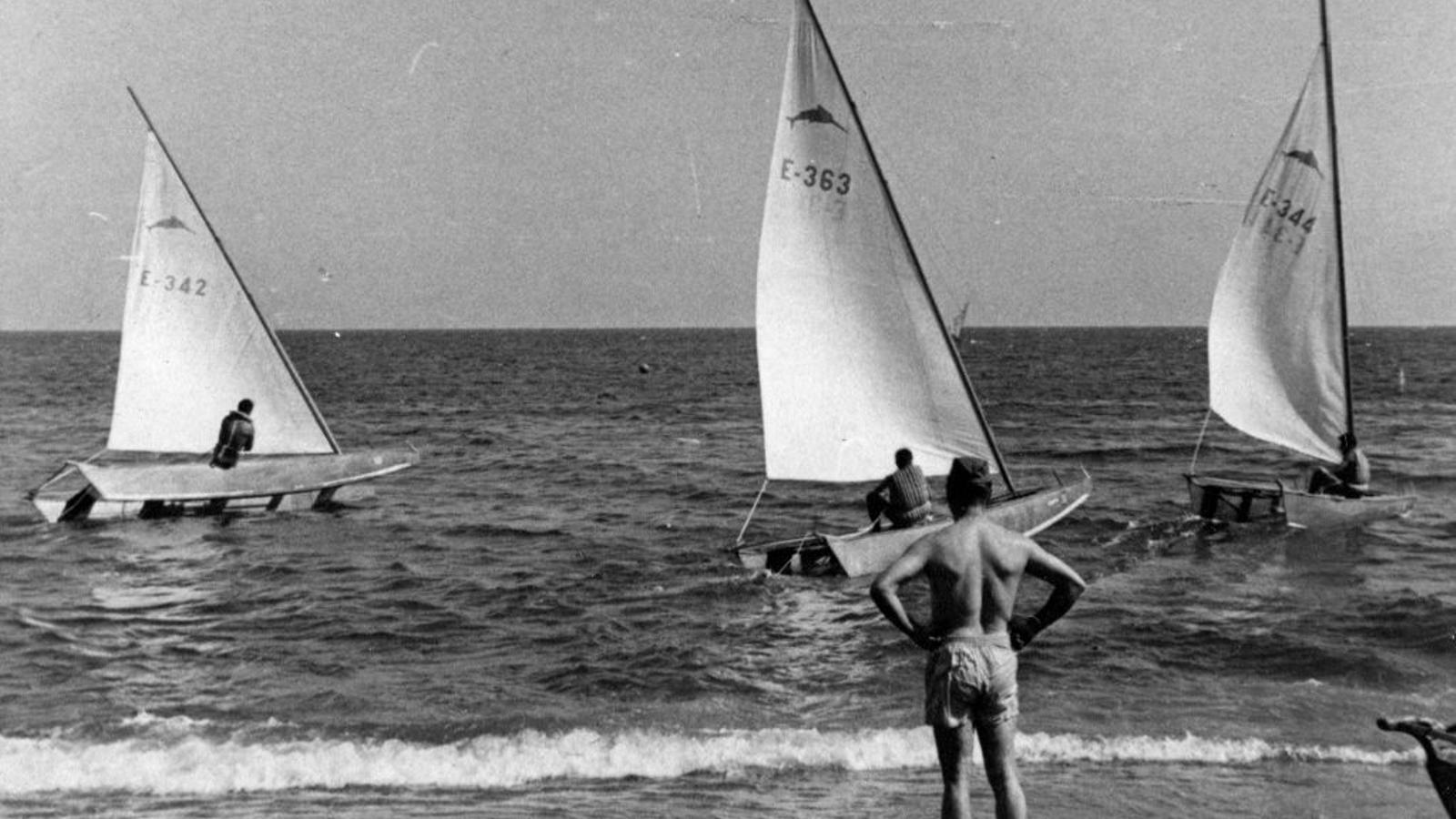
BarcelonaAnyone who wanted to swim in the sea 100 years ago didn't have it easy. People who lived near the sea still had the bad habit of throwing trash into the water. The factories that had been built on the Barcelona coastline were polluting the sea more and more. Chronicles speak of dead animals, all sorts of debris and industrial waste that deterred many swimmers. The most determined began to go a little further out to sea with "patinadors", modest boats that were essentially a small catamaran, with two canoes joined by a plank. They would climb on board and, by rowing, would go to the clean waters. At the beginning of the 20th century, the bathing clubs of Barcelona and Badalona rented these "patinadors", until someone had the idea of putting a mast with a sail on them. And so was born the most typical vessel of Catalan sailing: the "patí de vela", which has celebrated its 100 years of life in good health.
"There is some discussion between Badalona and Barcelona to decide who invented the "patí"" says journalist Daniel Romaní, a specialist in these boats. In fact, he has traveled along the entire coast of the Catalan Countries aboard one of these unique vessels, publishing the book Catalunya amb patí de vela. Del delta de l'Ebre al cap de Creus. "The "patí de vela" is a small boat, without a cabin, without an engine, and without a rudder. A boat with two parallel floats, a platform on top, and a single sail. It seems simple, but you need to know how to sail a lot to be able to handle it, especially in rough waters, as the course is steered solely by body movement on the deck and sail adjustment. In other words, there is no rudder," explains Dídac Costa, one of the few humans to have completed the Vendée Globe, the solo, non-stop round-the-world sailing race, twice. After sailing all sorts of sailboats, he has recently had adventures with a Catalan "patí", to "reconnect with a way of sailing that seems lost. Nowadays, technology has allowed for great advances and increased safety, but at the same time, it leads to losing the essence of sailing," he explains.
The "patí de vela" was born in the 1920s. One of its epicenters is Barceloneta, where Rafael Escolà, the first builder of "patins de vela", had a workshop. Escolà and his brother worked at 57 Meer Street, right on the seafront. He used to make the "patins" used by the Barcelona Natació Club and, together with two members of this entity, decided to add a sail. Using a stool, he fixed the base of the mast and thus became the first officially documented builder of "patins". By 1925, "patí de vela" races were already being held in Barcelona, according to nautical historian José María Martínez-Hidalgo. And in 1933, the first Championship of Catalonia was created, won by Jaume Agustí, who received the trophy from Lluís Companys and gave it to Rafael Escolà's family. In 1932, a race from Barcelona to Arenys de Mar had taken place. It had already consolidated rapidly, with strong rivalry between the marines of CN Barcelona and those from Badalona.
A vessel that has hardly changed
The 'patí' gradually spread along the Catalan coast, especially in Maresme, Baix Empordà, and Garraf. Initially, each builder and each nautical club did their own thing, so in 1942, official dimensions were established that are still respected today: it must weigh a minimum of 89 kg, with a length of 5.60 meters and a beam of 1.60 meters. It is said that to set these measurements, a regatta was held in Vilanova in 1942, in which the winner would receive the honor of setting the characteristics as a reward. A 'patí' from the brothers Lluís and Emili Mongé from Badalona won. Another resident of Badalona, Antoni Soler, created the so-called 'patí de vela júnior', with smaller dimensions, designed for children and adolescents, in 1968. "The 'patí' is special, as it has changed little compared to these 1942 regulations. In other sailing disciplines, technology has brought about many changes in equipment. Some would like to make changes to the 'patí', but for what reason would they be necessary? To go a little faster? The price to pay would be that the equipment would be more expensive. The 'patí de vela' is very fun as it is, with its essence," says Anna Pujol, one of the best Catalan 'patí de vela' racers, with numerous titles won and honorary president of ADIPAV, the association that defends the 'patí de vela' and has published a book dedicated to the 100 years of this boat.

"The patí has also reached abroad. Some Catalans or sailing enthusiasts have taken them to England, Belgium, or South America," explains Romaní. In 1958, the first international regatta was held in L'Estartit, France, and in 1960, Jordi Ferrer, one of the prominent skippers of the time, organized the first patí de vela regatta in Italy, in Sardinia. The patí has reached places like Germany, Austria, Japan, or Argentina because sailors from these countries have discovered the patí competing in Catalonia and have fallen in love with it. Or when Catalans go to work in places like Qatar and take one with them. When the owners of Bodegas Osborne in Jerez saw some patins on Badalona beach when they went to buy the company Anís del Mono, they took some to Puerto Sherry, in Cadiz, where you can still sail. But it is an activity that is primarily a Catalan sport, currently practiced by hundreds of people. "The health is unbeatable. We have fleets all along the coast, from Sant Antoni de Calonge to Sitges with weekly activity. And we also reach Altafulla or Torredembarra. In Barcelona, for example, at the patí de vela club, we sail four or five days a week with more than 30 boats," comments Pujol, who also recalls: "We work a lot with the juniors. We have a project with the Catalan Sailing Federation to restart the junior patí league and ensure its succession."

"It is an ideal modality for those who want to start sailing. It is not expensive, it is not very demanding. I am over 60 years old and I can launch, move and put the boat in the water by myself, for example. It is a comfortable boat to store, clubs can do it in their facilities without needing to keep them in the port. Once you sail with a sailboard, it's hard to stop", argues Pujol. "The uniqueness is that you carry it with your own weight. Your movement determines the direction, and you can go quite fast. Once you get practice, you enjoy it a lot. You can sail alone or with two people, at most. I sailed the entire Catalan coast from Alcanar to Cap de Creus in 11 days", points out Romaní. "Being shallow, it became popular because it could reach the sand. Now, with coastal laws, it's a bit complicated and you can only use the entry and exit areas", admits Romaní. Despite everything, the sailboard has reached its centenary in very good health, and is open to anyone who wants to discover it to sail as many Catalans did 100 years ago.
