Musical subcultures emerge: "There is a rock renaissance and we are part of it"
A new generation of bands in Catalan revives old sounds and moves away from everything that is fashionable with commitment as their banner

-
CAT -
CAST
Cabró Rock, Canet Rock, Empordà Music Fest, Festiuet, Castanyada Rock. Beyond sharing scarce semantic creativity when it comes to naming, they are festivals with several points in common. Essentially two: they are the most crowded in the country in the Catalan language, some with audiences exceeding 40,000 spectators, and they coincide in having practically identical lineups. Most of the participating groups in these gatherings are the same. In fact, names as well-known as La Fúmiga, Buhos, Figa Flawas, and The Tyets, for example, in this 2026 will play in all of them, as if it were an itinerant tour that jumps from summer to summer. The fact is that Catalonia can finally boast of having its own mass scene, consolidated in the country's language. This implies, for example, having several bands that accumulate millions of online streams, also a collection of crowded meeting points, and a part of the industry that monopolizes the lucrative business of music in Catalan for all audiences. But as it could not be otherwise, whenever an official, harmless, and domesticated movement consolidates, a truly rich and exciting one comes along behind it.
A veteran hardcore band from Tarragona, CrimExamples? A veteran hardcore band from Tarragona, Crim, is hanging the sold-out ticket sign at the entrance of a large Razzmatazz venue, with 2,000 people enthralled. Or Fetus from Bisbal, who have long been one of the most prolific bands in Catalonia, with six EPs released in nine years, the last of which, Romancer tartera. To culminate each tour, those from Bisbal de l'Empordà celebrate La Gran Xefla, a concert that has become a tradition and fills Barcelona's Sala Apolo. These are projects that work and do not follow the canons that mark today's music: they don't play the genre of the moment, nor do they have overexposure on social media, nor are they abducted by the maxim of constant novelty or by collaborations between musicians for the sake of it. Music made from the margins has always been outsider, and now many of these recently emerged projects are added an inseparable look at the past. If what triumphs now is digital and looking ahead to the future, they go for analog and homage to old bands and scenes. Like a cycle in which everything returns, including subcultures with their music, their clothes, and their ways of doing things. "Ours are the shaved heads," exclaim Testarudes, new standard-bearers of Jamaican roots sounds in Catalonia, referring to skinhead militancy. skinhead.
Self-management and militancy
“It is a great honor to flee the predominant trend,” explain the members of La Rauxa, the latest quality addition to the local independent circuit. They have only recently started playing live and have just released their first album, De bon començament, an exercise in style in which they wink at yé-yé pop, northern soul, and other genres with roots in the sixties and seventies. “We are passionate about these sounds, we have always been linked to scenes with a predilection for these genres,” explains Leo Hernández, guitarist of the band, which includes members of other combos of Mod descent from the country, such as Los Retrovisores or Trau, two names still active and who have remained faithful to modernist principles since their beginnings.

Pepo Márquez, a former industry worker for multinationals like PIAS or Universal, explained a few weeks ago on a Subterfuge label podcast that he had received a business plan on how the career of a newly formed band should be. The most unexpected thing is that they had prepared it themselves and not a record label. La Rauxa are an example of resistance to these ways of doing things established in the sector. In fact, it is a radically opposite project: not only do they make music from other decades, but they do not have a management agency, nor a press officer, nor is there any kind of label that publishes their records. They do everything themselves, without intermediaries. "Over time we began to see that the most coherent thing was to go for self-management," they explain. Working like this is the response to what they describe as "a system that systematically precariates musicians' work," and the solution they have found has been to establish themselves as a cultural association, a tool that seeks to be a counter-power within a sector as complicated as this one.
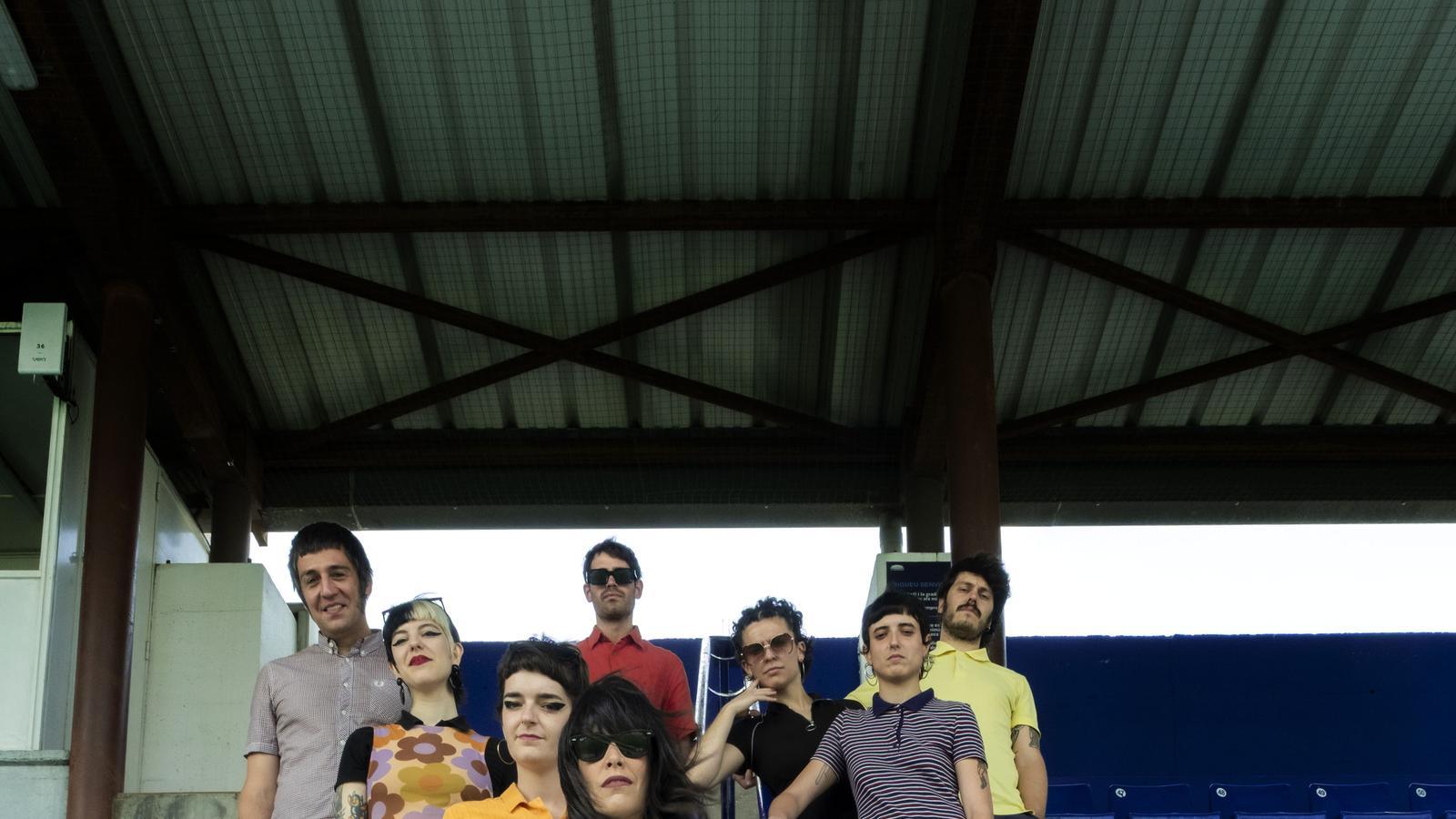
Allied with La Rauxa are Les Testarudes. And not just because of the presence of Laura del Pino, singer of the former and founding member of the latter: but also due to a love for 45-inch vinyl records, Fred Perry polo shirts, and music of Jamaican heritage: ska, rocksteady, and reggae. Les Testarudes, who like La Rauxa have also just released their first full-length album –Ai, Mare!– and have militants in the Sindicat de Músics Activistes de Catalunya, are one of the best pieces of news in Catalan music of the last five years.
In addition to being the new national benchmarks for the latest wave of ska, a genre with a special predilection in our country, they have also been one of the popular music acts that has covered the most road miles in recent years. If anyone has accumulated concerts, it's them. “Initially, we said yes to almost everything. From the beginning, we were clear that we would grow from our own spaces, that is, self-managed and decentralized ones,” recounts Júlia Soler, trombonist for Les Testarudes. The band draws on the most militant political-musical tradition, in the style of The Clash and Kortatu, carrying music and discourse stoically and almost without rest on both sides of the Catalan Countries, Euskal Herria, and Galicia. The van is smoking: “We have the energy to do it at this pace now,” they explain.
No spaces at festivals
The emergence of Les Testarudes has been a breath of fresh air in a scene, the Jamaican one in Catalonia, traditionally male and to some extent aging: “A generational change was missing, modernizing the discourse from a non-mixed point of view,” assures Amaia Hermoso de Mendoza, saxophonist of the combo, which is made up of nine girls from diverse backgrounds. The number of members in the project could make it falter –“maintaining a stable formation is our Achilles’ heel,” they say–, but they want to maintain their commitment to horizontality with all its consequences: they function in an assembly manner and work with a handful of commissions. “The expressions of each colleague are important. Everything is voted on and decided by majority,” explains Soler.
Nowadays, few concerts can be seen with such potent energy as one by Les Testarudes, who, in addition to being excellent musicians, have a good number of followers who follow them everywhere. Despite this, and as happens with practically all the bands mentioned in this report, they are systematically ignored by the country’s mass festivals. They are not the only case and the list would be long, but other examples that also sing in Catalan stand out, such as Roko Banana, Power Burkas, Les Salvatges, Trinitat Nova, Bons Nois, Ypnosi or The Parsimonians, who are really hard to see outside the circuit of venues or popular concerts. An example of good practice in artistic commitment is Tingladu, from Vilanova i la Geltrú, which each year excellently combines the most massive names in the country with other alternative and risky proposals. This summer, Els Pets and Nacho Vegas will share space with Crim, La Rauxa, Fetus, and others in between, such as Svetlana, a group without subcultural residue, but which has managed to break into media spaces without apparent godfathers.
A distinguishing feature that they all share is the respect for the pop heritage of great bands they idolize and enthusiastically embrace. They are generally music lovers, they have studied their favorite albums thoroughly and maintain the pop tradition of other decades. In an era when the LP format seems to have ceased to be important, Fetus releases an album every two years. The Empordà power trio has been growing, in number and experience, and if they started by looking at the Surfing Sirles, from whom they took the most garage-like coordinates, over time they have delved into tavern punk, incorporating traditional instruments and lyrics of absolute relevance in the form of a romance: against brunch, the Rodalies disaster or the dana tragedy. “We do what we like, and from there we set ourselves challenges,” explains Adrià Cortadelles, leader of the Empordà band, who even made an album, Sota, cavall i rei, adapting Jaume Arnella's songbook to punk.
In a moment of autotunes and pre-recorded tracks, Fetus take the stage with bagpipes and Irish flutes, diatonic accordion and violins. For now, the group advances by adding a few hundred followers, almost literally, each year: “We are not people who make big public booms. Every year we organize a concert at the Apolo and two hundred more people come than the previous one. That's fine with us,” they say with smiles.
Freedom as a flag
Unlike their peers, Fetus enjoy considerable media presence, although this exposure has not opened the doors to major pop festivals. That said, they have gradually earned a place on the traditional scene: in 2026, they were the ones to open BarnaSants. As for the rest, the usual ones, no news: “We don't know what's happening that we're not playing there. It's a mystery, we don't know the reason. Perhaps you don't quite see someone like us, with pro-Spanish slogans, at the Vida festival”.
With all the bands being so conscious, another factor that generally concerns them when accepting a concert is the event's relationship with its sponsors. It's important to know who is paying for the party. Les Testarudes, for example, look at everything in detail: “If it doesn't fit us completely, we don't play; we don't want what happened to Remei to happen to us,” clarifies their trombonist. She refers to what happened to one of the country's most popular emerging bands, Remei de Ca la Fresca, at the last edition of the Cruïlla festival. They found themselves playing on a stage called Vichy Catalan, performing right under the advertisement for the soft drink. Far from playing, getting paid, and leaving, Xantal Rodríguez, the singer, took advantage of the microphone to denounce the exploitation of the Montseny's underground water resources by this company.
Remei de Ca la Fresca, at the last edition of the Cruïlla festival. They found themselves playing on a stage called Vichy Catalan, performing right under the advertisement for the soft drink. Far from playing, getting paid, and leaving, Xantal Rodríguez, the singer, took advantage of the microphone to denounce the exploitation of the Montseny's underground water resources by this company.
They may not have massive stages, but it's not what they value most: projection is not an end in itself. “There is nothing better than the freedom to make your music without thinking about whether you will play here or there. We operate the old-fashioned way and today's industry doesn't,” explains Santi Fonfría, guitar and vocals for per se. “There is nothing better than the freedom to make your music without thinking about whether you will play here or there. We operate the old-fashioned way and today's industry doesn't,” explains Santi Fonfría, guitar and vocals for Minibús Intergalàctic. Also abducted by the mods, a subculture that has produced extraordinary names in Catalonia such as Los Negativos or Brighton 64, these artists from Girona are one of the sensations of the season thanks to their new work, Moviment oscil·lant polinòmic y=1/x., a compendium of psychedelia, noise, and extraordinary melodies.
Minibús Intergalàctic formed when they were students at the Faculty of History at the University of Girona and in a few years have proposed a musical journey ranging from the hazy Californian ensembles of the sixties and Pink Floyd with Syd Barrett, to Spacemen 3 and The Jesus & Mary Chain. Today, this is niche music, outside of any mass trend: "It's precisely for that reason we formed the band, to escape it. Catalonia has enough richness for groups of our style to exist and be successful. How can it be that there isn't a minimally consolidated scene for music like this if it happens everywhere else? The reception the album has had confirms we have a place," explains Fonfría.
Minibús Intergalàctic has recently been talked about a lot due to an anecdote, curious but very striking: the president of the Spanish government, Pedro Sánchez, recommended them in one of his usual social media posts. It's a fun curiosity –"even Basté called us," they recall–, but they admit it has had a much greater impact on listeners in Catalonia than outside. "You realize how complex our culture is, Catalanism itself, that Pedro Sánchez has to tell you about it for you to listen to new things," they say. In fact, the most notable increase in numbers after that notable publication was in Barcelona.

“We feel very well accompanied, there is a rock revival and we are part of it. Each band occupies its space,” details Fonfría. There is no doubt that the moment is exciting and it is worth paying attention to all these proposals that move away as much from the urban genre as from the worn-out commercial mestizaje that has reigned in the country's mass music in recent years. “I have the feeling that guitars are coming back. For now, there is Ludwig Band playing everywhere, but this will grow,” says the Fetus guitarist. Whether or not they return to the forefront, or are more or less intended for all audiences, these bands remind us that good songs tend to be the most sincere. And they have sincerity to spare. “We are all comrades among ourselves,” explain Les Testarudes about the other names, and they are travel companions, even if the albums of one and another may resemble each other like chalk and cheese. Get in their van, because great songs are playing there.
