Jacky Camós: "Competing six days without stopping has been horrible... and wonderful"
Long-distance triathlete

-
CAT -
CAST
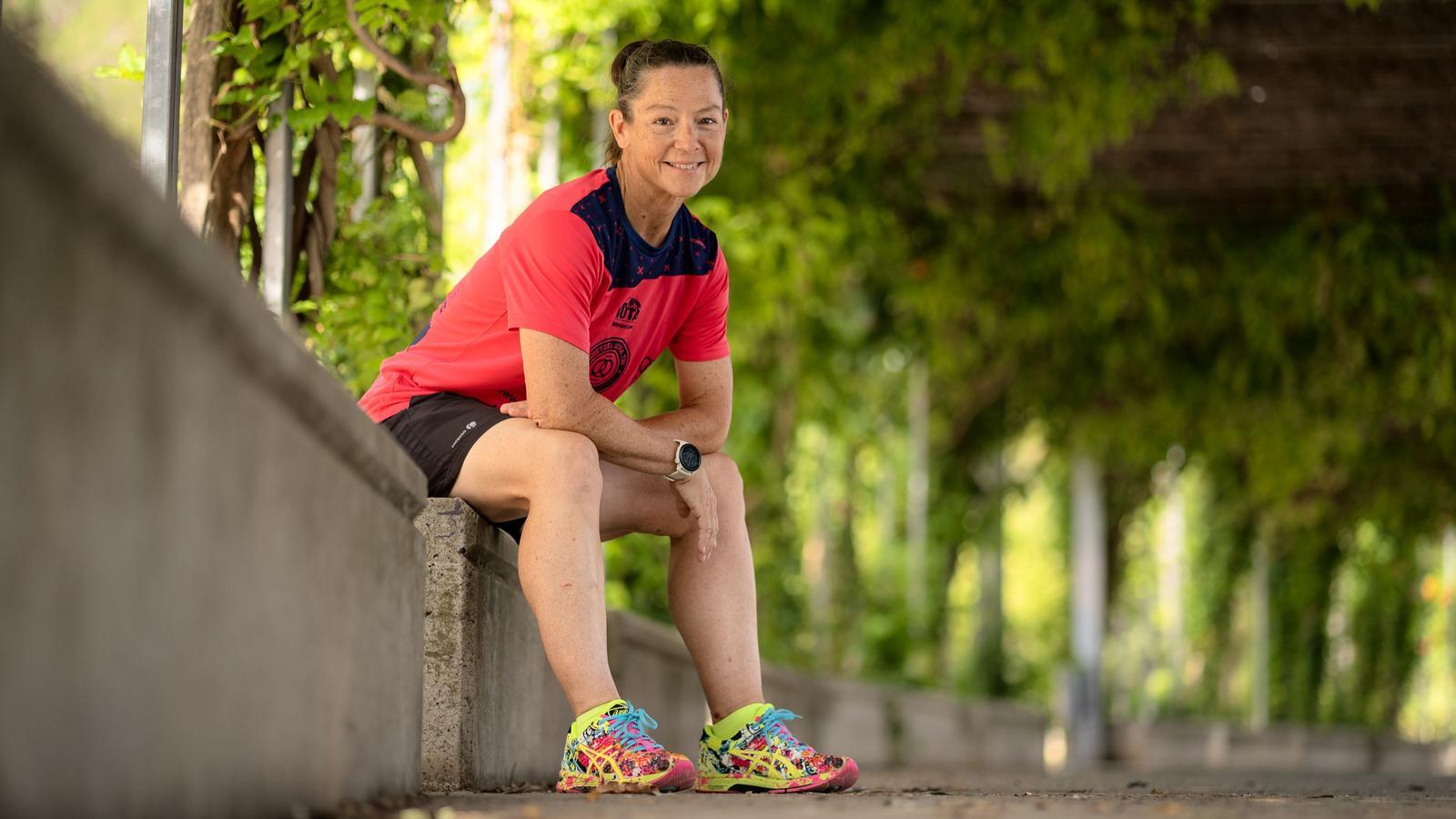
GironaWhen Jacky Camós explains her feat, it might be hard to appreciate. It's hard to understand and explain what this 55-year-old English teacher has done. "I've done a 6 Split," she says. "It consists of doing three long-distance triathlons on three consecutive days. And then doing a triple ultratriathlon," she adds. A feat that only ten people have achieved, among whom there is only one woman: her. Past thirty, she didn't do sports, but now she's breaking records with surprising willpower.
She has to explain her feat well to us.
— Understood. First, you need to know what an ultratriathlon is. It consists of swimming 3,800 meters, cycling 180 kilometers, and running 42 kilometers. In other words, a full marathon. Many people know it as doing an Ironman, which is a registered trademark. We can call it an ultratriathlon or long-distance triathlon. And then we can have tougher and longer formats, such as doing the same event on consecutive days. Or you can choose to do the equivalent of two long-distance triathlons continuously over two days. That is, first you do the 7,600 of swimming, then the 360 of cycling, and finally you do the two marathons. And finally, what I did, which is horrible, but also wonderful. This format is considered the most difficult of all, the 6 Split, six days of competition. It consists of doing three long-distance triathlons over three consecutive days. You do one and rest. The next day, a second one. And on the third day, the third. And then on the fourth day, the second part begins with three consecutive days of continuous racing. That is, first I swam the 11,400 meters, then I did the 540 kilometers of cycling, and then the three marathons. And I had 61 hours in total to do it. Six hours for the swimming, 42 hours for the swimming plus the cycling, and the rest to finish running. This combination is the worst, the one with the highest percentage of non-finishers, as they give you less time to complete the segments than in others. And fewer people make it within the cut-off time. I did it in Colmar, in Alsace, at the Bretzel Ultra Triathlon.
It seems like hell, six days like this. And being pending of a cut-off time. He has defined it as "horrible"...
— It's tough. You have to consider that you've just done three long-distance triathlons three days in a row. And then you start this. Yes, it's horrible. But at the same time, it was my dream. I knew that many people don't finish it, but I had set it as a big challenge for myself this year. And luckily, I haven't failed, so I won't have to do it again.
And what did he feel when he finished?
— Great happiness and a release. I thought it would be impossible, and look, I was able to do it. And I thought, maybe I'm not so useless after all. That's what I thought.
With the curriculum he has of completed tests, how could he think in these terms?
— Yes, it's just that I'm very... normal. I'm a mother, an English teacher at a high school in Salt. I'm not fast. I'm slow and I train as best I can. I go at my own pace and keep going, watching how others go faster. But I keep going. And I don't give up easily. And if I don't manage to finish, at least I've tried and given my all.
How does a normal housewife from Girona like you start doing these tests?
— I started doing sports about ten years ago.

Before you did nothing at all?
— No, beyond going for a run now and then. In July 2016, exactly ten years ago, I started training continuously. I was 45 years old. I weighed 30 kilos more than I do now. It was a key factor. I made a change in my eating habits, I lost weight over a whole year and very progressively I made a change in my habits. And I started doing sports because I like it a lot. And I don't know, I got hooked. One thing led to another. I did the first Ironman thinking it would be just one and that's it. And that planted a seed. Then I discovered by chance that there were races in which you could do two Ironmans two days in a row... and I also finished the first double. When I finished, I told myself I wouldn't do any more. No way. But I quickly wanted more.
What does it bring?
— It makes me happy. It's also a way to channel all the stress we have. I do it, I suffer, I say I won't do it again, but I need to do it again. It's like an addiction. An addiction like anyone can have... some go one way and others another.
His addiction is more surprising than others...
— Agreed. But one of the things that has attracted me the most and made me return is the community. The people who do these tests are great, everyone helps everyone. And everyone is congratulated for the effort they have made, including those who don't finish. If you don't finish, they respect you just the same. I train alone due to my schedule, so when I compete it's nice to find people. It strengthens me. I'm a very normal person and usually, I don't explain what I do to people either.
What do the students from Salt say?
— When they have seen things in the press or on social media, they tell me about it. They are in primary school and perhaps they don't quite understand the distances. Sometimes one comes up and tells me that his father has told him that I am very strong. And it's emotional, as I consider myself quite normal.
How is it done to train?
— For example, during the school year, I take a swimming course two days a week. This way I force myself to swim. Many days I leave school and go running. And on the weekend, I take the opportunity to go cycling. Adding up. Consistency is key. Obviously, I'm human and there are many days when excuses win, but in general I'm consistent.
When facing these challenges...how and when does one sleep?
— You sleep in spaces with tents. I sleep about three hours. Three hours to eat, shower, and sleep. Only three hours, because since I am slow, I need more time competing to pass the cut. Whoever is faster can sleep seven hours.
During these tests... what's going through their mind?
— Everyone asks me this. Many things go through your head. I fix the world and mess it up thirty times. I think what I would say to this person, to that one. I think what the heck I'm doing here. Then I also think I don't deserve to be here. Sometimes a song gets stuck in my head and you sing it a thousand times on repeat. Many times one thinks mainly about the low moments, which there always are. You remember people who have hurt you or who are no longer here...
And what challenges remain to be done?
— Now I have another continuous triple in northern Germany. And then I have a 50 km race... and at some point I want to do a continuous ten, which would be ten long-distance triathlons in two weeks. First you swim the 38 km, then you cycle the 1,800 km and finally you run the 422 km. If it fits with work, it would be the challenge of summer 2027. Some are held in Brazil or South Africa, but for me they are too expensive. But in 2027 one fits me in Poland...
What would I tell Jacky from fifteen years ago who didn't do sports?
— I think I would tell him: "I wish you had started exercising sooner".

