The Real Madrid supporter with a bad memory who threatens Flick's Barça
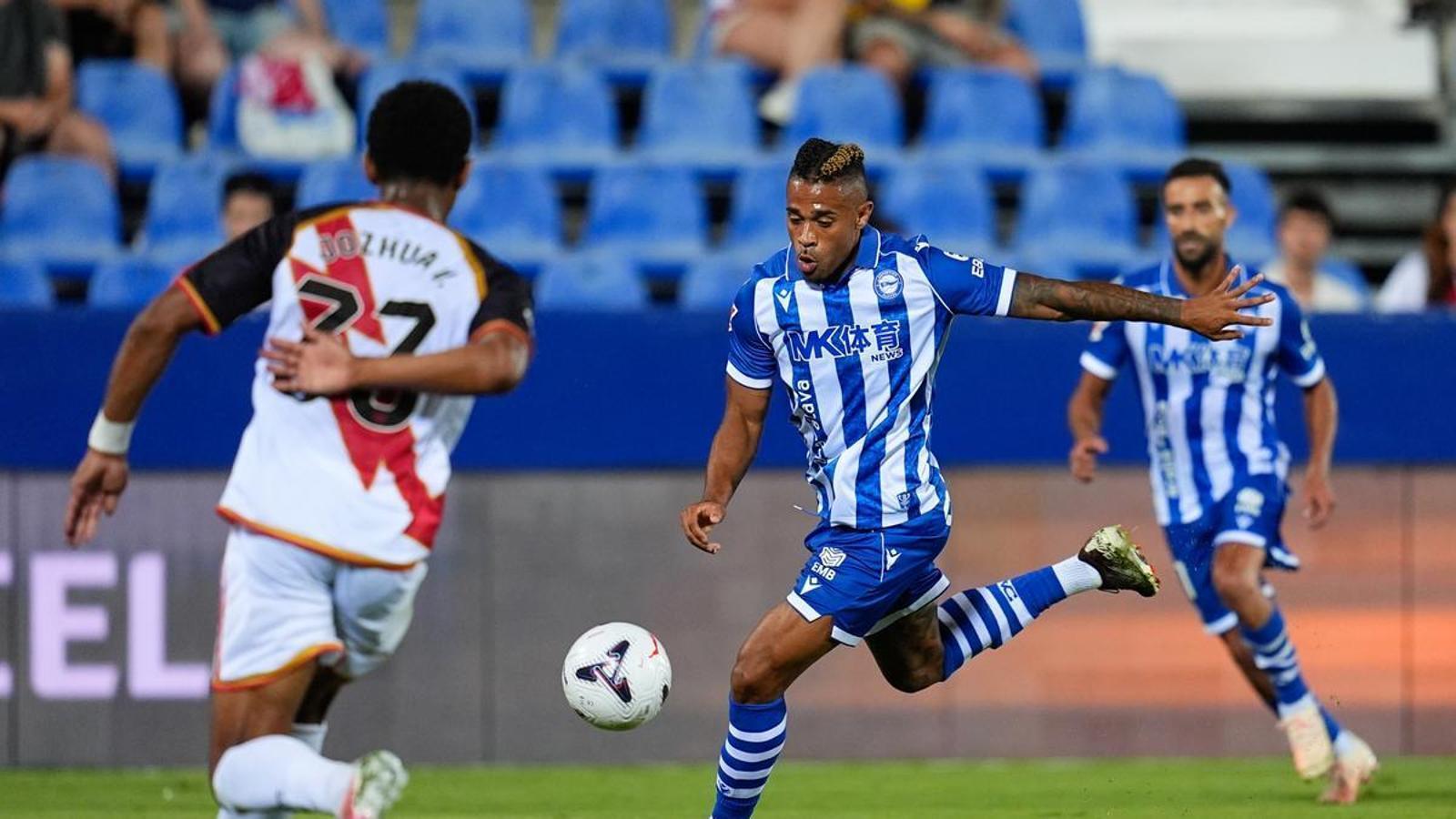
The Catalan Mariano Díaz has recovered prominence with Quique Sánchez Flores, coach of Alavés, the next rival of the blue and reds
-
CAT -
CAST
BarcelonaMariano Díaz (Premià de Mar, 33 years old) has once again found his place in elite football. After years marked by injuries, a lack of minutes, and a career defined by inconsistency, the Alavés striker has regained his prominence in Vitoria. The club was open to a possible departure in the summer, but Mariano did not want to leave. A few months later, the Dominican Republic international has accumulated three goals and four assists this start of the championship.
"Fundamentally, it is a question of mentality," explains Raúl Pando to L'ARA, a journalist from Radio Euskadi who follows Alavés' current affairs. According to him, the coach Quique Sánchez Flores has been the one who convinced the striker that he can be important: "He has an undeniable quality, but he must be mentally prepared, integrated into the group's dynamics, and predisposed to help the team." The change contrasts with last season, when Mariano barely counted for Eduardo Coudet and ended up being sidelined from the team's dynamics.
This summer the club would not have looked unfavorably upon a departure if a significant financial offer had arrived, but neither was it a priority to get rid of him. Quique, who already knew him from his time at Sevilla and at Madrid's youth academy, opted to recover him. "He has managed to put him back into the group's dynamics," summarizes Pando.
Mariano's evolution
Manolo Romero, who worked for nearly two decades as a scout for Real Madrid in Catalonia, was one of the key figures in Mariano's arrival at the white club at just 18 years old. He discovered him when he was playing for Badalona, after Espanyol had discarded him due to his height. He admits to L'ARA that he had gone to see another footballer, but Mariano convinced him with his profile as a forward: "He was very aggressive, very good in the air, and had a great goal-scoring instinct. Perhaps he wasn't as technically gifted as others, but he had characteristics that we weren't finding at Valdebebas".
Mariano would stand out years later in the reserve team under Zinedine Zidane and would reach the first team. After a great season on loan at Olympique Lyonnais, Madrid brought him back in 2018 and gave him the number 7 jersey of Cristiano Ronaldo, who had left for Juventus. But his second spell was overshadowed by a lack of minutes. "He was very much a Madrid fan and it was very hard for him to leave. He always thought that if he went out on loan and had a good season, he could return," recalls Romero, who advised him to take advantage of the few opportunities he had. His goal in the March 2020 El Clásico, which sealed the La Liga title, was one of the most notable moments of that stage, but he did not have consistency.
Romero considers that muscle injuries have been one of his main obstacles. However, he also sees a footballing evolution: "He has improved a lot in reading and understanding the game. Now he knows how to manage the tempo and do more things than he didn't do before". He also highlights his physical improvement and his commitment to the team's pressing, but he does not believe he has returned to his best, although he maintains the qualities to be decisive. "If he is physically well and regains his confidence, he is a forward who can create many problems," he warns.
A game-changer with unfinished business at the Camp Nou
At Alavés, Mariano has found a role that allows him to take advantage of his virtues without having to shoulder all the offensive responsibility. He competes with Lucas Boyé and Toni Martínez, two strikers who can also have a prominent role, and so far he has proven especially useful off the bench. "He contributes more as a spark plug than as a starter," opines Pando. His good run of form has also translated to the Dominican national team, with whom he has scored again after years away from international commitments.
The immediate challenge, however, will be collective. Alavés arrives at the Camp Nou after six matchdays without a win, a streak that, according to the Radio Euskadi journalist, reflects a decline in the team's general level: "Errors are being made in both areas and some of the offensive effectiveness they had at the beginning of the season has been lost". The duel will also have a special component for the Catalan striker, trained at Espanyol and a declared Madridista. This weekend he will return to face the blaugranes at a time when he has recovered part of the football that had been hidden over the last few years.

