Pedri's heir also dreamed of Barça
The interest of the blue and garnet club reinforced a comparison that Alberto Moleiro has left behind
-
CAT -
CAST
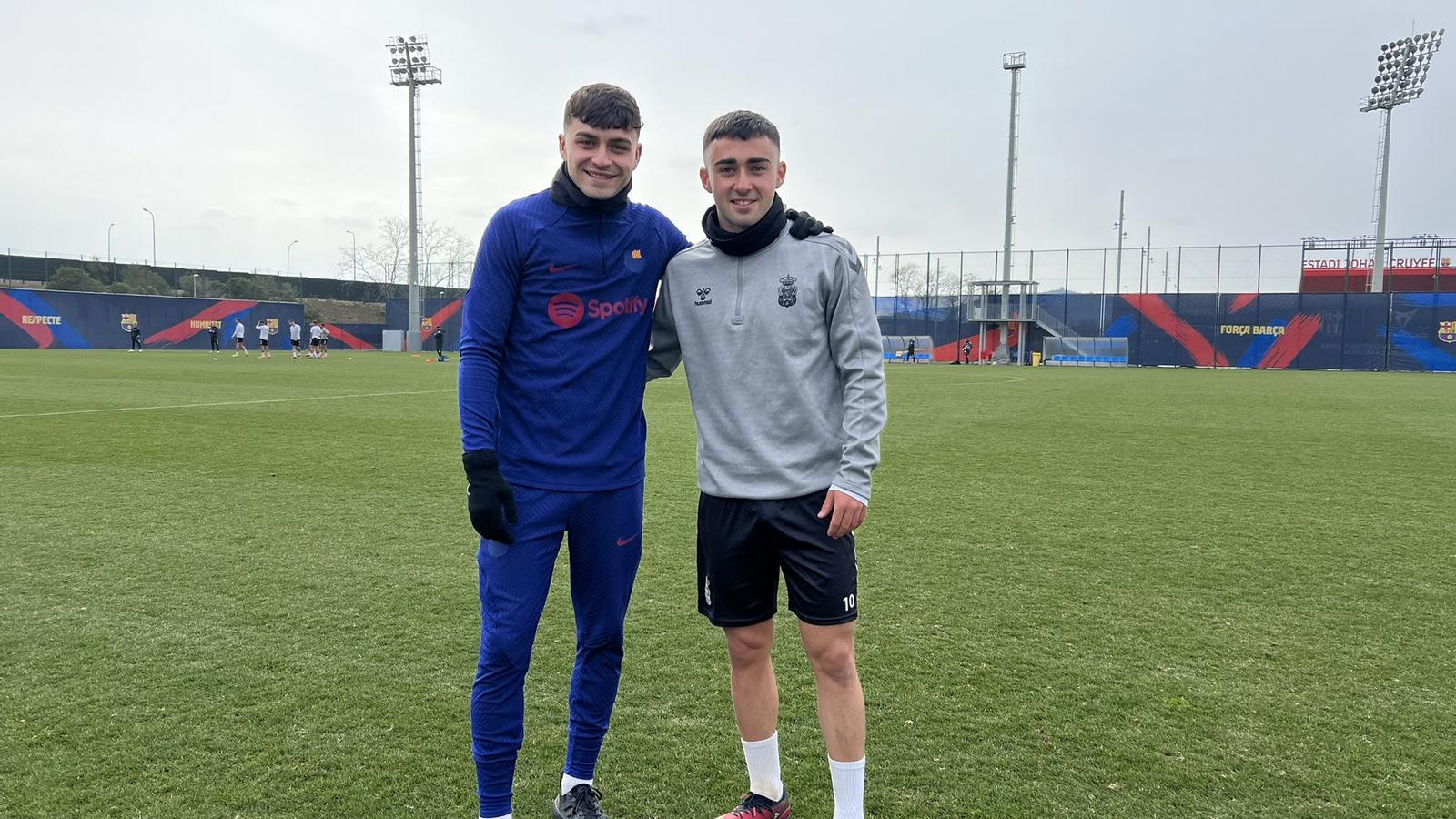
BarcelonaPedri and Alberto Moleiro will meet again on the pitch as rivals. The Barça and Villarreal midfielders share a past that began long before reaching the First Division: both were trained at Las Palmas, where they lived together at La Casa Amarilla, the La Masia of the Canary Islanders. When Moleiro began to stand out, the comparison with Pedri appeared inevitably.
Pedri had been the first to make the leap. At only 16 years old, he had already convinced the Las Palmas coaches and, shortly after, Barça bet on him. Moleiro appeared later as a new jewel of the Canarian institution and for a time carried the label of being his successor. Barça's interest in him did exist and Moleiro himself has admitted that playing for the blue and garnet club would have been a dream. This Sunday they will face each other in a League match at the Camp Nou (2:00 PM, DAZN).
The first impact
Pedri started training with Las Palmas' first team during the preseason and Roberto Ríos, then Pepe Mel's assistant, immediately detected that there was something different. “In the first possession drill we did, we already saw he was distinct. I remember telling Pepe: ‘Either this kid is very good or the others are really off.’ He had a spectacular training session,” explains the former international footballer to the ARA newspaper.
That first impression was not limited to Pedri's technical quality. Ríos also detected the ability to stay calm. “He knows how to stay calm and not let the pressure get to him, and he demonstrated that from the age of sixteen.” To this serenity, he adds other qualities he already showed back then, such as mastery of both legs, the ability to control spaces, the precision to always deliver the ball in an advantageous position, and a great willingness to work.
When Pedri left for Barça, Ríos was already clear that the blue and garnet club was taking a special footballer. Therefore, before the midfielder arrived in Barcelona, he spoke with José Ramón de la Fuente, Barça's goalkeeping coach, to tell him what they would find: “I told him that he would surprise them, that he was a very special kid.” Some time later, De la Fuente returned his call to acknowledge that that first impression had been spot on.
Moleiro, in Pedri's shadow
Eric Curbelo and Álvaro Lemos, former teammates of Pedri and Moleiro at Las Palmas, recalled in statements to ARA what both were like when they were starting to make a place for themselves in the first team. Curbelo is clear: “Moleiro is more electric, while Pedri is more consistent and provides more stability”. Despite sharing that ability to find the final pass, he explains that Moleiro stood out above all for his dribbling: “He had sparks in which, in one or two consecutive plays, he would beat two or three opponents and was capable of making a good pass from different positions”.
Pedri, on the other hand, impressed him with a very specific quality: “When you passed the ball to him, he made the perfect first touch so that the defender didn't even have the option to try to steal it”. For the defender, this difference also helps to understand the weight that the comparison had on Moleiro. “It wasn't good for him that everyone constantly compared him to Pedri, because it was a pressure he didn't deserve”. According to Curbelo, Moleiro has needed time to leave that label behind and find his own style of football.

Lemos also lived with both of them and focuses on another characteristic of Moleiro: “Bravery and audacity. Whenever he had the ball, he tried to play forward with great daring”. From him, he remembers a footballer who could adapt to different positions, from the wing to more interior zones, and who took on more responsibility in attack each time. When he talks about Pedri, on the other hand, he highlights above all his ability to control the game: “The control of the game that Pedri provides and the good judgment he brings to everything he does are in an abysmal category”.
This difference in profiles is precisely what makes Lemos not consider that Las Palmas lost so much when Pedri left. “Going from Pedri to Moleiro did not mean such a big loss”, he asserts. The Canarian had another path and a more progressive evolution, but he already showed his own characteristics. He also highlights his ability to attack, break lines, and look for the final pass.
Barça's interest
The comparison with Pedri went beyond their origin and career path at Las Palmas when Barça showed interest in Moleiro. The Catalan club followed him closely and even presented an offer that the Canarian entity rejected. The situation, however, was different from what Pedri had experienced: Las Palmas did not have the same need to sell and was able to keep the footballer.
Moleiro has explained that his agent informed him that Barça had presented an offer for him. At that moment, Pedri, who was already in Barcelona, was also pending to see if his former Las Palmas teammate would end up following the same path and asked him if he was going to go to Barça. Finally, however, the operation did not materialize and Moleiro stayed with the Canarian team, where he continued his growth process.
In the history of both, there is a certain parallelism. Barça detected Pedri's talent when he was still an adolescent and, a few years later, became interested in Moleiro when he was beginning to stand out. At that moment, the current Villarreal attacking midfielder found himself in a situation that Pedri had already lived through, but, unlike his former teammate, he forged his own path until he ended up being a reference point at La Ceràmica.

