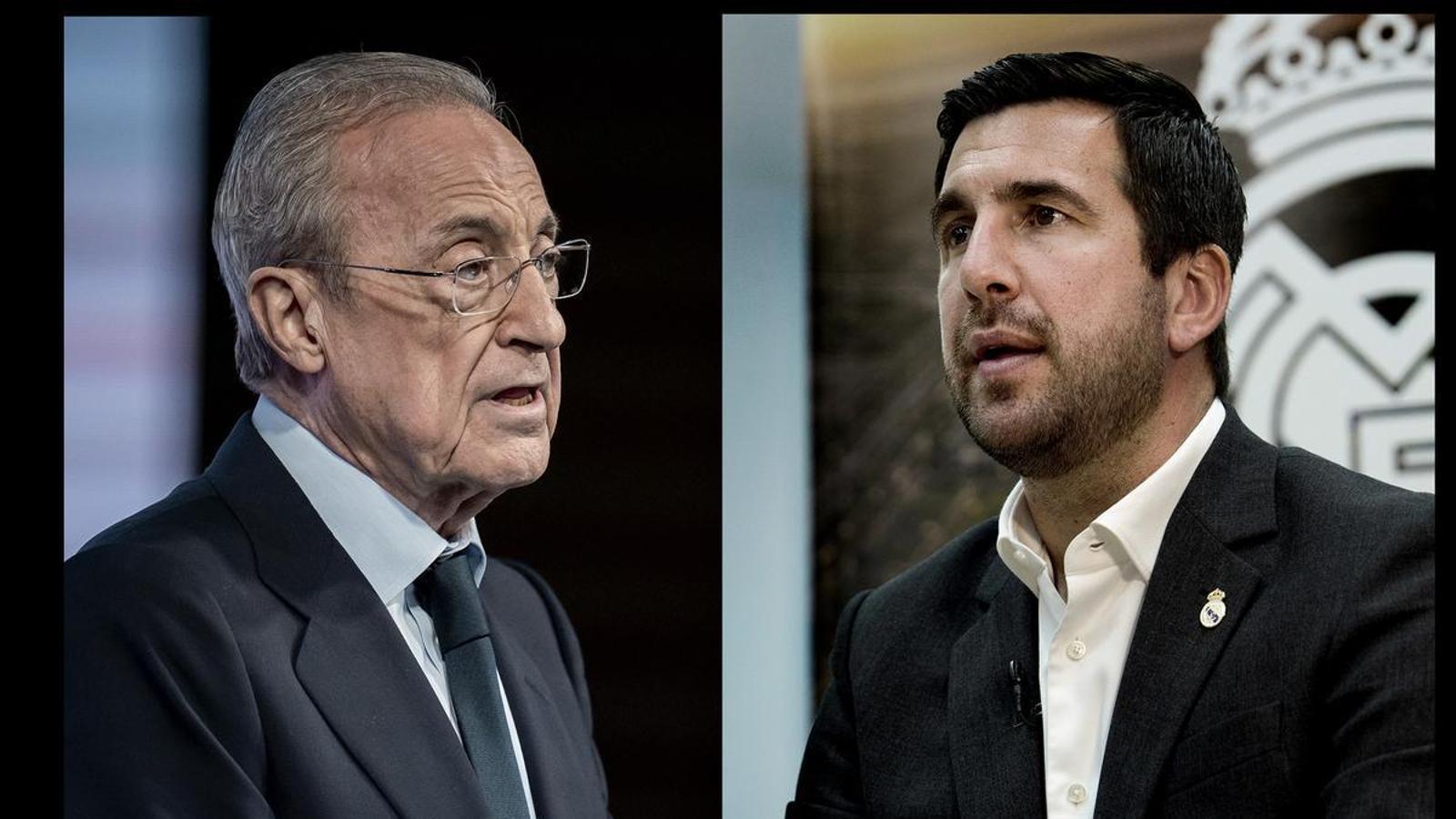
Florentino against Riquelme: the elections that will forever change Madrid
The first elections in the club in 20 years open the door to changes, whether Florentino Pérez or Enrique Riquelme wins them

-
CAT -
CAST
MadridFor some time now, Spanish politics has been immersed in a permanent electoral campaign, due to the calling of elections at the state, autonomous community, or municipal level. On the other hand, they cannot say the same for the world of football and, in particular, for Real Madrid. Twenty years later, the Whites are holding elections this Sunday and the campaign has suggested that, whatever the result, it will inevitably mean a mutation of the club: Florentino Pérez, president since 2009, has opened Pandora's box of ownership by rolling out the red carpet for a private investor. Meanwhile, Enrique Riquelme, his first opponent in history, has emerged as a critique of the model of recent years, promising a sporting structure that is "serious, modern, and profoundly madridista" and capable, he says, of leaving behind the low points the white team is going through. He has also promised a way of governing that is "transparent" and "more democratic." During the campaign, there has, of course, been talk of players and coaches. The candidates have promised the signing of great players, but depending on what happens, Madrid will experience very profound changes off the field.
But let's take it step by step. The fact that these elections at Madrid represent the first challenge Florentino has had with anyone to be the club's maximum leader has directly resulted in strong media expectation and his presence in the media, something unusual for the current white leader, who had not flirted with a format like an interview for years – in 2024, the Association of Journalists of Economic Information (APIE) awarded him the 'secant' prize again, an award for executives who are known for being opaque or for not making public appearances with a question-and-answer session.
The taboo of ownership
It has been in these comings and goings in the media, but also on social networks, where, in addition to promising star signings, both candidates have shown off to the members of the sports and business project they aspire to. And Florentino has confessed for the first time in public that he intends for not only the members to own the club. "The way to know what Madrid is worth is to sell a minimum part," he stated in an interview with El País. Forbes gave it a value of 9.5 billion dollars (about 8.2 billion euros) a few days ago.
Thus, the current president has opened the can of worms in one of the few teams in the State that is not a public limited sports company (SAE) – neither are Barça, Osasuna nor Athletic Club –. All of them, including Madrid, belong exclusively to their members. However, the entry of private capital ("private equity, in business jargon) makes it difficult for this to continue to be the case, although Florentino has assured that he would seek the legal fit for the members to maintain ownership. He also said that the private investor would not have political rights and could buy at most between 5% and 10% of the club. All this has served Riquelme as a campaign argument: he accuses him of wanting to "sell" and "privatize" the club.
While the model is not unusual in many professional leagues – in fact, US private equity firms are heavily investing in European football – there are those who, in Madrid's case, see it as "complicated," reflects Albert Fernández, one of the directors of the IESE Sports Management Center. This business school professor raises the question of who and why would put millions into a company, Madrid, over which they would have no political rights or decision-making power, according to Florentino's explanation. "I would ask for a dividend policy or the ability to sell [the stake] in the future, when I have obtained a return," adds Fernández in a conversation with ARA. There is also the possibility of seeing "intangibles" as attractive. For example, the Real Madrid brand generates indirect income. "However, this requires a negotiation on how to use the club's image externally," points out the IESE professor.
And what could lead the current president to open this debate now, in the middle of an election where he precisely needs the support of the almost 70,000 members who have the right to vote. In general, there are two reasons why professional clubs seek these investors: either because they have economic problems due to high debt, or because they want more income to make big signings and be more competitive. After all, the value of a football team is mainly its players, and if they don't deliver results, the value plummets. During the campaign, Florentino has promised the "most expensive signing in history" for Real Madrid – he has put it at 150 million euros – which he plans to announce on Tuesday.
Influence and power
Beyond the economic tug-of-war, which has been one of the campaign's major battlegrounds, especially because it touches the core of the role the members have in the club, the elections have brought to the fore the presidentialist weight of a team that has been led by the same person for over twenty years. "It is very difficult to distinguish between Madrid and Florentino, and he plays on that," indicates a business voice.
If Riquelme won the elections, Madrid would open a completely new era. The 37-year-old businessman –Florentino is 79– cannot play the title card, but he has tried to play the signing card, at least in the form of a promise. Riquelme has announced that he wants two Manchester City players: Haaland, even though his agent has denied it, and Rodri. At the same time, he boasts about the list that will accompany him on the board of directors, which includes names like the son of the former Real Madrid president, Vicente Boluda. He has also bragged about those who will have a leadership role within the club: Raúl, Hierro, Casillas, and Vicente del Bosque. "We want a model that combines signing galacticos and creating galacticos", stated Riquelme, who has not hesitated to look into the past. This is one of the few things on which he agrees with Florentino, who, 13 years later, has announced the return of José Mourinho.
Approximately 70,000 members have the right to vote: those who have been members for more than a year and are of legal age. The elections will not be held at the Santiago Bernabéu due to the Pope's visit, so members will vote at the Valdebebas sports city between 9 a.m. and 8 p.m., when it will be known what the Madridistas have decided.
