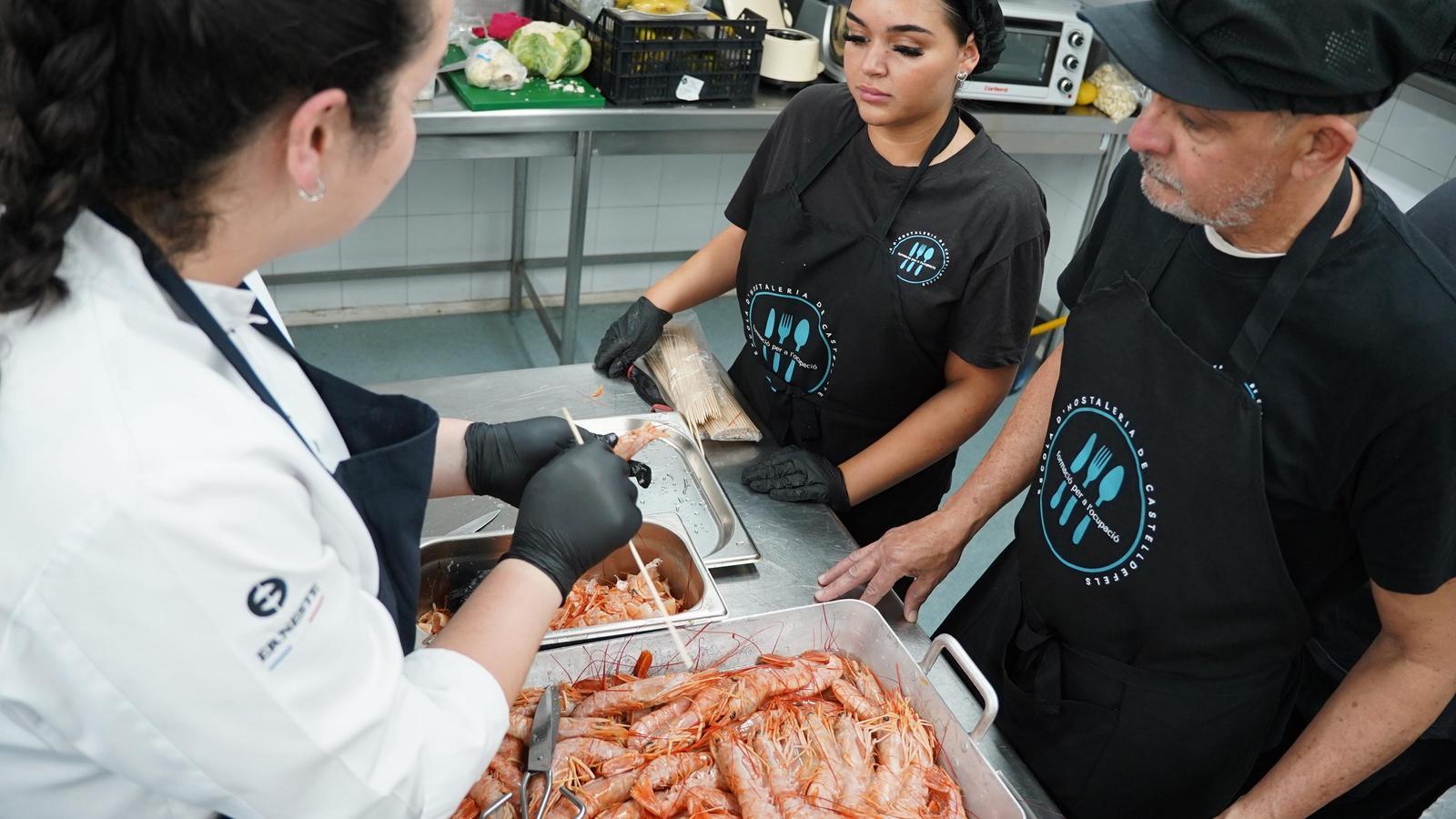
The Castelldefels Hospitality School prepares future professionals of the sector with training programs designed to meet the needs of the students and the sector within a context of growing demand
3 min
The school's cooking classes are eminently practicalEscola d'Hostaleria de Castelldefels
The hospitality sector has consolidated as one of the pillars of the business fabric, and initiatives like the Castelldefels Hospitality School demonstrate the importance of having quality training, oriented towards professionalization and talent development. Its training model contributes to preparing future professionals in the sector with its own methodology and an offer adapted to market needs.
The sustained increase in demand for places highlights the need to expand and strengthen this educational project. In this context, the Castelldefels Hospitality School becomes a benchmark thanks to its training programs designed to meet the needs of students and the sector.
"The hospitality sector is experiencing a significant change of cycle. For years it was the place where those who couldn't find any other outlet ended up, and the sector paid the consequences: lack of commitment, high turnover, and a bad image. Now companies understand that if you want real professionals, you have to treat them as such and they are beginning to demand a certain level, value training, and offer better conditions," explains Raimon Martínez González, general director of the Castelldefels Hospitality School.
Practical learning, specialized teaching staff, and orientation towards employment are the three pillars of a project that aims to respond to the real needs of companies in the sector. "The sector is regaining the respect it has always deserved, and we see this in the demand: more than 300 applications for 60 places in our latest Dual Vocational Training call. People are starting to see hospitality as a professional career, not as a temporary phase," emphasizes Raimon Martínez.
Dual vocational training and job placement
Based on eminently practical training, the school leads a transformation in both the educational and occupational fields. FP Dual students sign an employment contract from day one, train in reference restaurants and groups, and, in most cases, join these same companies once they finish their studies. In parallel, the school develops free programs for unemployed individuals financed by the SOC, as well as a professional pastry course also oriented towards entrepreneurship.
This year, the Castelldefels School of Hospitality closed the academic year and consolidated itself as one of the main gastronomic training centers in Baix Llobregat, with employment insertion rates between 80% and 90% in all its programs, and practically 100% in Dual Vocational Training. "Many enter without really knowing what to expect. And halfway through the training, something changes. They discover that it requires technique, judgment, and a real level of demand, that they have a knack for a profession they had never considered. This is what makes us most proud of our school: opening a door for you that you didn't even know existed, not just offering you an official certification," highlights Martínez.
The school's programs are aimed at very diverse profiles, from young people without qualifications to migrants, long-term unemployed individuals, those over 45, or women in vulnerable situations, and facilitate their access to the labor market through training and high demand for professionals in the sector.
The pastry course of the 'Inspira Method'.Escola d'Hostaleria de Castelldefels
Real training
"Dual Vocational Training students have a contract from day one and are paid from day one, with an average remuneration of 1,050 euros, while they train in leading hospitality groups such as Grup Soteras, Tiburon Group, or Grupo Lancaster. Employment insertion upon completion is 100%. And this week we are launching FOAP 2026. Summing up previous editions of FOAP, Forma i Insereix, and Dual Vocational Training, our SOC programs record an average employment insertion rate of over 80%. The results speak for themselves and are endorsed by the guilds we collaborate with: the Hospitality Guild of Castelldefels, Gavà, Sitges, and Vilanova i la Geltrú, who know firsthand the level of our students".
In fact, as the center's general director also explains, "a sector that values both life and technical experience has an inclusion capacity that very few sectors have". "That's why we work with very diverse profiles and the sector absorbs them all. Here we don't ask you where you come from. What matters is what you are capable of contributing".
New business lines
Looking ahead, the center is expanding its activities with new business lines: tailor-made training for hospitality companies, international programs in English, and gastronomic workshops open to all citizens, with the aim of strengthening the link between the school, the professional sector, and the territory.
The training proposal for tailor-made business training is based on workshops lasting between three and four hours for closed groups of up to fifteen people. The approach is simple: each company identifies a specific need, selects the most suitable training, and agrees on a date for its team to receive practical knowledge directly applicable to their daily activities. Thus, they acquire knowledge directly at the workplace.
Starting this June, registrations are open for the new FOAP courses, which aim to carry out training actions primarily for unemployed people, with new places for kitchen assistants and waiters. This is a program financed by the Public Employment Service of Catalonia — SOC, aimed at people who want to train in the hospitality sector, learn a trade with a future, and improve their employment opportunities.
'Inspira Method'
A proprietary program
The Castelldefels Hospitality School promotes the Inspira Method, its own pedagogical methodology that focuses not only on technical learning, but also on understanding processes and developing students' professional judgment. This model, born in the pastry program, is gradually extending to the rest of the center's specialties.