Understanding the rain: the importance of prevention, planning and common sense
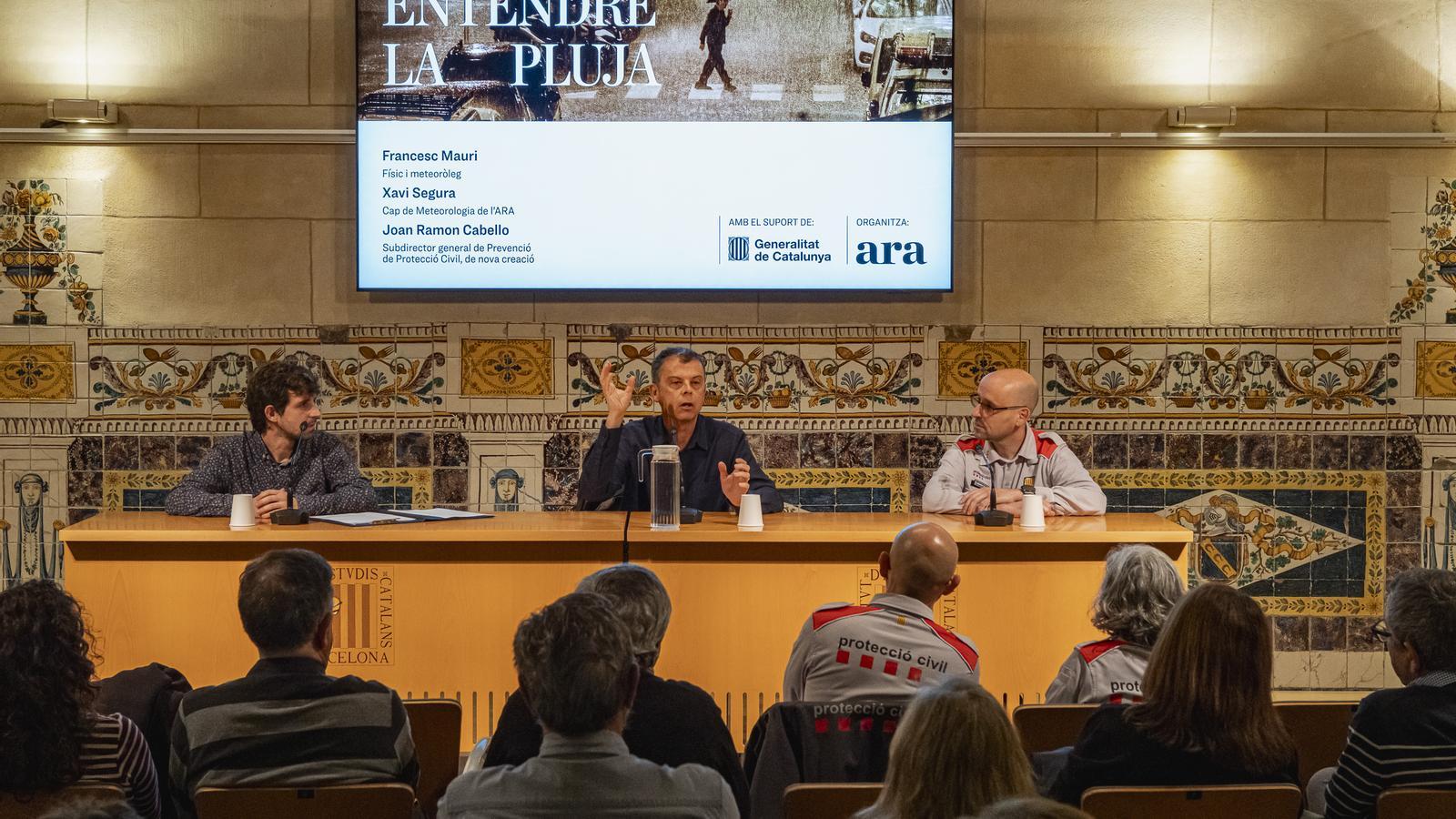
The meteorologist Francesc Mauri and the deputy director of Civil Protection Joan Ramon Cabello talk about the effects of climate change on our lives and the challenges of emergency management in a conversation organized by ARA and moderated by our weather man, Xavi Segura
-
CAT -
CAST
The Mediterranean is warming at an accelerated rate and episodes of torrential rain are increasingly testing the territory. But what makes some storms end in floods? ARA brought together, in collaboration with the Generalitat de Catalunya, meteorologist Francesc Mauri and the deputy director of Civil Protection, Joan Ramon Cabello, to analyze the new challenges posed by climate change, in a talk moderated by Xavi Segura, the newspaper's meteorologist.
In the last 50 years, the Mediterranean Sea has warmed by around 1.5 degrees, a particularly relevant piece of data given that it is an almost closed sea. The heat peaks reached this summer, the temperature records and the episodes of torrential rain, such as the DANA that had devastating effects in the Valencian Community, have stopped being small talk to become part of our lives, and prediction has become, in this context, paramount.
However, predicting exactly where a storm will dump rain is practically impossible. "Absolute precision does not exist, it has never existed and will hardly ever exist," warned Francesc Mauri. Meteorologists can define alert zones, but not specify where the most intense rains will fall. "Sometimes it is a matter of streets," he explained, referring to phenomena that can unleash "authentic walls of water".
The episodes are increasingly isolated. That was the case with the recent downpours at the Roda de Berà campsite or in Granollers. "We cannot know if a storm will dump rain on the Plaça de Gràcia or in Sants" and "all this is occurring in a context of increasingly intense meteorological episodes, to which the possible arrival of disturbances of tropical origin is added," the meteorologist stressed.
Joan Ramon Cabello, head of Civil Protection, explained how emergency services are adapting to the new challenges and strengthening work on the ground. "We are lucky to have meteorological forecasts that allow us to anticipate important rainfall episodes. We always apply the precautionary principle. Faced with a red warning, we will not stop alerting the population, even if we have to assume that in one municipality the rainfall may be very intense and in another, much less." Although sometimes the predictions do not end up being fulfilled in some areas, "we must be prepared in case they materialize."
At Civil Protection, we work in a coordinated manner with the Meteorological Service and the Catalan Water Agency. ES-Alerts are a very useful tool in the event of flood risk. "You can't please everyone. We have received criticism for sending ES-Alerts, but there are also those who have positively valued this tool," acknowledged Cabello, who defended its usefulness, although work is underway to incorporate lower-intensity warnings to adapt the alerts to different risk situations.
Snow, heat, and super-Niño
Climate change not only brings more heat, but also more extreme meteorological phenomena, including episodes of intense cold and heavy snowfall. "Deniers will use this to say that there is no global warming," warned Francesc Mauri, but the increase in energy in the atmosphere can also favor more powerful storms in winter. "Snow will fall at higher altitudes, but this does not mean that we will stop having heavy snowfall," he explained.
"When 37 liters fall in just three minutes, the situation is practically impossible to manage. It is not enough to build larger sewers," warned Mauri, who also recalled that "science cannot always offer explanations with the speed that is demanded." As an example, he cited the recent alert for a possible DANA, with forecasts of torrential rains and winds of up to 200 km/h. "It was not speculation," he insisted, to defend the importance of prevention.
Hence the importance of adapting urban planning to climate change. "In the 70s and 80s there was disordered urban growth. Now we work with urban planning commissions to avoid new construction in areas exposed to floods or chemical risks," he explained.
The possibility of a super-Niño keeps experts on alert and, although there is no evidence that it will cause extreme phenomena in Catalonia, "we cannot rule out surprises," warned Mauri. From Civil Protection, Cabello assured that teams are preparing to face longer droughts, torrential rains, and increasingly intense emergencies: "We have grown, we have strengthened ourselves, and we continue to prepare," he stated. He also insisted on citizen responsibility: "Common sense, risk perception, and individual preparation are fundamental" to face the first hours of an emergency.
"In about 23 years, Barcelona and the Catalan coast could have an average temperature comparable to the current one in Malaga, and Lleida, to that of Seville, if we set aside the winter quarter. What will happen to the forests, the crops, the tourism model, or life on the terraces? What will we be able to grow in Lleida?", asked Francesc Mauri. "We started our lives in some conditions and we will end them in others. Even the children who today are ten or fifteen years old will live a reality very different from the one we know. That is why it is fundamental that everything we plan now we do well, thinking about the future and the effects of climate change".
