When a driver travels along the C-32 or crosses complex infrastructure such as tunnels, they expect one thing: for everything to work. That information arrives when it is needed and that, in the event of an incident, the responsible teams can act quickly.
What they probably do not see is everything that happens behind the scenes. Cameras, sensors, and digital systems constantly generate data about the road and traffic. The change is that this data is no longer used only to know what is happening. They can also help to better understand a situation, foresee how it might evolve, and make decisions sooner. It is the shift from a highway that reacts to a highway that learns.
The C-32, an infrastructure belonging to the Government of Catalonia that connects the Garraf, the Penedès, and the Barcelona metropolitan area and which is managed by Autopistas, is one of the places where this transformation is being put to the test. The corridor hosts Abertis' Future Road Lab, an environment that allows testing technologies in real conditions. The particularity is this: the laboratory is the highway itself. Solutions are tested on a road in service.
More eyes to understand the road
In order to anticipate, one must first understand what is happening. And to do so, one must observe better. Analytical video systems based on artificial intelligence allow for the analysis of traffic images and the identification of situations that may require the attention of professionals in control centers. The ZADAR project expands this observation capability from the air using drones that provide complementary information about the road network.
Cameras, sensors, drones, or connected vehicles are different sources of information for the same infrastructure. Their value does not lie in accumulating data, but in having a more complete vision of what is happening and what could happen on the road. But understanding what is happening is only the first step. The next question is whether this information can also be used to anticipate.
Can a highway help an ambulance arrive at an accident sooner? One of the tests of DIMOS 5G, a project developed by Autopistas with the i2CAT research center, has worked precisely on this scenario. Based on data from the road and connected vehicles, the test has trialed how to facilitate the passage of an emergency vehicle. In the scenario tested on the C-32, the solution allowed for a 20% reduction in the emergency vehicle's response time. It is a concrete example of how infrastructure data can help not only to understand what is happening, but also to improve the response to an incident.
Having more information about the highway, however, is not enough. The challenge is to relate data coming from different sources, interpret it, and convert it into useful knowledge for managing traffic. This is the function of TMaaS (Traffic Management as a Service), a technology developed by Autopistas to support control centers.
Its operation can be summarized in four steps: understand, predict, decide, and communicate. First, identify what is happening; then, analyze how the situation may evolve; next, evaluate which response is most appropriate; and finally, deliver this information where it is needed.
TMaaS is prepared to meet the needs of the connected car in the short term, and is already laying the technological foundations that will allow it to support autonomous driving in the medium term. This function connects sources such as sensors, cameras, and other monitoring systems to help professionals have a more complete view of what is happening on the road network and how an incident may evolve. It is like the 'brain' that connects the different pieces of traffic management.
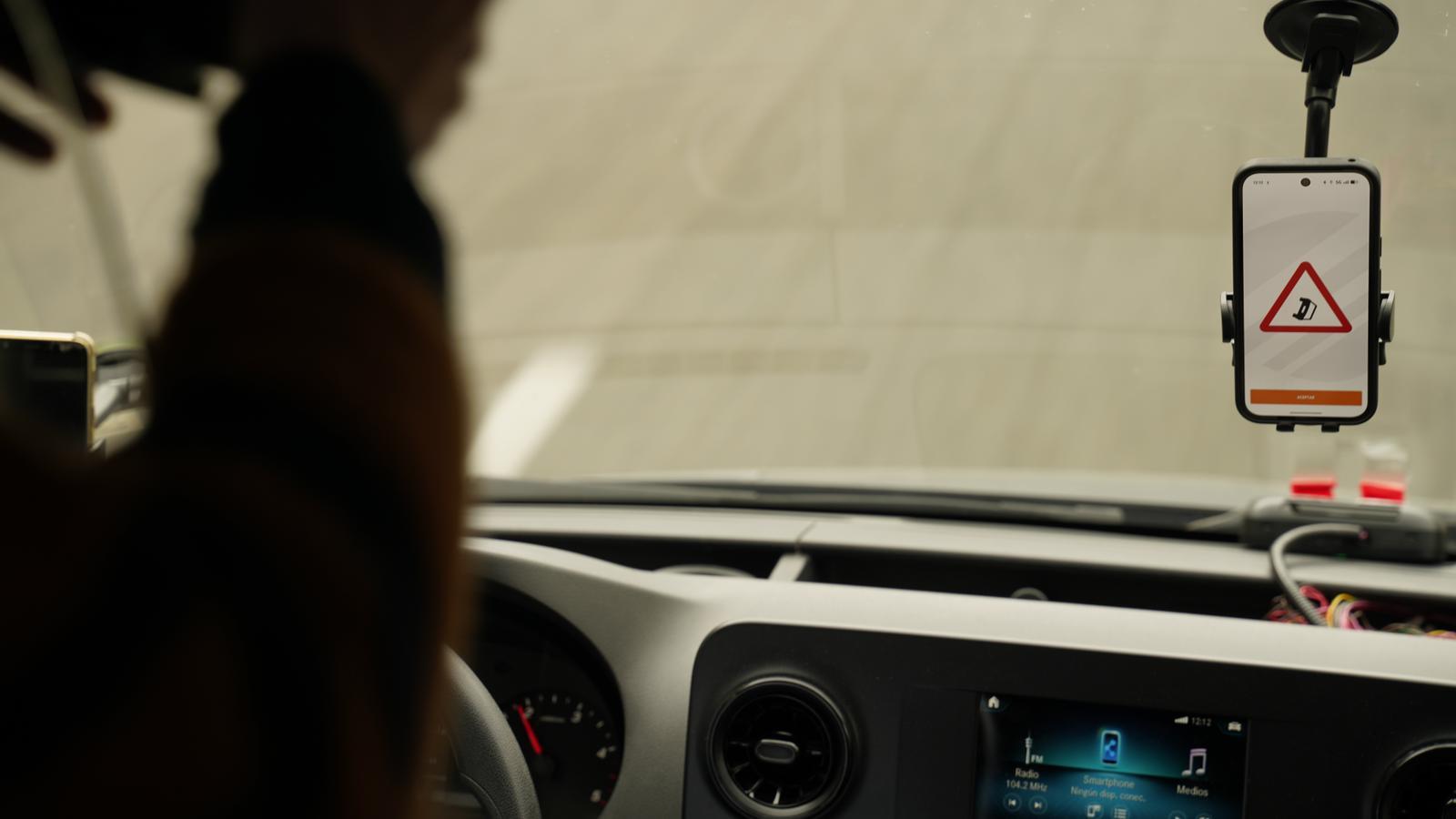
And deciding is not the last step. It is also necessary to communicate. On the C-32, Autopistas and SEAT S.A. have tested the sending of road safety alerts from the advanced traffic center of the Future Road Lab directly to connected vehicles. This same service logic also reaches AWAI, Autopistas' mobility app, which simplifies the journey, allows payment management from the mobile phone, and incorporates useful information for a more connected and safer driving experience. In this way, information that may affect traffic does not just stay in the control center: it can also reach the driver in advance.
An almost invisible transformation
The circle is completed by understanding what is happening, anticipating the evolution, deciding how to act, and communicating it. Anticipating can also mean something else: testing before acting.
Most drivers probably won't think about algorithms or communication systems while driving on the C-32 or crossing Vallvidrera. And they don't need to. The value of these tools lies in what they allow to be done: better detect a situation, assist an emergency vehicle, send an alert to the driver, or test a new configuration before applying it in a real tunnel. This is where it makes sense to talk about a highway that learns. Not because it decides on its own, but because it has more tools to understand what is happening, anticipate how it might evolve, decide on the best response, and communicate it. Because, in the face of an incident, the challenge is no longer just to react quickly. It is to have the necessary information to anticipate and act better.
TMaaS, the brain that connects the pieces
TMaaS connects different sources of information and transforms them into traffic management support tools: understand, predict, decide, and communicate.
The C-32 is both a highway in service and a real testing environment for new mobility solutions.
The great transformation is not visible to the driver: it is having more information to detect incidents and anticipate them.
Observe, anticipate, decide, communicate, test
- Observe and understand: Video analytic systems and the ZADAR project, using drones, expand the available information sources on traffic and infrastructure.
- Anticipate: A DIMOS 5G test on the C-32 has trialed how to use road and connected vehicle data to facilitate the passage of an emergency vehicle.
- Decide: TMaaS works as the "brain" that connects different information sources to help transform them into support tools for traffic management.
- Communicate: To communicate the C-32, road safety alerts have been tested that can reach connected vehicles directly from the Future Road Lab.
- Test before acting: Autopistas carries out pilot tests of all the applications and tools it develops and, once tested, transfers them to all the infrastructure it manages.