'Pau Casals, music for peace', at the Palau Robert
The exhibition vindicates the artist's legacy, coinciding with his 150th anniversary, and can be visited for free until January 10th
-
CAT -
CAST
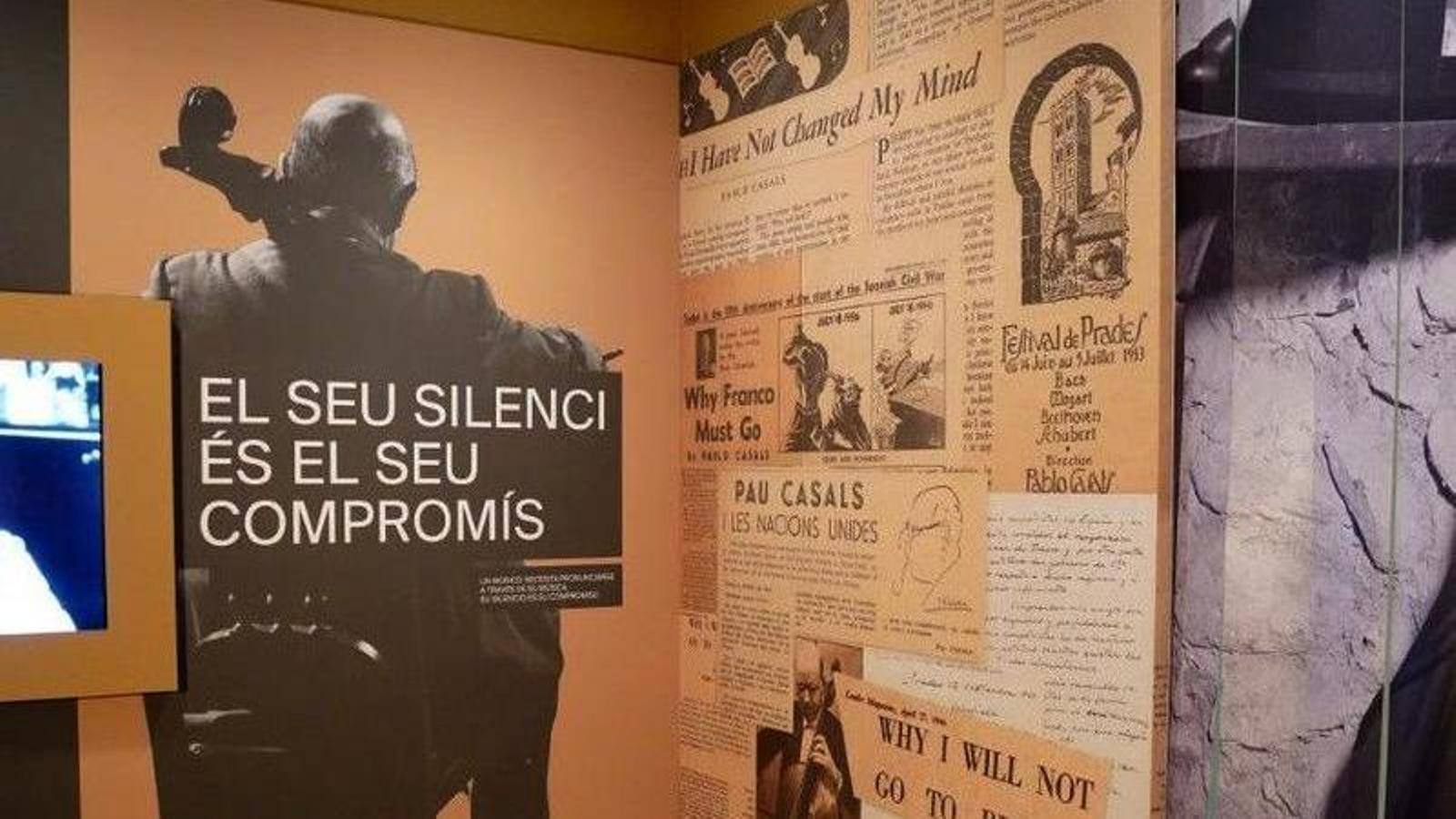
The exhibition celebrates the figure of Pau Casals and highlights the legacy of an artist who put his art at the service of peace. Curated by Núria Ballester, director of the Pau Casals Museum in El Vendrell, and organized by the Government of Catalonia, together with the Pau Casals Foundation and the "la Caixa" Foundation, it can be visited for free at the Palau Robert until January 10, 2027.
The exhibition project is part of the celebration of the 150th anniversary of the birth of this universal Catalan. The exhibition will also be on display starting in February 2027 at CaixaForum Madrid and from June to August at the Pau Casals Museum in El Vendrell, and has developed a teaching unit with the youth newspaper Junior Report, aimed at secondary schools.
The exhibition runs through room 1 of the Palau Robert and is structured into five areas. The first, which provides a chronological overview of his life through photographs and documents, introduces the figure of Pau Casals (El Vendrell 1876 - San Juan, Puerto Rico, 1973) and highlights his virtuosity as well as his commitment to freedom, democracy, and peace. Exiled after the Civil War, Pau Casals was always a tireless defender of human rights and world peace.
The second area explains, through documents, original objects, and two audiovisuals, the cellist's connection to music. For Casals, music had to move and awaken an authentic emotional experience, both in those who perform it and those who listen to it. Therefore, its purpose went beyond technical perfection. The Catalan artist revolutionized the way of playing the cello, perfected the technique of the bow and fingering, but at the same time wanted to transmit his inner strength and the spirit that is within the music.
The space also dedicates a place to the Suites for solo cello by Johann Sebastian Bach, which Casals discovered at the age of thirteen in Barcelona, and introduced to the general public, eventually turning them into iconic works of the cello repertoire.
The baton and the cello as a weapon for peace
The third block explores music as a tool for commitment and protest and asserts the social role of the artist. Casals used the power of his music to make his voice and message heard. He refused to play in countries where democratic principles were not respected, such as Soviet Russia, Nazi Germany, and Francoist Spain. At the end of the Second World War, he transformed silence into a form of protest against the attitude of the Allied countries towards the Francoist dictatorship, and he continued to help thousands of Republican refugees and those affected by the Great War. This humanitarian work is represented through large-format images with powerful statements such as: "The only weapons I have at my disposal are the baton and the cello".
In a fourth space, music is highlighted as a message of peace. Casals always considered music a universal language, capable of transcending the borders of language, politics, and nations. In the midst of the Cold War, the concern about the nuclear threat reinforced his commitment to international governance and the role of the United Nations. He was invited to perform there on three occasions, and his speeches and messages consolidated him as a global reference in defense of peace. A commitment that was also reflected in his participation in different international organizations.
In 1958, shortly after his first performance at the United Nations, he was nominated for the Nobel Peace Prize. A few years later, President John F. Kennedy invited him to play at the White House, a fact that further consolidated his international projection.
'The Manger'
In his final years of life, through the oratorio The Manger, he undertook a new tour that he called the Crusade for Peace, which took him to more than 50 cities around the world. In the room, The Song of the Birds is played, along with Casals' speeches at the United Nations in 1958, in favor of peace on the occasion of the premiere of the oratorio The Manger, the Freedom Award of 1968, for Hiroshima Day in 1962, and the one from Central Park in New York in 1973. One can also observe documentation such as Pau Casals' candidacy for the Nobel Prize, the letter from Kennedy thanking him for the concert at the White House in 1961, or the poem The Manger by Joan Alavedra dedicated to Pau Casals.
The exhibition concludes with reflections from personalities such as Albert Einstein, John F. Kennedy, Thomas Mann, Albert Schweitzer, and internationally renowned musicians such as Jean Sibelius, Zubin Mehta, and Isaac Stern. It also includes interviews with musicians such as Miklós Perényi, cellist and student of Casals; Joan Magrané, composer; Arnau Tomàs, cellist of the Casals Quartet; Mariona Camats, winner of the Pau Casals Award; Pablo Ferrández, internationally acclaimed cellist; and Antoni Ros Marbà, orchestra conductor. The activist Òscar Camps and the historian Joan Esculies also participate.
