GRAUSTIC places digital responsibility at the center of the technological future
During two days, professionals have shared reflections around six great areas: technology, industry and business; society and welfare; governance, ethics and responsibility; information, culture and critical thinking; infrastructures and digital sovereignty, and knowledge, research, talent and technological future
-
CAT -
CAST
The ICT Day in Catalonia, organized by GRAUSTIC on November 18th and 19th at the World Trade Center Barcelona, has placed digital responsibility and the social impact of technology at the center of the debate on the country's digital future.
Under the motto “Technology with purpose: the challenge of digital responsibility” and with the concept “In the age of omnipresenceAI”, the meeting started from an increasingly evident reality: artificial intelligence and new technologies no longer constitute an area separate from economic and social life, but are present in companies, administrations, education, health, industry, information, culture, and relationships between people.
Based on this observation, the Diada has sought to broaden the conversation. It is no longer just a question of asking what technology allows us to do, but also what we want to do with it, what we should not do, who should make these decisions, and under what criteria of responsibility.
During the two days, professionals from business, institutions, academia, research, and civil society have shared reflections on six major areas: technology, industry and business; society and well-being; governance, ethics and responsibility; information, culture and critical thinking; infrastructure and digital sovereignty, and knowledge, research, talent and technological future.
The debates have addressed issues such as the impact of artificial intelligence on work and talent, the future of education, the convergence between technology and health, European technological sovereignty, cybersecurity and defense, disinformation and the role of the media, robotics and automation, or the digital transformation of public administrations.
After the opening of the ICT Day by Josep Ramon Ferrer, Àngel Garcia, Vice President of the CNMC (National Commission on Markets and Competition), intervened. In his inaugural speech, he placed special emphasis on understanding technology before regulation: “Today’s regulation is the democratic shield that protects rights and freedoms against the law of the jungle”. At the same time, he added that technology does not have a purpose in itself, but rather we give it one. “Innovation with purpose, regulation with purpose and responsible citizens”, he concluded.

From the debate on immersion to experiencing the debate from within
One of the differential elements of this edition has been GRAUSTIC XR, a pilot experience with which the Diada has wanted to explore new forms of conversation and participation through immersive technologies.
Four years after the 2022 Diada placed the metaverse and new digital realities among its major areas of reflection, GRAUSTIC has revisited this debate from a different perspective: instead of talking about immersion, experiencing it.
During the experience, three speakers and 24 attendees equipped with virtual reality headsets shared the same digital environment and were able to interact during the conversation, while the rest of the participants followed the development of the experience through the auditorium screens. The initiative has allowed us to experience, in a real professional context, how virtual spaces can transform the way we communicate, debate, and share knowledge, simultaneously connecting the physical and digital space.
The speakers, Josep Ramon Ferrer, Alejandro Carballo and Jordina Torrents, have experienced what a congress of the future would be like and have set out the path to follow, the compass that guides us towards building a community based on technology.
“Technology is part of practically everything we do, and that compels us to broaden our perspective. Digital responsibility does not just consist of using technology well, but of asking ourselves what impact we want it to have on people and on society. With experiences like GRAUSTIC XR, we also want to do something very typical of the Diada: not to limit ourselves to talking about the future, but to experience it and generate spaces that help us understand it,” states Josep Ramon Ferrer, president of GRAUSTIC.
Alejandro Carballo, director of Vodafone for Catalonia and Aragon, has appealed for technological responsibility: “We have the obligation for technology to offer purpose, well-being, and equal opportunities”.
Before starting the first conversation, GRAUSTIC prepared a surprise with the presence of a special guest: Boira, a humanoid robot. The robot reaffirmed the main idea of the Diada, which insists on developing technology, but with a purpose at the center: “Let us be capable of walking together, let us make a path together, at the service of people. [...] I provide the hands and you (the humans) the purpose”.
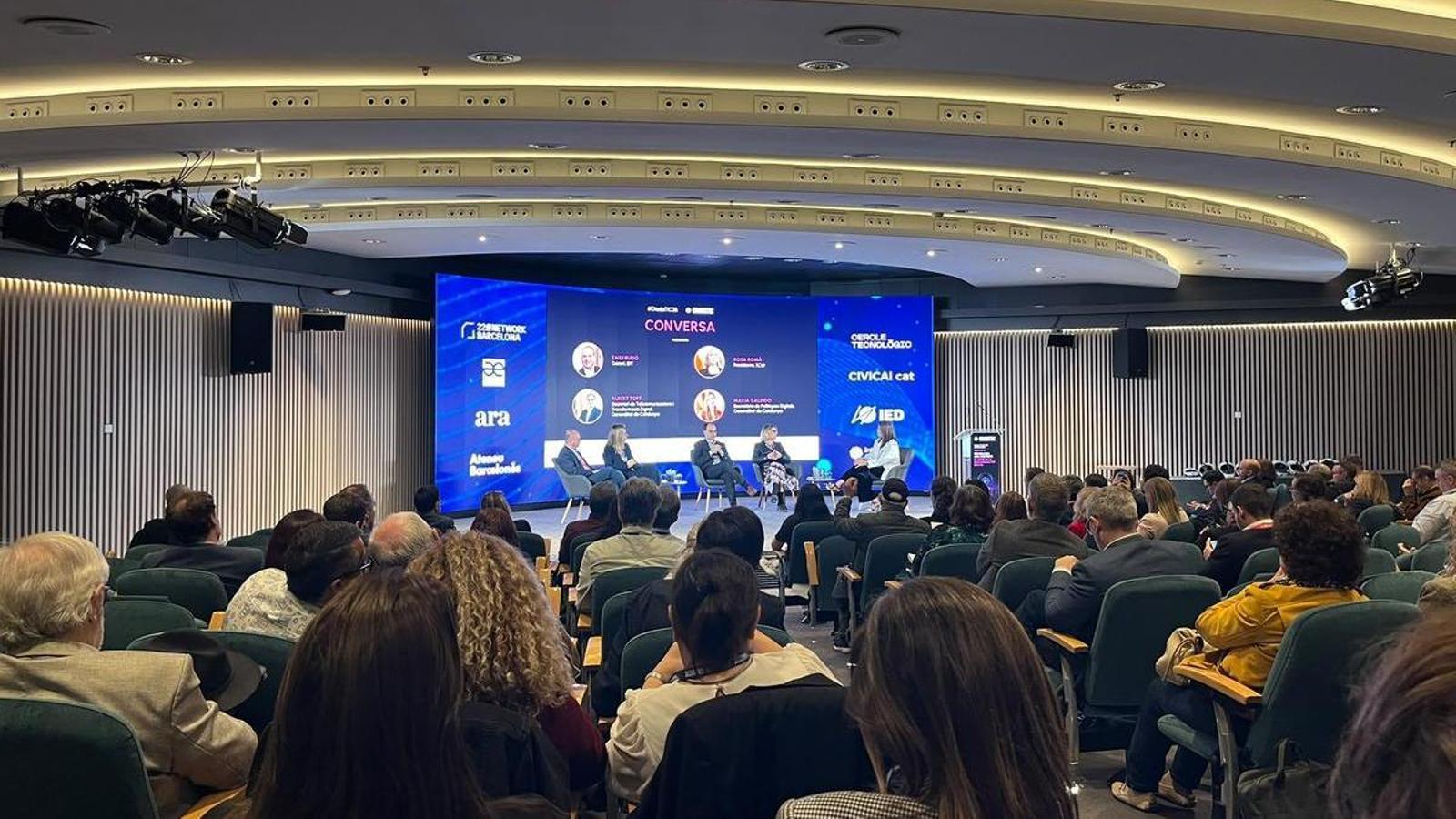
After the appearance of the robot, the first day continued with an initial conversation with Rosa Romà, Emili Rubió and Maria Galindo, moderated by Laura Aparicio. The speakers brought to the table issues of technological sovereignty; culture and critical thinking; governance, ethics and responsibility and cybersecurity. Emili Rubió, manager of the BIT (Barcelona Municipal Institute of Innovation and Technology), insisted on the importance of innovation: “Innovating involves certain risks, but what is important is to take these risks and it is what must distinguish us as a society. The purpose is well-being and improvement. If we do it ourselves we will be able to preserve our culture and our way of doing things”. On the other hand, Maria Galindo, Secretary for Digital Policies of the Government of Catalonia, highlighted the technological talent of Catalonia. “In Catalonia we have an ecosystem of research entities, cutting-edge innovation, and companies with a very powerful capacity for response. We all share these challenges and this vision that makes us truly unique”, she adds.
A National Day built with the digital ecosystem
The 2026 edition has also deepened GRAUSTIC's commitment to turning the Diada into a shared space for the entire Catalan digital ecosystem.
Several of the round tables and conversations have been promoted jointly with entities such as Innertic Experience, STEM Women Congress, 22@Network Barcelona, SECARTYS, the Cercle Tecnològic, Telecos.cat, Localret and the Energy Efficient Cluster of Catalonia.
The Diada also hosted for the first time an in-person meeting of the Cercle BarcelonaDOT, a digital community made up of more than 300 people who regularly converse about artificial intelligence, technology, and society. Under the concept "From chat to the agora," the initiative has moved a conversation born and developed in the digital realm to a physical space.
This combination of communities, disciplines, generations, and sectors responds to GRAUSTIC's desire to connect realities that often conduct their activity separately and to generate a common space between the technological world, business, institutions, knowledge, and society.
A good example of attempting to connect different realities was the round table that started from the idea “Growing up in the digital age: are we protecting our teenagers?” The table, moderated by Chelo Fernández and accompanied by Mireia Yter, Joan Manuel del Pozo, Sandra Ruiz, and Carlos Bajo, placed at the center of the debate how to help teenagers live with technology that increasingly conditions their way of relating, learning, informing themselves, and building their identity. Joan Manuel del Pozo insisted on the need to create a constant conversation and share the concern with the youngest ones, as well as fostering their autonomy in decision-making.
A conversation that continues after the National Day
The conclusion of the two days does not put an end to the open debates. GRAUSTIC proposes the Diada as the starting point of a conversation that continues throughout the year through the Diada RECAP, the GRAUSTIC Lunches, the working groups, visits to research and innovation centers, and other activities of the association.
Furthermore, the collaboration with the Ateneu Barcelonès will allow for continuity in addressing various issues raised during the Diada, transferring the reflections that emerged from the round tables to new spaces for conversation and opening them up to people from other sectors of civil society.
With this edition, GRAUSTIC consolidates the ICT Day as a transversal space to connect people and organizations, generate shared knowledge, and contribute to building a digital transformation that has a positive impact on Catalonia.
