The Spanish government gives figures about Ceuta: how many minors are still on the street?
Minister Torres speaks of 2,084 registered, but acknowledges that there may be between 700 and 1,000 minors still wandering through Ceuta

-
CAT -
CAST
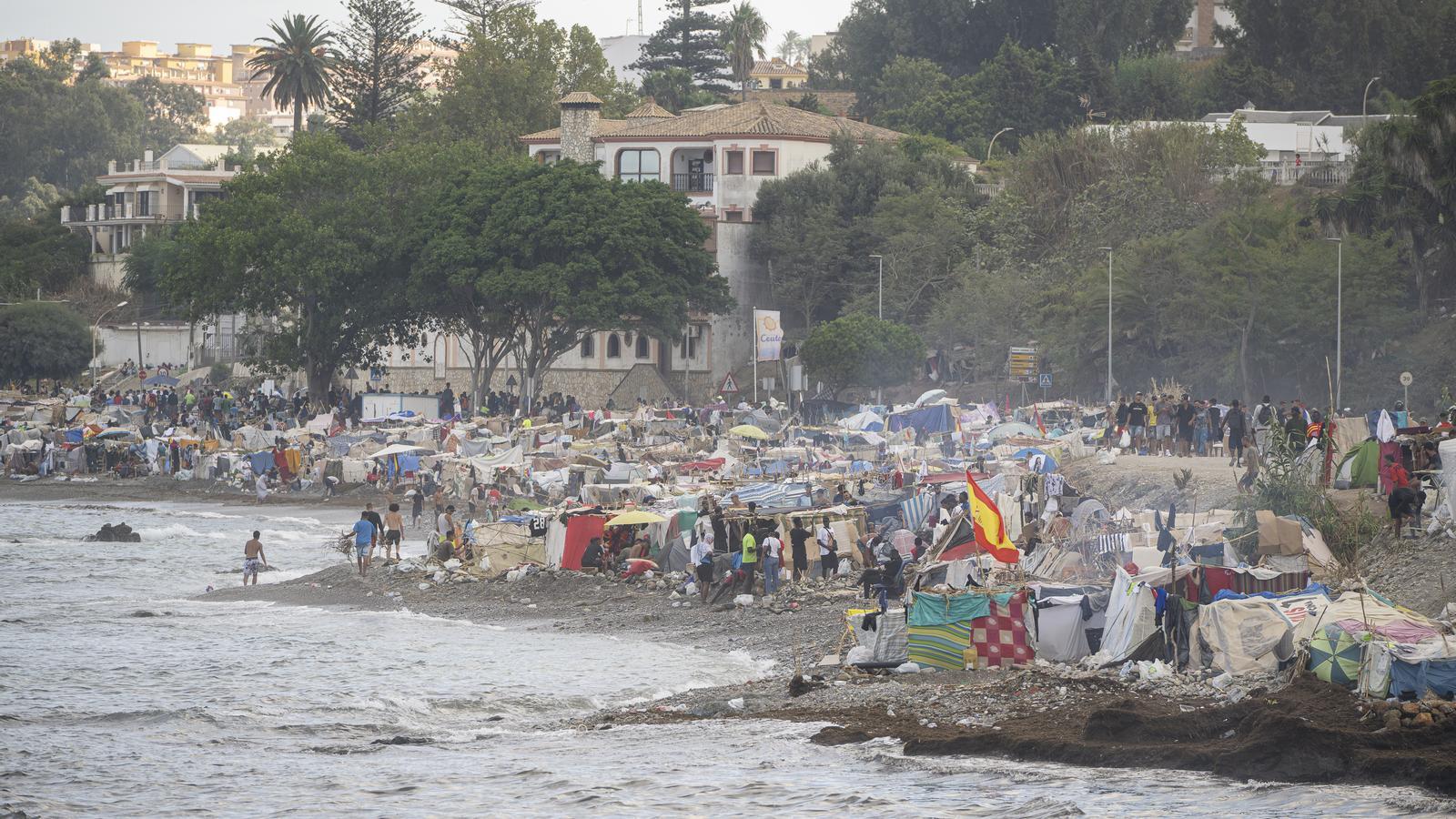
MadridThe Spanish government provided new data this Tuesday regarding the situation in Ceuta, despite the fact that on Monday the Minister of the Interior, Fernando Grande-Marlaska, avoided giving updated figures. It was the Minister of Territorial Policy and leader of the unified command over the autonomous city, Ángel Víctor Torres, who put numbers to the situation: he specified that there are currently 2,048 minors registered in Ceuta, that is, registered with name, surname, and origin by the police, but that only 10 files have been able to be initiated. The problem with this slowness has been, he admitted, that the new European Union Pact on Migration and Asylum requires the presence of a legal guardian to process these files and that until fifteen days ago they had not managed to find a mechanism to provide them. It is a competence of the autonomous city, but Ceuta argued that it did not have the resources to exercise it. For this reason, according to the Spanish government, the State administration has ended up financing it.
"Today marks 15 days since we approved the royal decree-law of 63 million euros in which there is an item of two million euros so that the autonomous community could provide legal representation to the minors so that the files could be processed. I am happy to say that yesterday we began to process the first ten files for minors," he informed in a press conference after the Council of Ministers.
However, he also admitted that there are many minors who have not yet been registered. He estimated that there are between 700 and 1,000 still wandering the streets of the autonomous city. Although he said that it is "difficult" to give a figure, he considered that this would be the most approximate taking into account the food that is being distributed.
Once the Spanish government manages to register all the minors and complete the individualized file —legally mandatory—, Torres explained that the priority will be family reunification and that the young people can return to Morocco. However, he also admitted that if this is not possible they will have to remain in the State under the tutelage of the administration. At this point, he put the focus on the PP: he recalled that in order for these minors not to concentrate in Ceuta, the autonomous city must request the transfer to the Peninsula, a matter that may make the PP uncomfortable, which governs in the majority of autonomous communities with Vox and does not want to hear about it. "Solidarity", requested the spokesperson for the Spanish government, Elma Saiz.
From the Ministry of Childhood, they are even clearer. Ministry sources cited by Efe ensure that transfers to the peninsula will eventually have to take place: they are skeptical that Morocco will end up responding with family reunification and believe that the minors will have to be taken to other autonomous communities. This is based on the experience of 2021, when there was also an influx of immigrants without reaching the current scale. Childhood recalls that there were 600 files of minors for family reunification and that Morocco has not yet answered any of them. For this reason, they even set a date for the transfer of minors to the peninsula: in two months. It should be taken into account, in any case, that this is a ministry led by Sumar, which has been more critical than the PSOE of the Alawite regime.
5,482 voluntary returns
The situation for adults is different. Torres has estimated the number of adult files currently open in Ceuta at 1,822 and has warned that only those migrants who have a right to asylum will be allowed to stay in the autonomous city. The rest, migrants for economic reasons, he reminded, will be returned to their countries of origin—although they will also need the collaboration of those same countries. "I want to be clear. The majority of people who are in Ceuta will not have international protection; I am speaking of adults. Therefore, they will all be returned and we cannot give them expectations" of asylum, the minister stressed.
In this sense, he said that since August 10, 5,482 people have voluntarily returned to Morocco, while the State is currently providing shelter to 4,160 migrants through temporary places. He did not provide figures on the adults who live on the street and have nowhere to spend the night, but he assured that all the spaces that are necessary will be enabled "as soon as possible" while the files are being processed. On the other hand, he added that there have been 307 express expulsions due to breaches of the law and other criminal assumptions, and 100 have renounced international protection, according to the Spanish government. They also gave figures on the school year, which began with complaints from the residents of Ceuta due to the "fear" of attending school due to the situation in the streets: Torres said that class attendance was 90.4% this Tuesday, slightly higher than in previous days. Regarding hospital occupancy, the Ministry of Health reports that 113 of 210 beds are occupied, 21 of which by immigrants. Pedro Sánchez promised this Monday to normalize the situation before the end of the year.
