The residents of eighteen apartments evacuated due to the hole in the L9 construction works will not be able to return home until 2027
The tunneling machine is stopped, which will cause a delay of months in the completion of the L9 tunnel
-
CAT -
CAST
BarcelonaEighteen of the families affected by the sinkhole caused by the L9 metro works in the Putxet neighborhood of Barcelona will not be able to return to their homes until the end of December or the beginning of January 2027. The rest of the evacuated residents, corresponding to fifteen homes, will be able to do so by mid-October. In a press briefing, the Director General of Mobility Infrastructure of the Generalitat, Ramon Ramírez, confirmed this Friday that only the return to one of the four evacuated buildings, number 5 on Teodora Lamadrid street, has been authorized.
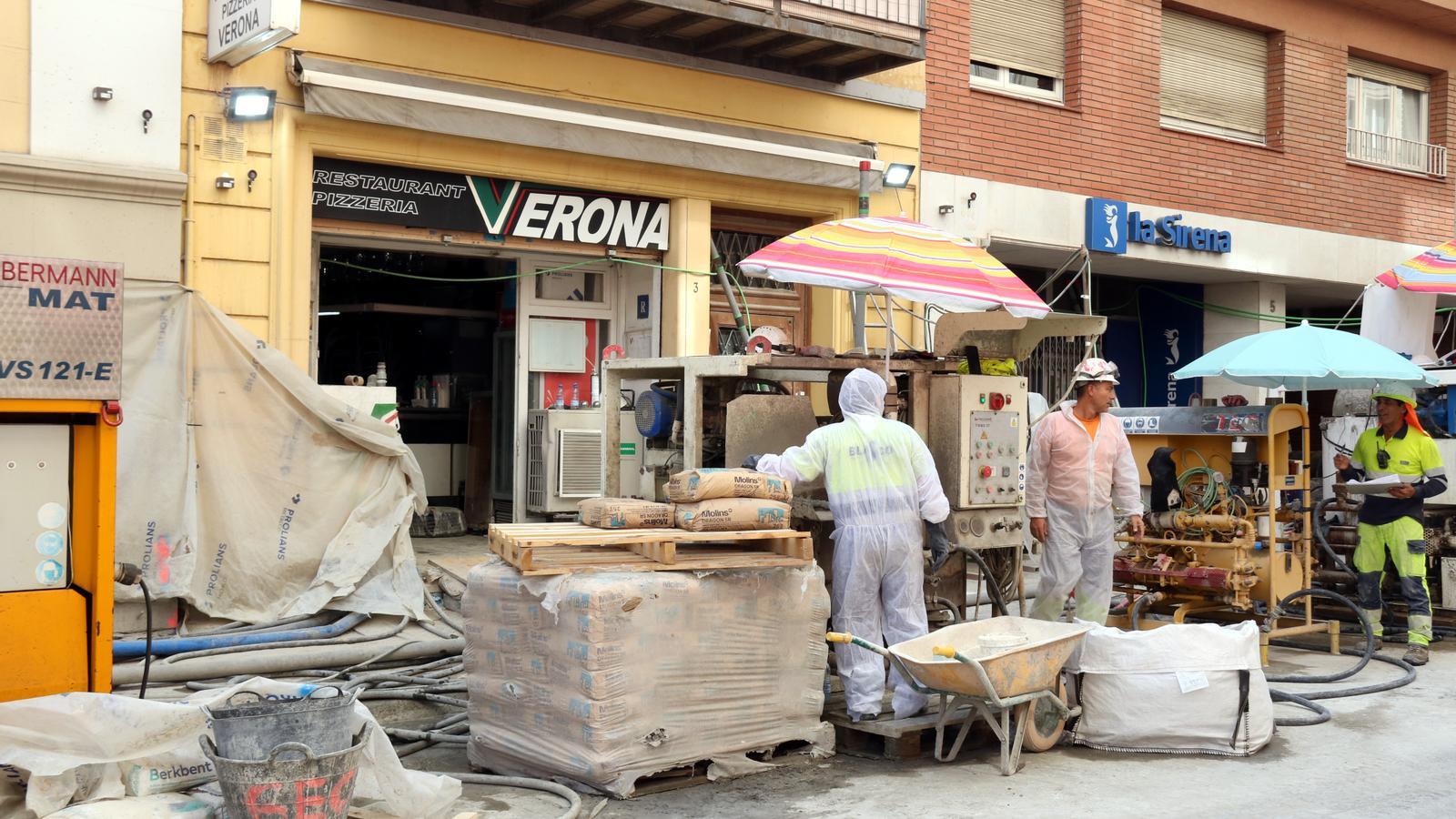
There are also eight businesses that remain closed, seven of which will have to wait until the beginning of next year to reopen. All of this affects the premises and homes on Teodora Lamadrid street, 3; Rubinstein, 2; and Rubinstein, 4. That is, 20% of the 87 homes evacuated on July 7. "We were taken aback," explains Domingo Fínez, owner of the Verona pizzeria, the business most affected by the sinkhole, about eight meters long and four meters deep in an inner courtyard. Even so, after seeing the extent of the works, he admits that "it looked like it was going to take a long time".
According to the Government, the delay in return is due to ground consolidation work. The schedule is also conditioned by the removal of the tunnel boring machine. The machine, responsible for excavating the L9 tunnel, will have to be moved about 20 meters to get out from under the buildings before residents can return home. Currently, residents of 54 homes in four of the eight affected buildings already have authorization to return, while 33 are still pending. Eight of the sixteen affected businesses also remain pending.
On the other hand, Ramírez assured that the delay "is not caused" by the new crack detected on the night of July 29 on Rubinstein street. “After this month of many hours of cement injection, more or less we can estimate the time it will take us to first consolidate all the ground,” he detailed. Nevertheless, he estimated that the repair of the building at number 2 Rubinstein street will require “a longer repair process”. “I was very sad when I heard they still can't return – explains Fínez–. We are all a family”.
Until now, those affected will be able to return to their homes to recover some belongings, but always accompanied by the Firefighters. In addition, the Generalitat, together with the Institut Català de Finances, will continue to provide them with economic aid, both to residents and to shop owners, who have not been able to open for almost two months. "Everyone wants to help us, they are doing what they can," adds Fínez. The restaurateur celebrates that he still has access to an emergency credit for merchants, although he "is still waiting" to see if they will also compensate him for a loan he has been forced to take out.
Delay of the tunnel at Lesseps
The tunnel boring machine in charge of the L9 works continues to be stopped under the buildings, which prevents the excavation of the tunnel from resuming. However, Ramírez emphasizes that, once removed, a study on the causes of the sinkhole will need to be completed and the control measures and previous safety protocols redefined to avoid further over-excavation. For this reason, everything indicates that the L9 works will not resume "for a few months yet". This will mean that the one-kilometer section remaining to complete the tunnel, out of the nearly 30 kilometers planned, up to Lesseps, will also not be finished according to schedule. Territori does not specify a new date for the completion of the works.
Regarding the residents of the four properties whose return was approved in mid-July, some have opted not to return to their homes and are staying in second homes or hotels in the area. "There are people who have a reasonable fear of returning," explains Ramírez. Added to this fear are the disturbances from the noise of the works, which, according to the Director General of Mobility Infrastructure, continue active 24 hours a day, seven days a week. The noise, however, will gradually decrease, as the drilling works have already been completed.
