Faced with images of platform saturation, a few hours after the eclipse, both the opposition and government partners strongly criticized Salvador Illa's executive for mobility management. Junts led the offensive by registering seventeen questions in the Parliament of Catalonia to demand explanations for the “collapse” in Rodalies services and on roads and highways such as the AP-7, denouncing the “propagandistic use” of the phenomenon. Carles Puigdemont's party considered that the Government “prioritizes public image over citizen service” and asked for the planned deployment to be detailed.The rest of the parties joined the barrage of reproaches. From Comuns, the deputy in Parliament Lluís Mijoler demanded clarification on “what went wrong” and accountability for the closure of stations like Tarragona, while ERC ironically commented on the “excellent results of this year's work” on roads and trains. For their part, Laure Vega, CUP deputy in Parliament, accused the Government of “failing in the most basic” by not guaranteeing adequate transport for “the majority of Catalans”. Finally, from the PP, the general secretary of the popular party in Catalonia, Juan Fernández, directly pointed to Illa and the Minister of Transport, Óscar Puente, as the main responsible parties: “They are not up to the task,” he sentenced.
Trains cancelled and crowds: this is how the Government underestimated the train service for the eclipse
The Generalitat admits a "collapse" in Rodalies, while users denounce "neglect"
-
CAT -
CAST
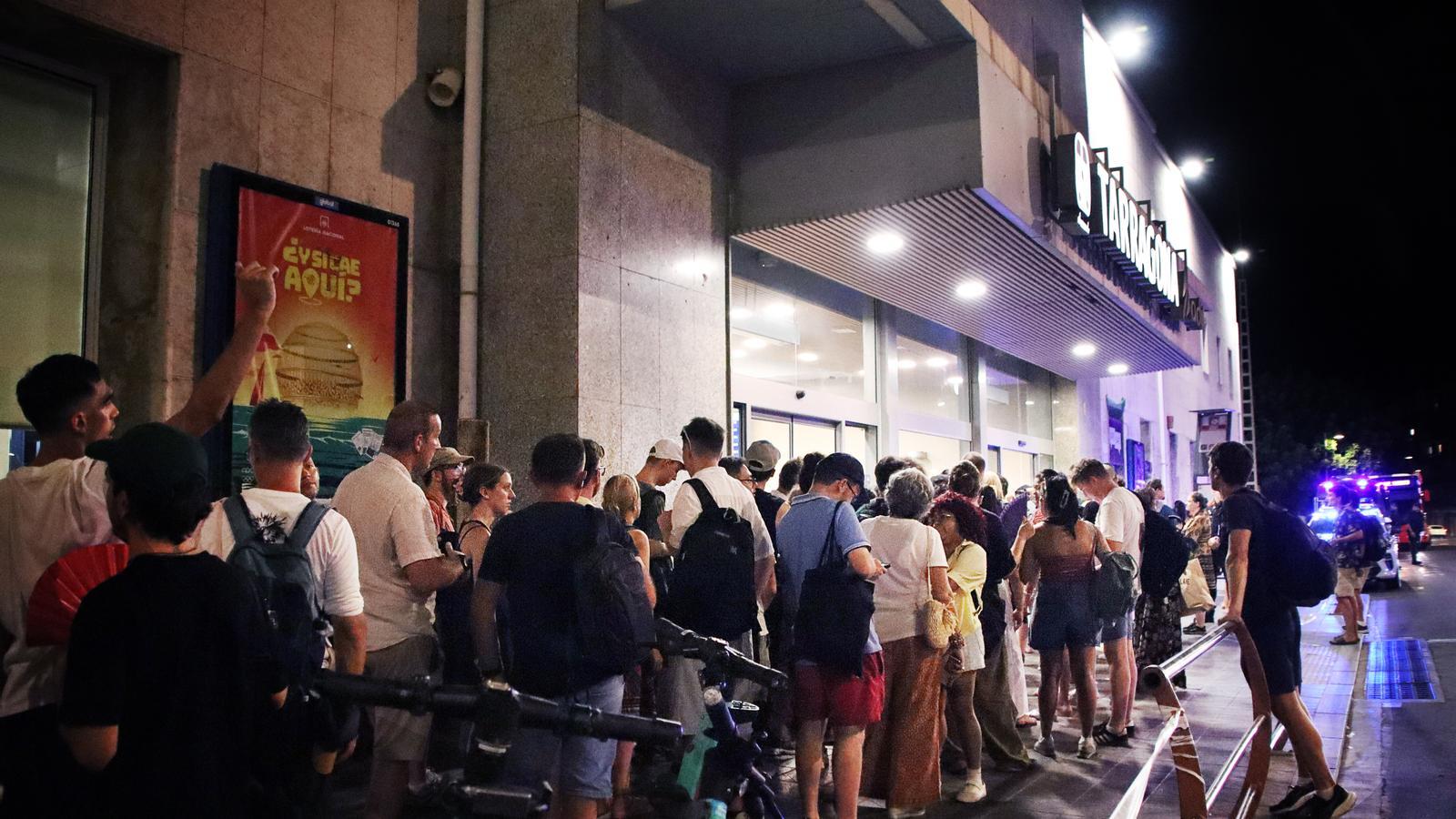
BarcelonaThe images of saturation on the platforms and crowds on trains to travel by train to the south of the country on the day of the eclipse continue to have repercussions. This Friday, two days after the chaos, the Government admitted that there was a "collapse" on Rodalies (commuter rail) during the afternoon of the astronomical phenomenon. But the Secretary of Mobility and Infrastructure, Manel Nadal, defended that it only occurred on the way south and that, on the other hand, the return "was orderly". However, in the evening, scenes of queues to enter the stations, especially those in Tarragona, and platforms packed to the brim were repeated, and Civil Protection had to activate the Ferrocat plan for crowds in pre-alert.
A year ago, the Government assured that an unprecedented security and mobility device would be designed to ensure that everyone who wanted to experience the astronomical event of the century in Catalonia could do so without collapsing the main communication routes. The plan, presented at the end of July after multiple interdepartmental meetings, focused mainly on trying to protect traffic towards the approximately twenty designated observation points, mostly accessible via the AP-7. Furthermore, a call was made for those who could to "arrive at the site one or two days before the eclipse", and to postpone their return, taking into account that it was August and there would be people on holiday. But reality has shown that the weak link in the device was public transport. Specifically, the train and, especially, in the southern area of the country, which is already per se a service with much less frequency and connections, with stations that suffer from investment deficits and structural shortcomings.
User platforms claim that the errors in the train service demonstrate a "neglect" by the Government. “It is impossible that the Government was not aware that many people would take the train to see the eclipse,” laments the spokesperson for Dignitat a les Vies, Anna Gómez. She explains that the platform has long been warning Renfe that they are "short" of southern corridors and that it was evident that more seats would be needed for the eclipse. “You do all the propaganda to promote the eclipse in Tarragona, but you don't look at the Commuter Rail plan so people can go see it. We have made a fool of ourselves as a country,” criticizes Gómez.
In an interview with Catalunya Ràdio, Nadal insisted that the train forecast "was sufficient," but he took "mea culpa" acknowledging that it was not foreseen that there would be a concentration of people in the early afternoon. In fact, Nadal did acknowledge that there were communication problems and that people were not sufficiently advised to use public transport in a staggered manner. In this sense, he described public communication as "inadequate," and pointed out that the call to travel in advance was made mainly for private transport – the Government had been warning for weeks about possible saturation on the AP-7 and asking to use secondary routes – and not for trains.
"The [train] offer was sufficient, but there was a concentration at certain times that perhaps was not sufficiently foreseen to provide an adequate response," explained Nadal. "According to us, the forecast was correct, but it has been proven otherwise. It did not work as it should have worked because people did not arrive on time or traveled in inhuman conditions, or not appropriate for public transport," added the secretary. On the other hand, on Thursday, the operations manager of Commuter Rail, David Andrés, acknowledged that they also did not have "more trains" to offer more seats. An argument that does not convince users: Gómez emphasizes that, if they had wanted to, trains could have been requested from other provinces or communities “because it had been known for more than a year that the eclipse would occur”.
Double-composition trains and 5,000 seats
Mobility problems already began in the early afternoon, with a breakdown in Castelldefels, a key station for the communication of R2 Sud line trains and southern regional trains. Regarding the return from Tarragona, Nadal defended that it was done "orderly" and that the Government decided in coordination with the Mossos and Rodalies to close the station around 9 p.m. to avoid problems. The secretary also assured that "Renfe was instructed that if there were not enough trains, buses should be provided." Finally, no bus service was necessary because an extra train was put on at the end of the morning that functioned as a "sweeper train".
Regarding the reinforcement of trains, the Secretary of Mobility has assured that three trains from line R11 – from Portbou – were moved to the southern corridor, and more than 20 trains were put into double composition, in addition to a special one that departed from Tortosa. Nadal said that some of the trains that left Tortosa were almost "empty", and pointed out that although the forecast was that many people would travel to the Ebre, the majority opted to stay in Tarragona.
For its part, Rodalies defended on Thursday in a statement that "whenever possible" trains were programmed in double composition. Thus, they assure that the forecast was to double the capacity on the R16 (from 1,800 to 3,600) and increase that of the R15 by 60% (from 1,000 to 1,600). They also admit that the incident on the R2Sud meant that between 4 p.m. and 5 p.m. only two trains per hour and direction circulated between Barcelona Sants and Sant Vicenç de Calders.
Seven trains with 51 minutes delay
From Dignitat a les Vies they have carried out an exhaustive analysis of the situation of the R15 and R16 trains on the day of the eclipse and they confirm that, when it came down to it, whoever wanted to travel south after 2 p.m. – when many people leave work – only had seven trains that would allow them to reach Tarragona in time to see the phenomenon. In this regard, it should be taken into account that one of the planned trains, which was also double-decker, was cancelled: the R16 that left at 4:15 p.m. from Barcelona França station towards Tortosa. Apart from this train, the other seven did run, but they arrived at their destination with an average delay of 51 minutes, according to the platform's calculations.
Beyond the forecasting errors, the spokesperson for Dignitat a les Vies also criticizes the little information that was given during the hours of chaos on the platforms. “While people were suffocating on the train, no one said anything. We found ourselves at moments when people were crowded on platforms 2 and 4 and the train arrived at platform 6 and left and no one warned us,” criticizes Gómez.
