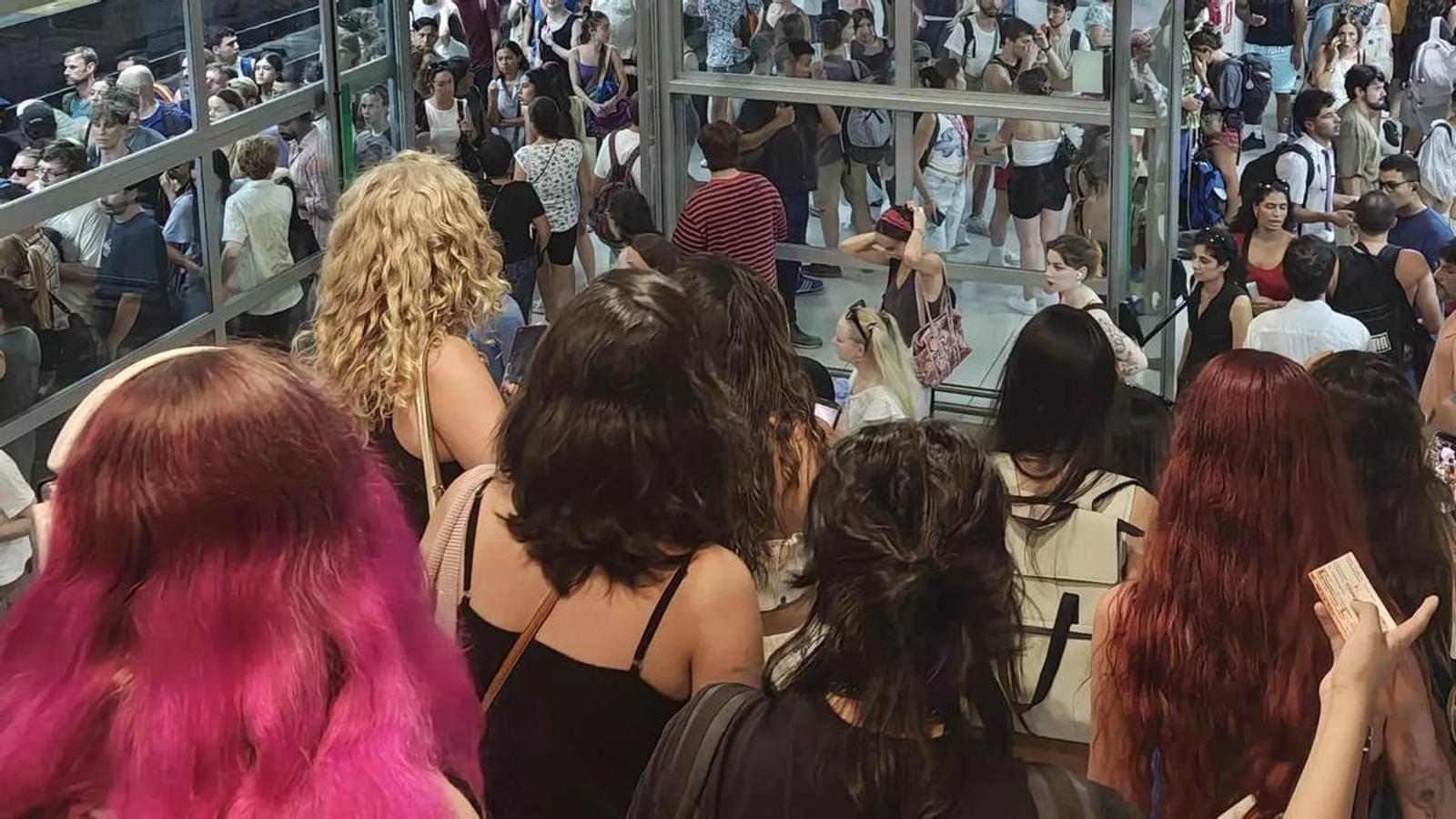
Crowds at Tarragona and Tortosa train stations: the eclipse fever affects mobility
The roads have suffered a high influx of vehicles and some traffic jams in the early afternoon, before the astronomical event
-
CAT -
CAST
BarcelonaThe great interest in the eclipse has also affected mobility in Catalonia, especially in the south of the country, which has been the most privileged area to see this historic phenomenon. If initially it was the roads that suffered especially from the high influx of vehicles, after the eclipse —and coinciding with the return towards Barcelona— it is on the train where significant crowds have occurred. The stations of Tortosa and Tarragona, packed to the brim, have doubled demand on lines R16 and R15. In fact, Mossos and Renfe staff had to manage access until the last train of the day, around 11 p.m., took all the passengers.
Although being the height of August many opted to leave hours or days before, from this Wednesday morning and in the early afternoon hours, traffic jams and crowds to travel between Tarragona and Barcelona have been repeatedly occurring. Government sources confirm to ARA that the average demand (round trip) on the R16 has doubled compared to a normal day, going from 1,600 users to 3,600. On the R15, it has also shot up by 60%, to 1,600 passengers.
In the afternoon, on the platform of the Sants and Sant Vicenç de Calders stations, there were already significant crowds of people trying to catch a train, to the point that Civil Protection had to activate the pre-alert of the Ferrocat plan.
In addition, several users have complained on social networks that inside the trains people were traveling crammed together and some had suffered motion sickness due to the heat. To all this, a new incident at the Castelldefels station had to be added, which caused 30-minute delays on trains on the R2 Sud and Regionals Sud lines. At 8:40 p.m., passenger flow at Sant Vicenç de Calders and Sants had normalized.
Renfe sources assured ACN that this Wednesday trains have been reinforced, “trying to run all those going south in double composition”. On the return, a special reinforcement train of the R16 has been planned to facilitate the return after the eclipse, which will depart from Tortosa at 9:56 p.m. and will be bound for Barcelona's França station, and will stop at all stations until Sant Vicenç de Calders, and also at Vilanova i la Geltrú.
Dense traffic on the AP-7
The Government's main recommendation for travel has been to try to avoid the AP-7 to prevent saturation of this route, but nevertheless, more than 30 kilometers of queues accumulated during the afternoon, and there were also queues on the A-2 in Martorell and on the C-31 on the Costes del Garraf.
After the eclipse, the main Catalan roads continued to be affected, but, obviously, in the north direction: the densest traffic was concentrated in the section between Altafulla and El Vendrell. The Servei Català de Trànsit (SCT) also reported traffic jams in the AP-7 section between Santa Margarida and Els Monjos and Vilafranca del Penedès in the south direction, and 8 kilometers on the N-340 between Creixell and El Vendrell, also in the south direction. Likewise, there was slow traffic on the C-31 between Cunit and Vilanova i la Geltrú and between Cubelles and Vilanova i la Geltrú, both also in the south direction.
The first disruptions began around ten in the morning on the AP-7, aggravated by two accidents that caused traffic jams in the south direction, one in Castellbisbal and another in El Papiol, the latter with 10 km of queues. Subsequently, traffic progressively increased in the southern half of the country, especially on the AP-7, N-340, C-32, and C-31. In the early afternoon, a couple of accidents on the A-2 in the direction of Lleida (one in Vila-sana and another in Granyanella) caused some queues.
Throughout the afternoon and until 7 PM, roads such as the southern section of the AP-7, the C-32 in the south direction, and the N-340 were quite busy. Additionally, an accident on the C-31 on the Costes del Garraf caused queues of more than 10 kilometers leaving Barcelona. From 7 PM onwards, traffic volume decreased very rapidly, and around 8 PM, the time of the eclipse, traffic had almost normalized.
