The arrival of thousands of migrants in a few days forces declaring an emergency in the Canaries
The Canarian president estimates that in the last 10 days more than 7,000 people have disembarked on the archipelago
-
CAT -
CAST
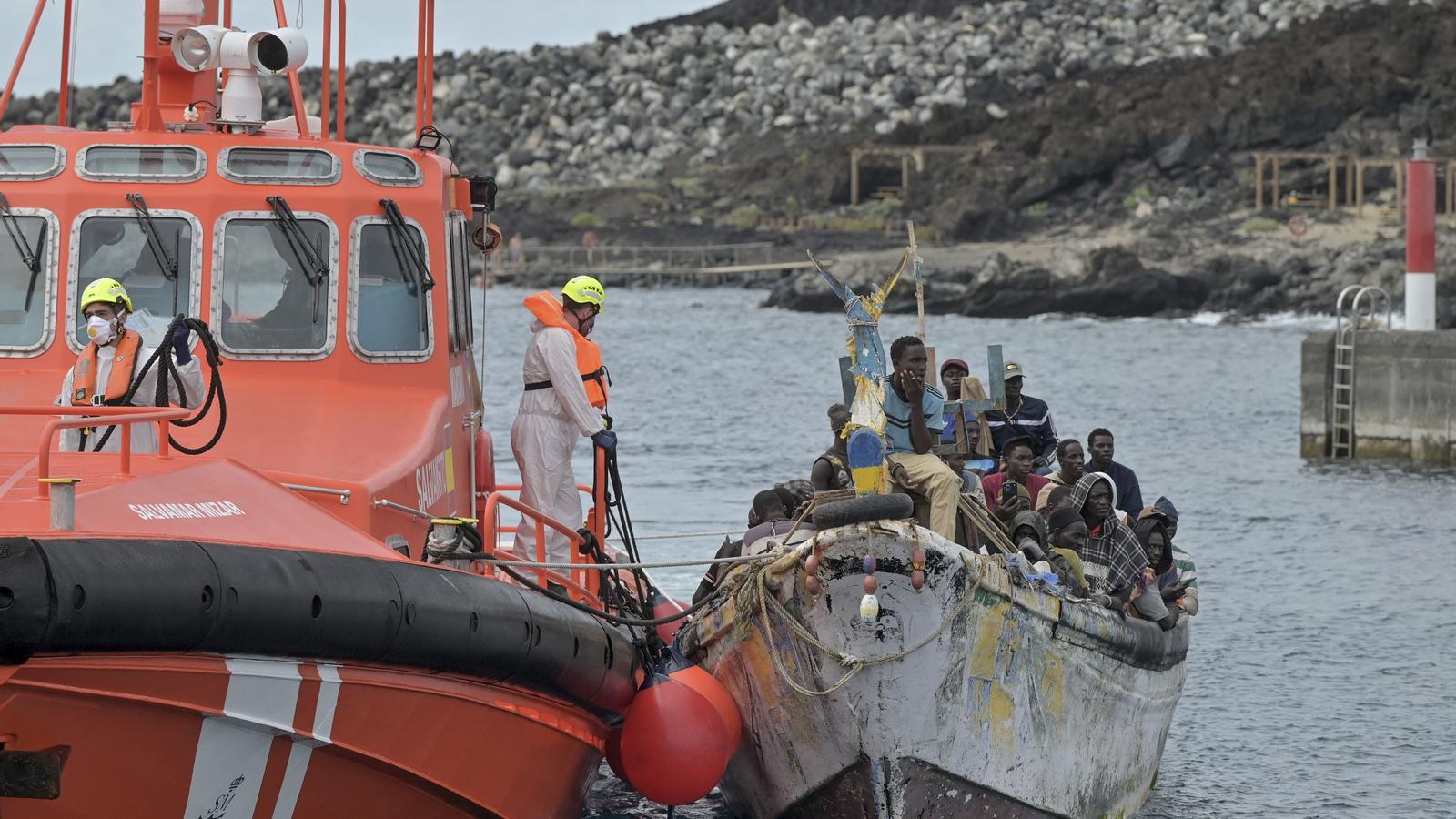
BarcelonaMore than 7,000 people have arrived in the Canary Islands in rafts, cayucos and inflatable boats in the last 10 days. The Atlantic route to the archipelago reached its peak of arrivals in 2024 and had since followed a downward trend that was abruptly interrupted in the first two weeks of November: this 2026, about 20,000 people have already arrived there, about 3,000 more than in the whole of last year. For this reason, the Spanish government this Tuesday declared a migration emergency in the Canary Islands and announced an extraordinary allocation of 15.18 million euros to deal with the rebound in arrivals. With this money, more reception places will be set up throughout the State and transfers between the islands and the Peninsula will be increased. As ARA has learned, some of these people will be transferred to Catalonia.
Many of these vessels have ended up on the island of El Hierro, which has few resources to manage so many arrivals. Judicial sources explain that in these cases it is common to open an expulsion file and transfer them to the Peninsula, from where they are returned to their countries of origin. They insist, therefore, that the transfer to Catalonia is within the norm and is usually done when the situation requires it. This Tuesday, the Interministerial Commission on Immigration met at the Moncloa to address the migratory pressure on this island and it was agreed to increase health resources and Maritime Rescue teams. The Minister of Territorial Policy, Ángel Víctor Torres, explained that 92% of the people arriving in El Hierro are of sub-Saharan origin and many are susceptible to receiving international protection.
The President of the Canary Islands, Fernando Clavijo, also participated in the commission, from which he emerged "satisfied", although he regretted that measures had not been taken before the massive arrival of people, since they had requested them previously and had warned of the situation the archipelago is experiencing. The Canarian president explained that part of the new resources will be used to hire Red Cross personnel to help with the first health assistance for migrants. The goal is to relieve the services in El Hierro, which have been very strained in the last 10 days, during which about 7,432 people have arrived, according to Clavijo. Regarding the minors who have arrived this November, he celebrated that the relocation system to other communities is working normally, as there are almost 3,000 minors in the islands' reception system.
Departures from Senegal
The factors behind the rise in arrivals are diverse, but the Spanish government delegate in the Canary Islands, Anselmo Pestana, explained on Monday that the big difference is marked by Senegal. During 2025 and much of 2026, hardly any cayucos arrived from this country. The route had been blocked for months in Mauritania and also seemed to be under control in Senegal, which forced the majority of vessels to depart from further south, such as from Gambia and Guinea, but in recent weeks almost all arrivals have come from Senegal. The Minister of the Interior, Fernando Grande-Marlaska, met last week with his Senegalese counterpart in Dakar to try to achieve greater containment of departures.
This Tuesday, Clavijo explained that the migratory spike may be related to the celebration of the Youth Olympic Games in Senegal, which has concentrated 15,000 police officers at the site of the organization, which has led to a decrease in surveillance on the coasts, and also the electoral campaign in Gambia. Facing this scenario of arrivals in the Canary Islands, the Minister of Foreign Affairs, José Manuel Albares, stated this Tuesday from Brussels that Africa is "a challenge for all of Europe" and recalled that the islands are also part of the border of the European continent. For this reason, he argued that all actors are involved in resolving this situation as soon as possible and demanded that all European commissioners "get decisively involved and continue working jointly with Spain" to resolve the migratory crisis.
In this sense, Clavijo explained that this Thursday he will meet by videoconference with the Commissioner for Home Affairs and Migration at the European Commission, Magnus Brunner, to address the possible deployment of Frontex, the European Union agency in charge of border management, to the African coasts to more effectively prevent the departure of migrants at the source.
