Jo Nesbø: "If Harry Hole were to find that which he desires, then there would no longer be a story"
The Norwegian writer returns with a new intrigue in which the policeman has to face an artist capable of everything
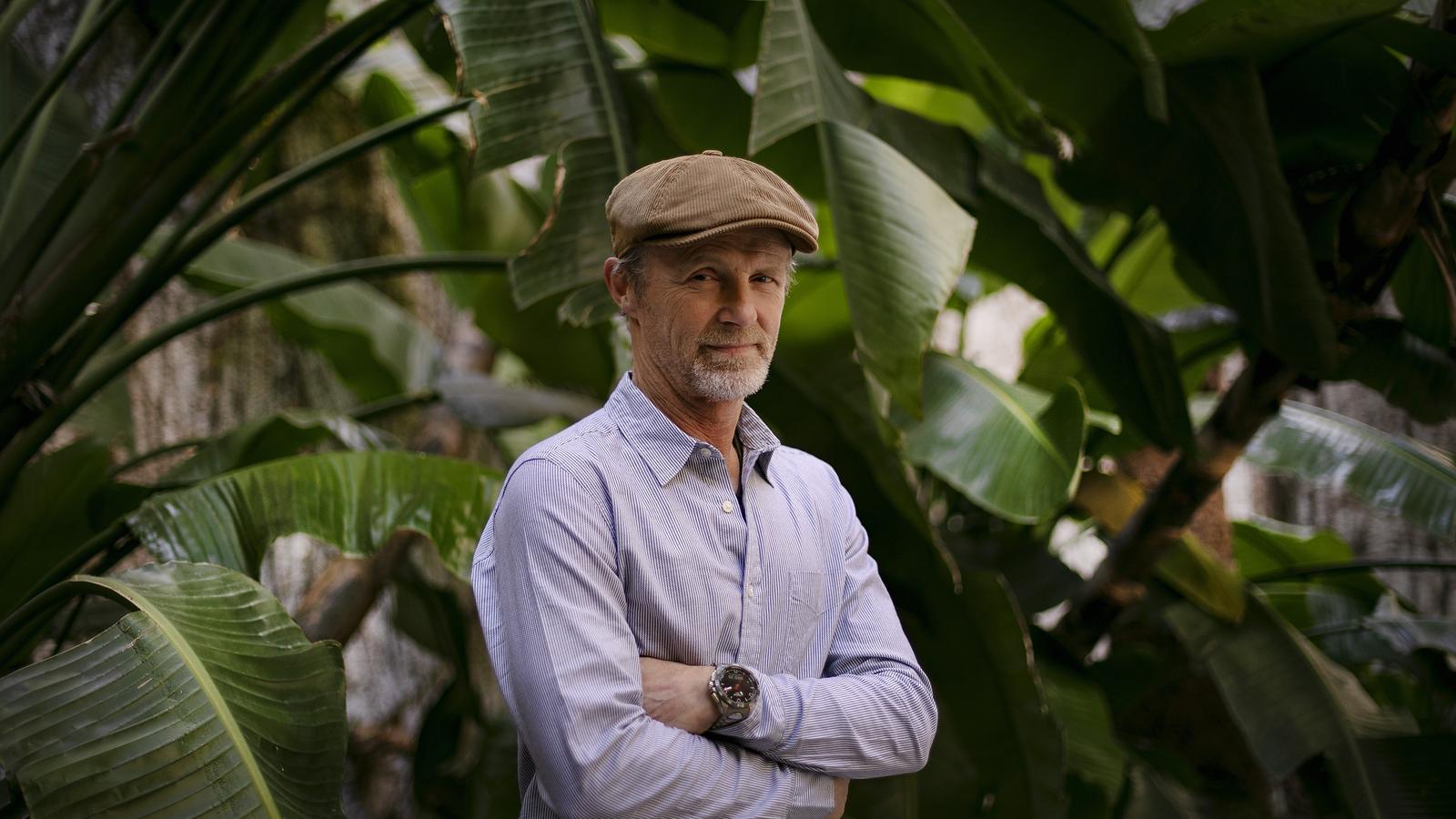
BarcelonaAfter three and a half years of waiting since the last Harry Hole adventure, the Norwegian writer Jo Nesbø (Oslo, 1960) returns to bookstores with Killing Moon (Proa). It is the 14th installment of the saga starring the undisciplined, dark and, until now, quite self-destructive policeman. In this new novel, translated into Catalan by Laura Segarra Vidal, Hole must face a killer who wants to create an artistic work that everyone will remember. "I wanted to talk about the artist's ambition and how it ends up being a force that consumes many creators," asserts Nesbø in a video call conversation with several journalists. "Sometimes artists feel entitled to cross red lines and break rules because they consider their work more important than everything else," he adds.
The Norwegian writer, who has a huge poster behind him that reads "death" (death), does not suffer from this darkness and says that success has not taken a personal toll on him: "Maybe when I had a regular job I sacrificed my time because my heart wasn't in it; I was sacrificing my integrity. On the other hand, as a writer I have only had rewards; I work long hours and do a lot of work, but I have never felt disappointed –explains Nesbø–. I wake up in the morning ready to write a masterpiece and in the process I suffer".

The paternity of Hole
The novel's beginning starts off quite badly for Hole. "The story begins in a very dark way, with Harry on the verge of suicide. He has lost everything: he no longer works for the police, he has lost the hunt that defined his life, he has lost his great love, Rakel, and alcohol no longer works for him. He has nothing left," explains the author, surprised when one of the journalists comments that the novel is very dark. However, from this point on, the narrative becomes more "luminous". Little by little, he recovers his desire to live, pays attention to Rakel's son, Oleg –whom he acts as a father to and who already works for the police–, and to a much smaller biological one, Gert, and is able to return to hunting a serial killer.
Parenthood marks a turning point in the detective's emotional evolution, according to Nesbø, who admits that he has transferred part of his personal life to the page. "I have poured a little of myself and my own experience into it, because I became a father quite late," he admits. "Harry is a wounded man who, when he related to others, always ended up getting burned. Rakel was the first one he let in, as Nick Cave would say, but happiness is like walking on a frozen lake and feeling that the ice could break at any moment. Harry thinks it is better for it to break completely than to keep waiting. Now he once again assumes the risk of feeling vulnerable again," defends the author, who says he has not grown tired at all of the character that has brought him the most success. "As I get older, I am more interested in reconnecting with my old friends, the ones I've always known, rather than meeting new ones. It is the same for me with Harry: the more background he has, the more interesting the conversation becomes."
In this novel, he gives more prominence to Oleg, but Nesbø is ambiguous about whether he might replace Hole in the future. "I have no immediate plans in that regard, but that doesn't mean it couldn't happen. The truth is that I never reveal my future plans and, if I give any detail, it is surely a lie," he asserts. Continuing with the intrigue, Nesbø asserts that there are surely things about himself in Hole that the reader is unaware of, but that he also does not intend to explain.
For the Norwegian writer, the moment Hole finds peace, the novels will be over. "Stories are about conflict, they are about a character trying to achieve something. If Harry were to find peace, that which he desires, then there would be no more story. What he finds in the hunt... it's like alcohol: finding the killer is like if he himself were a serial killer, there is always disappointment, he does not find the climax", explains the author, who says that Harry is an outsider, with an imperious need to do the job, but he does not like it. "In this hunt he finds a purpose and a way to contribute to society, since he does not find any purpose in his private life".
The audiovisual influence
The publication of Killing Moon coincides with the adaptation of his work as a series for Netflix. This proximity to the audiovisual world is reflected in the novel's plot. The author admits to having many influences, from the readings of his childhood to pop and rock music—his novels are always filled with musical references—to the cinema of the 70s or classics like M (1931), by Fritz Lang. Now, becoming so involved in the series has ended up carrying over to the page.
Nesbø, who just returned from Poland on Monday, where a far-right youth murdered six people, does not seek in his novels to reflect social reality or the violent events we are experiencing at this moment. "Today's society is not necessarily more violent than that of the 70s, when there was terrorism in Spain, Ireland, Italy, or Germany. I use the crime novel to focus on people, not to analyze actual criminality. We are not fascinated by real violence, which is banal and unpleasant, but by the exploration of primary emotions like anger and fear," he asserts.
