Cristina Farré: "They have invested a lot of money and brains to install fear"
Communist activist

-
CAT -
CAST

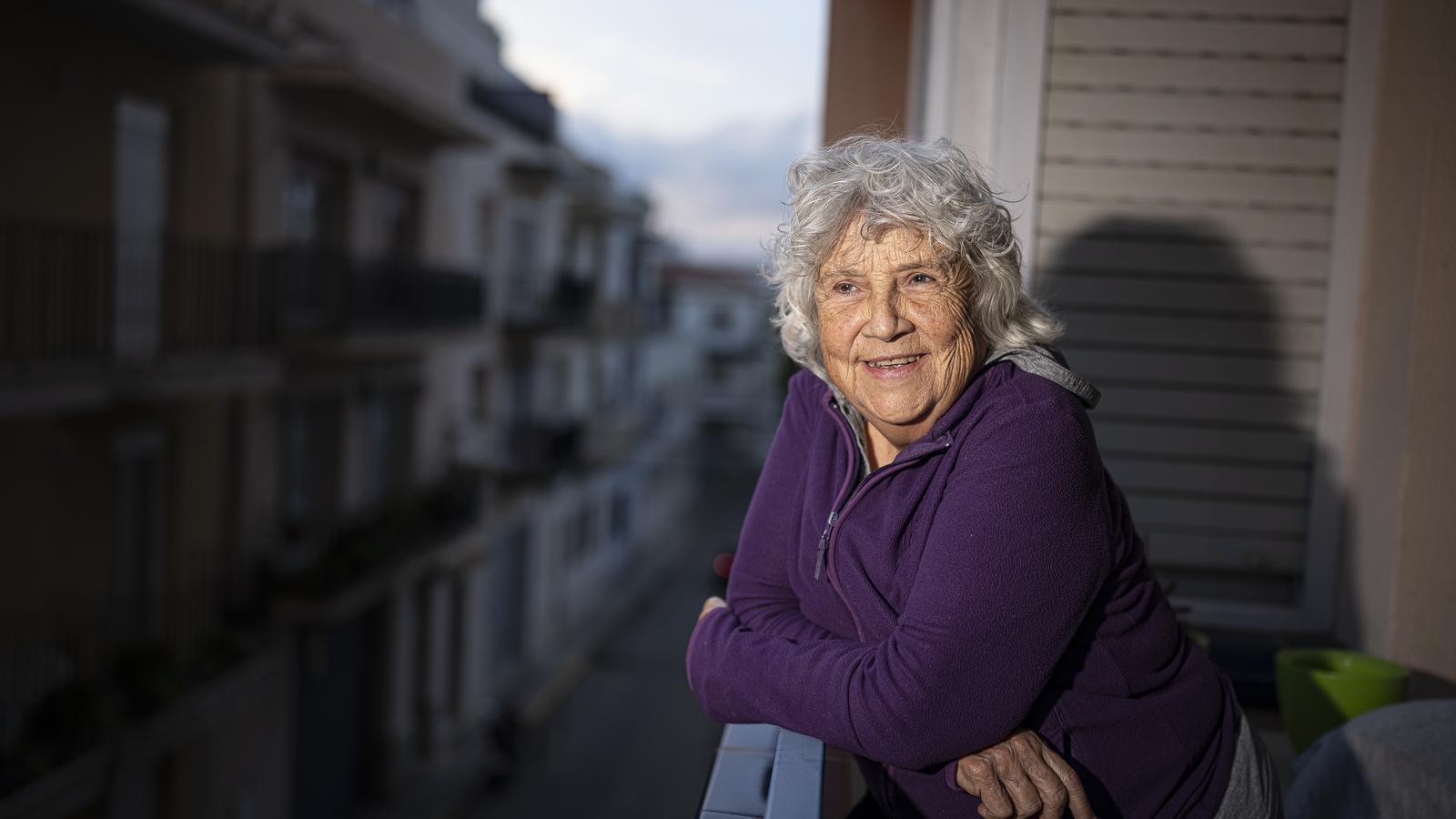
On her WhatsApp profile, she has a photo of the Flamisell River, in Pallars Jussà, and in the status text, it reads "Against the current". Cristina Farré has lived her whole life against the current. And what a life! A former militant of the Communist Party of Spain (international), the political struggle led her into clandestinity, to suffer torture, to prison, and to exile; a story that she has collected in the memoir book We gave it all.
How do you see the strike?
— Everything has deteriorated and become so expensive that I find the strike absolutely necessary. I fear it may not quite work, but I believe that, whatever the outcome, it will be positive.
Are you having second thoughts?
— The most mobilized are students and housing unions, but the changes must be led by the working classes, or it will be impossible for this to have continuity. I don't see as much mobilization in the neighborhoods as I would like.
In 1969, you and other students threw a bust of Franco out of a window of the rectorate of the University of Barcelona during a protest against the entry of the police into the premises.
— It seemed the most normal thing in the world to us, there was no metaphysical discussion. 30 or 40 of us locked ourselves in the rector's office, we thought that Franco had no right to be at the university, not even in the form of an iron head, and we threw it down.
The climate was very different…
— A lot. Every day there were demonstrations, clashes with the police, distribution of leaflets. We were clear that we had to change the unjust world in which we lived and we did not make any calculations. And they imprisoned and killed many comrades, like Gustau Muñoz, murdered by the police in the middle of "democracy". Looking at it with perspective, we were very brave.
Where did that courage come from?
— We had the privilege of living through a historic era. There were important struggles all over the world. The levels of demand were very tough because we found ourselves in pre-revolutionary moments everywhere. Or, at the very least, that is what we believed.
Why did that momentum end?
— Because they responded with brutal and coordinated repression. Thousands dead, imprisoned, and tortured. They have invested a lot of money and many brains to install fear and domesticate us so that we do not abolish the privileges of a few in favor of the majority of the population.
Will this domestication work indefinitely?
— I don't know. A Vietnamese comrade told me: "Being a communist in a European country really is heroic. We kicked out the French and the Americans because we had nothing to lose".
But you yourself did not grow up in absolute poverty and, despite everything, you got involved.
— I belong to a family repressed by Francoism and, above all, to a family that talked about it all day long, that did not choose silence. That leaves a deep mark on you: my first demonstrations were arm in arm with my father.
But what makes people commit?
— You have to stop navel-gazing. When you are aware of the collective situation, you get involved in the struggle in a serious and total way. Then you don't just militate in the party or at university: things are happening everywhere and you have to take a position, you have to be consistent.
Like in 68, when you refused to make the children pray at a school in Carmel where you were teaching.
— And the children went home and told their parents that they would kick out the teacher. The working-class families responded by saying that if they expelled me they would take their children out of school, and that is how they managed to keep me in my job.
In '71 you were imprisoned in Alcalá de Henares. You organized a labor strike at the women's prison... and you won as well.
— It was one of the most important episodes of my life. It is an example that things can be transformed in any circumstance.
Any secret to organizing strikes from that episode?
— Talk to everyone, make people see that they have rights that are being trampled upon. The prisoner who rose to become the leader of that strike could neither read nor write, but she ended up perched on a table giving a speech at night and convinced her companions. Everyone is capable of fighting, and you learn as you go.
You are very critical of the Transition and the role of Workers' Commissions.
— They were constantly braking any struggle of the sectors that did not sell out. We would tell them: "Don't you see it? How can you call this democracy? Did we really fight for forty years for this Bourbon Francoism?" Without radical struggle, the powerful never feel threatened enough to change things.
You went into exile in '81, after Tejero's coup d'état.
— Exile causes great pain and I do not wish it upon anyone, but it is always a front for struggle. We went to Algeria and we were recognized as political refugees under the Geneva Convention, the only ones to achieve this status during the supposed democracy. It was the result of our deep commitment to internationalism, especially to the Sahrawi cause.
After 15 years away, what was it like to return?
— People laugh at it, but what impacted me the most was that here there were no people carrying food through the street, which was a constant image there. Here, when someone new comes to the apartment building, I always go to introduce myself, and sometimes they look at me as if I were crazy. But the most important thing in life is to relate to people. If you can relate to them politically, better, but at the very least the human level is necessary… If we abandon that, what are we turning our societies into?
How have you navigated the tensions between social and national struggle?
— My father was a militant in the National Front and was a visceral Catalanist. I think I ended up in the most internationalist party of all to be a bit contrary. But the language and the national struggle have always been fundamental for me. A people cannot be free if it is oppressed by another, and here the Spanish state has always oppressed us. The national struggle and the struggle for the revolution depend on each other.
Have you ever wavered or modified your principles?
— When I was very young I decided that I would dedicate my life to changing the world, nothing more and nothing less [laughs]. It sounds very pretentious, but since the world hasn't changed, I keep trying. Obviously, I have done a lot of self-criticism of the actions of communist parties, and at one point I abandoned organized militancy to work at the street level with neighborhoods or with internationalism. But even if tactics change, the fact that the struggle is the only way never changes.
How can people be convinced not to be afraid?
— The problem is not having no fear, but being capable of acting despite the fear. I experienced a lot of it, but I faced it. Stepping out of individualism and having a global vision helps you understand why you are afraid and, at the same time, pushes you to move forward.
What would you say to a young person who is organizing the strike and feels they want to change the world?
— Do not let it fail. That this is not a flash of youth. That you collaborate with any cause that seems just to you, because the struggle is the only honest way to be in the world.
