Seven suicides and one crime: what is happening in Catalan prisons?
Penitentiary centers accumulate in a few days serious incidents while they approach the limit of their capacity
-
CAT -
CAST
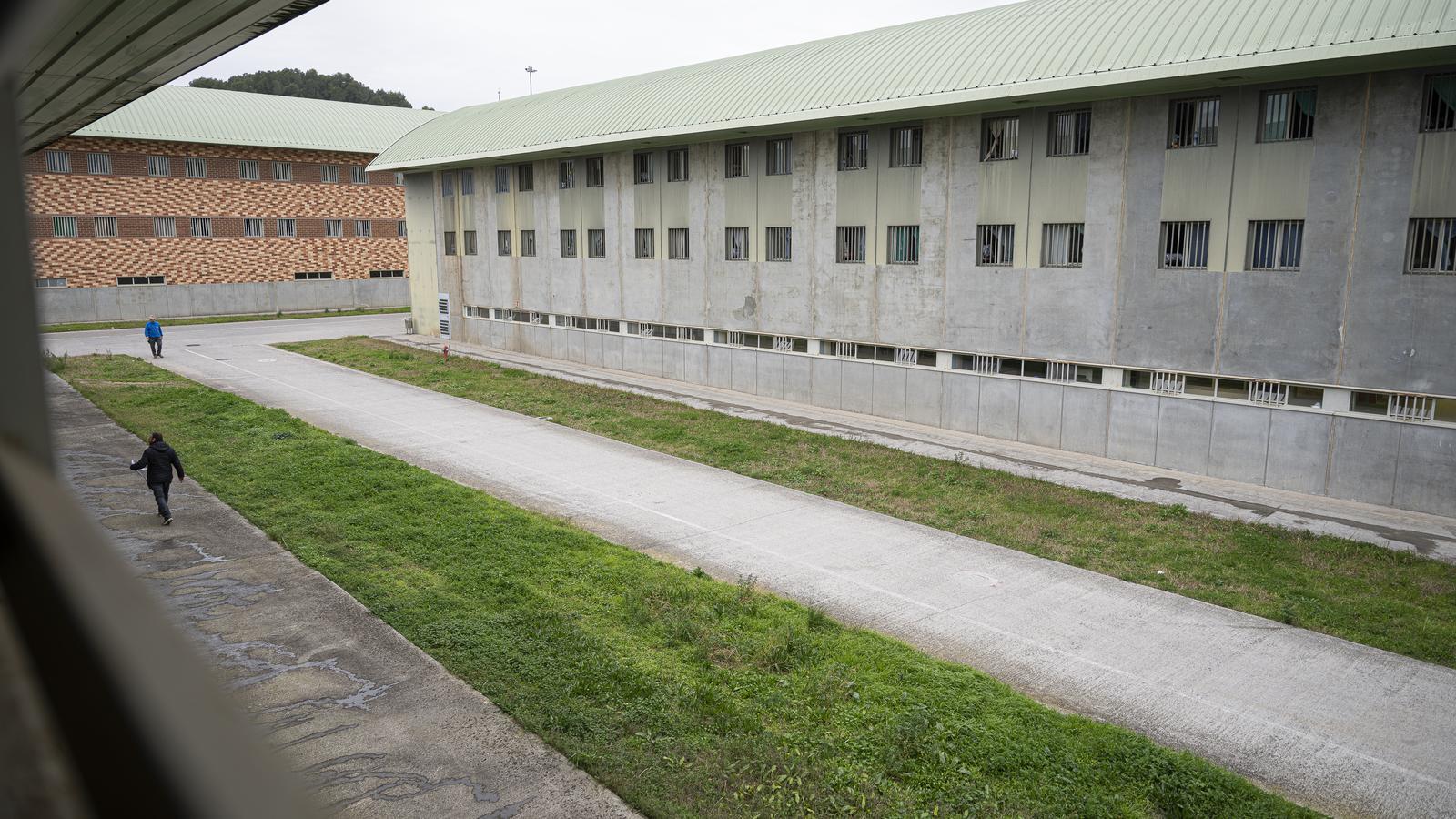
BarcelonaIn recent days, prisons have experienced a series of serious incidents. Last week, an inmate from Mas d'Enric convicted of murder escaped during a scheduled outing in Tarragona. A prisoner at Quatre Camins killed his cellmate and another inmate at the same prison died by suicide. His death is the seventh by suicide in Catalan prisons this year, one more than in the whole of last year. All this at a time when the prison population is on the rise and the centers are approaching their capacity limit.
Sources from the Department of Justice admit concern about the situation, although they remark that the incidents of the last few days are not interconnected. The department also explains that the fact that there are more inmates implies more tension in the centers, although they assure that the number of assaults by prisoners on staff has not grown, unlike what is inferred from the department's data published by ARA, which indicate that in 2025 there were 677 assaults, five times more than a decade ago.
According to the professor of psychology of violence Antonio Andrés Pueyo, overcrowding is not the direct cause of any specific incident. "When they are so serious, they are extremely infrequent. Crimes in prison can be counted on the fingers of one hand and are not necessarily associated with a general deterioration, although they are often mixed with less serious operational problems," he assesses. The expert indicates that the diagnosis is not one specific problem, but rather many factors added together that cause "an increase in discomfort, in low-level fights, but which are very uncomfortable, added to the lack of resources." A situation, however, that is brewing inside the facilities, which is barely visible to the public and which, at this moment, has not acquired a political dimension comparable to the tension being experienced there.
Pueyo also warns that the solution "is a dog chasing its own tail and nobody really knows how to solve it". In his opinion, there should be legislative changes involved to favor small sentences being served in semi-freedom, changes in the care for inmates with addictions and mental health problems, and for courts to issue more sentences that do not involve entering prison. "These are slow changes, and it is a triangle that feeds itself. Sentences have always ended up being increased, making them longer, and that ends up collapsing the penitentiary systems. Now we are here and it is not easy to solve: these measures must be planned beforehand, not when you have the storm upon you".
More prisoners and more friction
The Justice Department assures that there are now also fewer assaults between inmates, both serious and minor cases: if in 2022 serious assaults were 3.1 per 1,000 inmates, last year the rate was 2.5; and the rate of minor assaults between inmates has gone from 7.5 in 2022 to 4.1 per 1,000 prisoners last year. The same sources point out that in prisons, possible incompatibilities between prisoners are carefully studied to prevent them from sharing spaces or cells, and they recall that the government is working to expand prison places, with more modules that will be available starting in 2028. In fact, the increase in the prison population is even above the forecasts made by the department, according to Justice sources.
However, the department also points to an increase in self-harm: since the beginning of the year there have been 36 serious cases, more than double that of 2025, and 606 minor cases, which also exceed the 510 from last year. According to Pueyo, whether or not the day-to-day life in the centers is more complex depends on factors such as "the configuration of the population and the daily reality of overcrowding, which does not only mean a lack of space but also a lot of friction". Although Justice sources rule out that there is a correlation between the suicide rate and the number of inmates, Pueyo considers that the situation of overcrowding "ends up in situations where violence increases and all this has consequences for the inmates and the staff": "It not only causes two or three prisoners to have to sleep in the same cell, which is not yet the case, but also many difficulties in day-to-day life".
The director of the Observatory of the Penal System and Human Rights of the University of Barcelona, Iñaki Rivera, agrees that there is an increase in tensions in the centers. "We have been warning for some time that we are facing a serious deterioration of prison conditions," says the man who is also the spokesperson for the Rights and Prison Network, a platform that brings together a dozen human rights entities. Among the factors to which he attributes this escalation of tension are mechanical restraints, the changes to get a job inside prison, and the increase in the prison population.

Rivera also warns of a "hardening of the regimental measures requested by the unions" following the 2024 murder of a cook at the Mas d'Enric prison. As they demanded in the protests after that crime, the officers also have achieved this year the status of agents of authority, which gives them the presumption of truthfulness in administrative procedures such as sanctions on inmates and gives them more legal protection in the face of an assault.
Multi-offenders and prisoners in preventive detention
Among the factors that contribute to higher tension within the centers, Pueyo also points to a change in the profile of the inmates. In this sense, he believes that "the success of the shock plan against repeat offending" has influenced it, as well as the legal change that facilitates pretrial detention for the accumulation of petty thefts. "Repeat offenders who previously did not go to prison now do. It is a prisoner profile that is not comparable to a murderer or a rapist, for example, but they have the same residential needs and need for attention from the officers," he suggests.
In addition to the type of crimes that have led them to prison, the psychologist also points out the impact of being in pretrial detention and not serving a sentence. According to Pueyo, a convicted person has a certain conformity with prison, because they know how much sentence time they have ahead and under what conditions they are. "Preventive inmates do not have this and generally do not follow the treatment programs typical of prisons either," he concludes.
