Repopulating is easier with a group of friends
Beget, in the Alta Garrotxa, has gone from 19 to 27 inhabitants after the pandemic, when a group decided to put down roots there and open three businesses there
-
CAT -
CAST
Beget (Alta Garrotxa)The daughter of Annabel and Guillermo, Willy to her friends, has just turned one. The couple celebrated an anniversary this September that was not only a family one: in 2025 she also became the first child born in Beget, in the Alta Garrotxa, in 16 years. A sign of the turning point that this small, scattered village has experienced, isolated from Camprodon and Castellfollit de la Roca by a long, narrow, winding road of 20 and 28 kilometers, respectively.
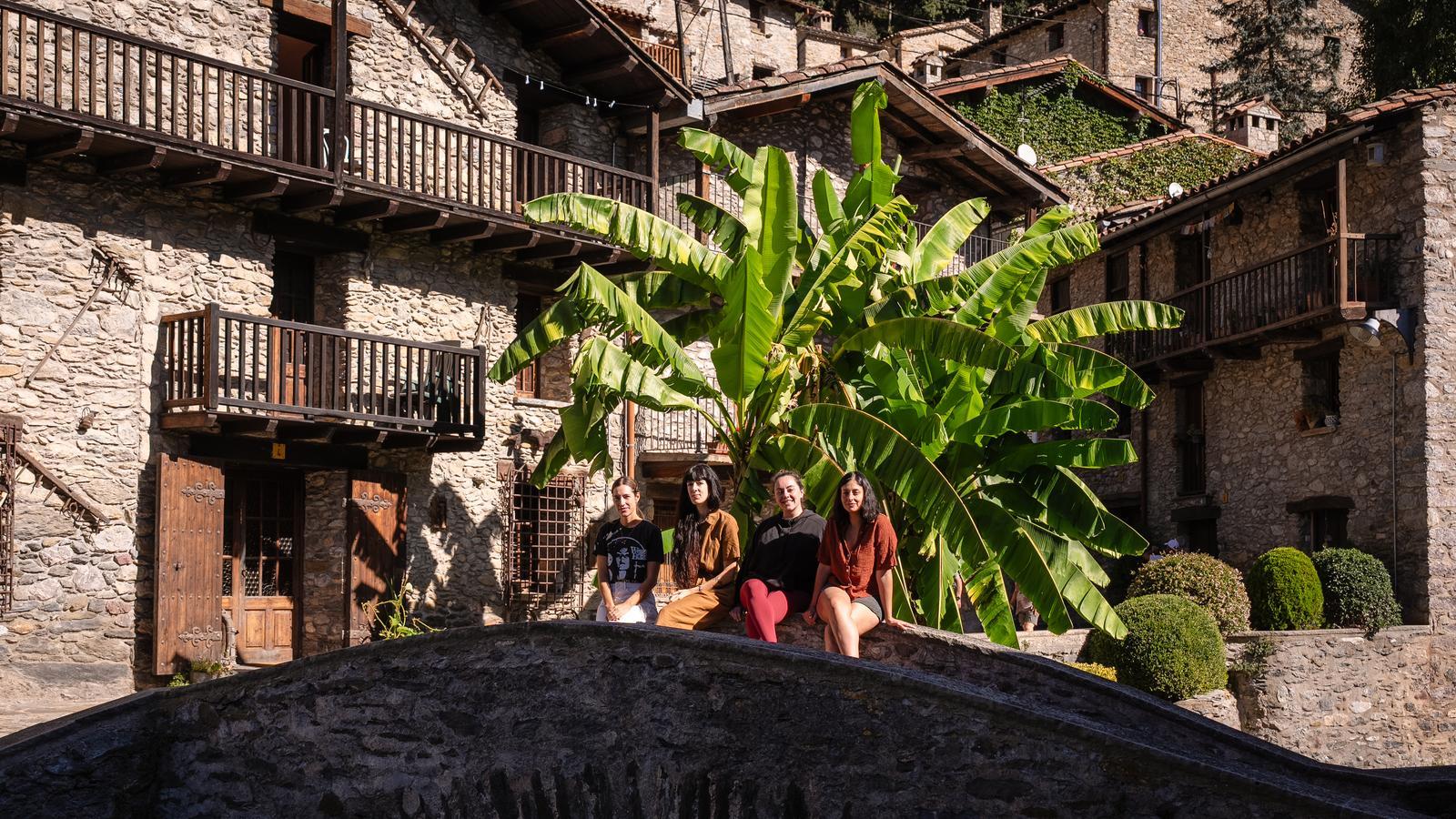
Annabel and Guillermo are two of the three souls behind the Ricolta workshop in Beget, a bakery that has also become a meeting place and a starting point for the repopulation of the village, which in seven years has grown from 19 to 27 inhabitants. Ricolta is the name of the mountain located just above where they live and which exudes the project's intention: to make bread, but also culture and projects linked to the territory. "It is key to have a bond where you are, because we are an isolated village and for us it would not make sense to go to work in Camprodon every day," explains Annabel Botello Tarifa, in charge of communication and design for the cooperative.
They are not the only ones with this drive. Since the pandemic, three businesses have been born in Beget. 2022 saw the opening of a bakery for the first time in 60 years. 2024 saw the opening of Flora et Labora, a sustainable floriculture and floral design studio run by the couple formed by Lorea Palacios and Imanol Salvador, who were inspired by the Rule of Saint Benedict for the name. And 2025 saw the opening of the Botica Pirinenca Arthemis, an herbal shop led by Bea Andrés Molero, who has stopped being a professional cellist to sell medicinal plants.
All three businesses have a common denominator: they are integrated by a good group of friends. "Doing it together makes everything easier," says Botello, even more so since she became a mother. "Ricolta is a benchmark –adds Palacios–. Each business is very different, but it has helped us to focus. We would not have made the change if they weren't there. Especially during the winter, when the village is empty." In turn, Bea expresses: "Not a single day have I felt alone."

The fourth member of the family is Rosa Llorca Algado, a native of the Finestrat mountain range, in the Valencian region of Marina Baixa. She responded to a call from Ricolta to do baker internships in Beget. "I was blown away, I fell in love with it," she explains, and now she is a member of the cooperative. "If it weren't for them, I wouldn't be here," she says. In her case, she is the only one who has left one village to settle in another. The rest come from the city, mostly from Barcelona. And what they found in Beget was a place to reconnect with nature, but above all a network of friends.
The lower neighborhood
We met in the Baix neighborhood, where they say "things happen" in Beget. Known for its Romanesque church, stone houses, and the stream that crosses it, it is one of the most picturesque villages in the Alta Garrotxa. But, like many others, in recent years it had become a showcase, a place to visit, leave, and, at most, have a second home. To visit it, you have to leave the car up above, in the parking lot next to the road that connects with the rest of the Ripollès on one side, towards Rocabruna and Camprodon; and towards the Garrotxa on the other, as far as Oix and Castellfollit de la Roca.
To get to the Baix neighborhood, or Downtown, as this group of friends ironically calls it, you have to cross the whole village downhill to a final bridge framed by a large plane tree surrounded by kiwi vines. The foreign plants clash with the sea of holm oaks and granite cliffs characteristic of the Alta Garrotxa. But they have taken root strongly and survive every year, whether it rains, snows, or there is a great heatwave. They embody the spirit of the neighbors who live on both sides. In the first house lives Llorca; in the next, Andrés, with the herbalist shop below and the apartment above; two doors down, Botello's family; on the other side of the bridge is the Ricolta workshop and, right next to it, until two years ago, the apartment of Palacios and Salvador.
Despite coming from the city, in Beget they encountered a reality they knew well: housing problems. But, little by little, as Salvador remembers, they managed to start "unlocking" houses for rent, also for friends who come on weekends, which had been closed for years. José Luis, better known as Osso, lives there for periods and remembers a very different village. "This village was dead. 50 years ago 80 people lived here, and all of them were elderly," he explains. Back then, life revolved around holm oak charcoal and smuggling. With the butane gas cylinder, democracy, and the entry into Europe, that world came to an end. The houses were gradually bought and fixed up, but many have remained closed for years. Until they started to find new inhabitants.
The difficulty of housing
Now, the problem is finding an affordable place to live. Palacios and Salvador had to leave where they were and, in the end, they were lucky to be able to rent a farmhouse on the outskirts, Can Batlle, where they have planted seasonal flowers in two terraces that they use for events and weddings. "It was very difficult to find a house," they explain. "The prices are exorbitant and, at the same time, it makes us feel that we are partly to blame," reflects Botello. "The fact that we showed that it is possible to live here makes them go up."
They remember well the first time they stepped into the village during the post-pandemic period. In this case, Botello and Palacios, with their respective partners. "It was ultramagical," they point out. In Andrés's case, he found Salvador working at the church, conducting the visits. He invited her to go to the Baix neighborhood and to think about moving to Beget: "It had a pull effect." In most cases, they have left an eight-hour job locked in a space for a job in the open air. "It is outside where things happen and where I wanted to be," explains the village's new herbalist, who is also studying Chinese medicine.
The electricity problem
But, beyond housing, if there is a shared problem, it is that of isolation and electricity. Llorca takes a breath to list the problems with distribution: "Nobody wants to reach Beget. If they don't bring a ton of flour and leave it in the parking lot –which we then have to carry to the workshop by weight–, at most they go as far as Camprodon or Rocabruna". Added to this are the power cuts. The lines are not underground and this year they have already had two lasting more than 24 hours, almost 48 hours, which causes everything that is refrigerated to be lost. "A few drops of rain fall or there is a little wind and we no longer have power".
The other one, however, which they are increasingly coming to terms with after having sired the first child of Beget in 16 years, is always being the outsider. "Everyone in Beget is in some way an outsider," reflects Botello, who is grateful that, little by little, it is understood that their involvement in the village is not a flash in the pan, but rather for the long haul. And even more so now that their daughter in the future will have to travel the long, winding road alone to go to school.
It is Tuesday, the workshop is closed, but Osso has come with his wife to chat near the stream, which leads to the creek –which still serves as the village's sewer, since there is no treatment plant–. They are from El Masnou, they have just retired and plan to live half the week in Beget and spend long periods there in the summers. "Little by little, old people are dying and, thank God, these people have come," he says. They have done it without any written formula, also without having references from other repopulations, but everyone agrees that the only way is to do it with friends.
