The territorial delegate of ONCE in Catalonia, Enric Botí, has announced that, to commemorate the 25th anniversary of Ull del món, 5.5 million coupons will be sold for a draw to be held on October 26th. It is a recognition, he said, of the “silent and invisible, but essential work” of the organization. “The important things in life are done with eyes closed and an open heart,” he concluded.
A pair of glasses… and a life that starts again
The Eyes of the world foundation celebrates 25 years training ophthalmologists and preventing cases of preventable blindness in the world
22/10/2026 - 08:01 h

BarcelonaAt least 2.2 billion people around the world have some form of visual impairment, even though many cases, practically half, could be prevented or treated simply, with glasses or surgery. Avoidable visual impairment continues to be, today, a major public health challenge in numerous countries. In Sahrawi refugee camps, in Mozambique, or in Bolivia, the difficulties in accessing specialized health services in vulnerable communities prevent prevention and early diagnosis and, therefore, the indication of treatments.
For twenty-five years, the Ulls del Món (Eyes of the World) Foundation has been working to reverse this: they conduct eye exams and surgeries, provide glasses to children and adults, fund specialized equipment, but above all, they train professionals. The motto is simple: being able to see is to live. It means being able to return to work, being able to return to study, being able to walk again with autonomy, being able to look into the eyes of others again. “Recovering sight is like being born again,” describes the president of the entity, the former Ombudsman of Catalonia, Rafael Ribó.
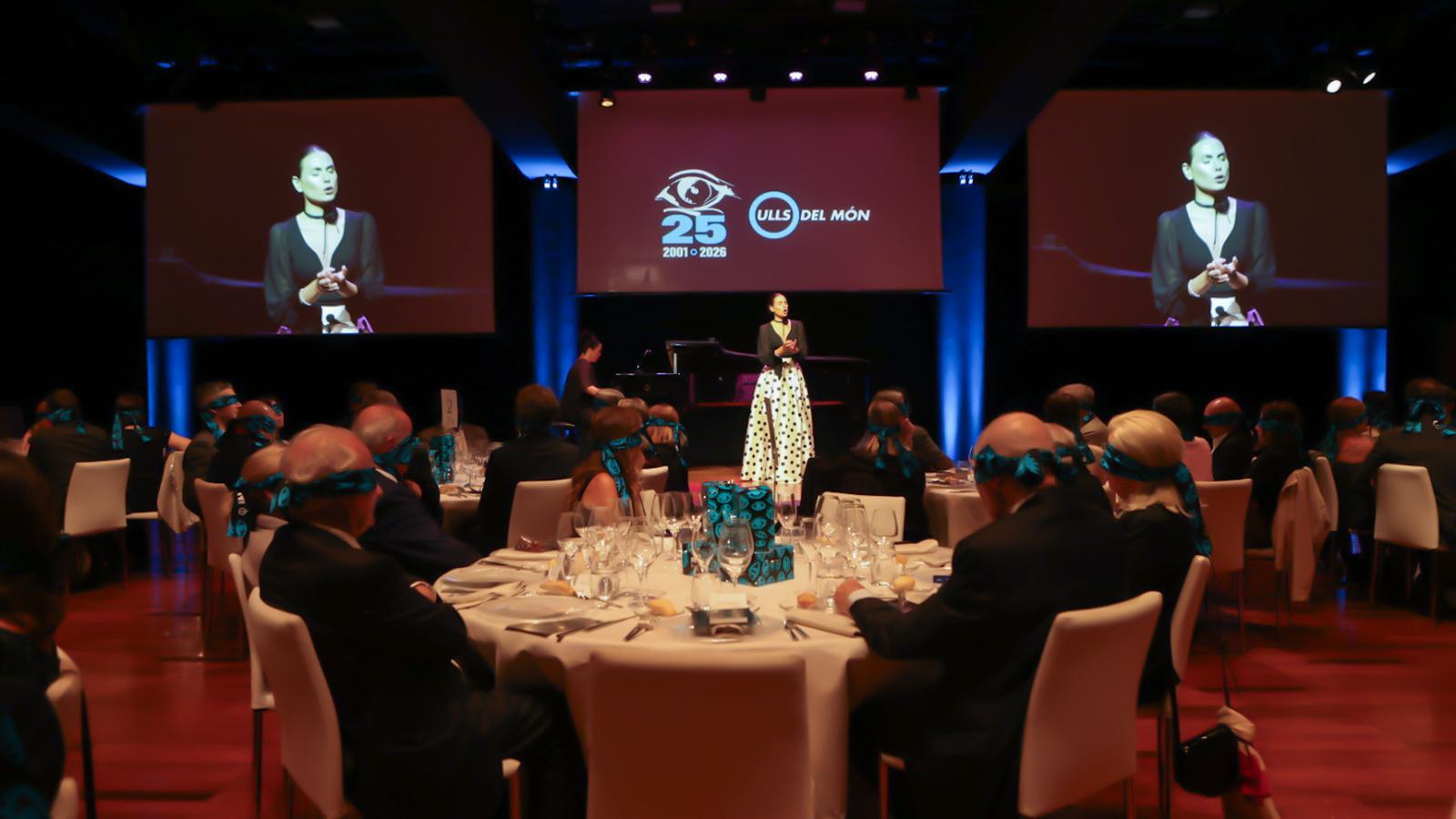
This Wednesday, this private non-profit organization celebrated its 25th anniversary. Under the slogan “We take off the blindfold to raise awareness about preventable vision loss”, the Gran Teatre del Liceu in Barcelona hosted an institutional and charity event to raise more than 140,000 euros to fund international ophthalmological cooperation projects and care, prevention, and awareness-raising in Africa and Latin America, but also in Spain.
In 2001, Ribó and the renowned Basque ophthalmologist Borja Corcóstegui launched Ulls del Món (Eyes of the World) after a trip to the Sahrawi refugee camps in Tindouf (Algeria). “We found a very dramatic situation there, a very primitive ophthalmology. The list of patients was endless, in a few days people arrived from very far away”, recalled Corcóstegui. There, after some grueling days, both agreed that vision could not be a privilege and that the fact of it being so due to one's place of birth was an injustice. And these 25 years they have worked, in his words, so that visual health is a real right. “For the next 25 years we must continue like this: promoting training”, defended Corcóstegui, vice president of Ulls del Món.
And today, with more than a million and a half people treated and a network of 20,000 ophthalmologists in low- and middle-income countries, they raise their voices. "We have shown that transferring knowledge to local doctors works, but the work is not finished: as long as there is someone blind from a curable cause, we cannot lower our arms or close our eyes," stated Ribó.
Also in Catalonia
At the event, headed by the President of the Parliament of Catalonia, Josep Rull, and hosted by journalist Xavier Grasset and actress Àgata Roca, soprano Serena Sáenz gave a very emotional performance that included great works by Rossini and Mozart. In one of the final pieces, O mio babbino caro by Giacomo Puccini, the singer from Barcelona asked the attendees to cover their eyes with a handkerchief to enjoy the music without the sense of sight, while sharpening the rest.
The doctor and director of the organization, Anna Barba, has recalled that blindness is an invisible crisis because vision problems do not cause death. “But they profoundly condition life,” she pointed out. And, furthermore, blindness has a gender: two out of every three affected are women. “They have more difficulties accessing treatments because, due to the roles they have in their communities and families, they tend to put their health in the background,” Barba explained.
Ocular exclusion, however, is not a distant problem: it also affects Catalonia. Last year, the Ulls propers program was launched, with a pilot project in Barcelona in conjunction with Arrels to assist homeless people. “We have seen a reality harsher than we imagined: nine out of every ten people living on the street needed glasses,” explained Barba. Now the organization wants to extend the diagnostic and treatment initiative to more vulnerable groups and other autonomous communities.
Special ONCE coupons
