Is Catalonia prepared for a large fire at the gates of a city?
Firefighters and Civil Protection explain how the population would be protected in cases like those experienced in France
-
CAT -
CAST
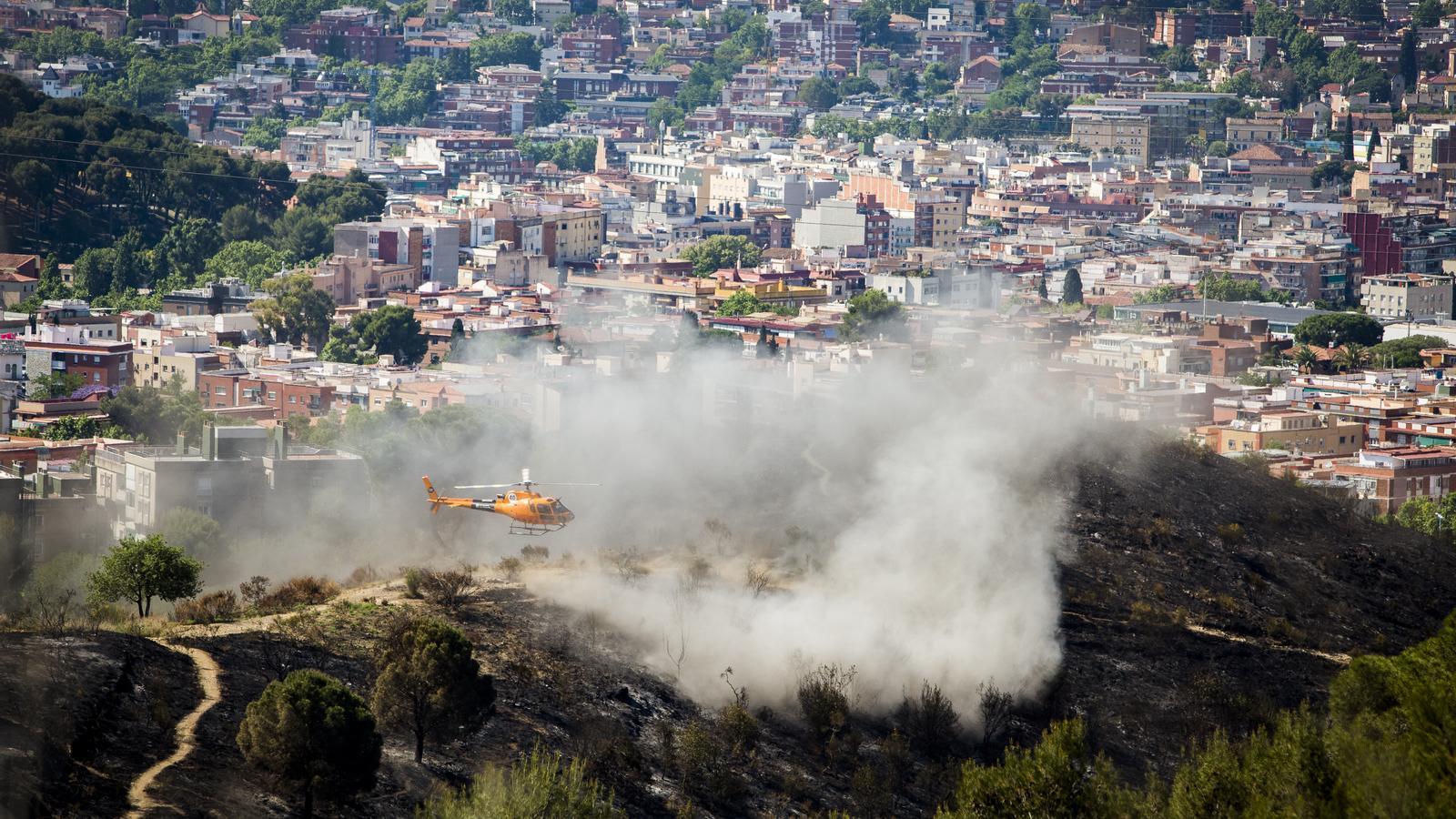
BarcelonaThe fire of Occitania, the most serious recorded in France since 1949, has become a warning about the challenges posed by large forest fires when they approach urban areas. Now stabilized, the fire has ravaged over 16,000 hectares and has advanced to within just fifteen kilometers of the Occitan city's metropolitan area. This fire, added to the one that a few days ago affected the Community of Madrid and Avila, reinforces a question that is gaining more and more strength in a context of climate emergency: is Catalonia prepared to face a major fire on the outskirts of a city? What changes when the flames leave behind the more distant forest areas and threaten inhabited neighborhoods, essential infrastructure, and thousands of people?
When a forest fire threatens a large city, the priority ceases to be exclusively putting out the flames. The focus shifts to protecting the population. "It's a factor that changes everything," summarizes José Luis López, inspector responsible for the Operations Division of the Generalitat Firefighters. "We are no longer talking about a fire burning in the woods, but one that can directly affect people's safety." For the Firefighters, each situation is analyzed based on two concepts: exposure, meaning whether there are homes or urban areas in contact with the forest mass, and vulnerability, which depends on the type of construction and the buildings' capacity to withstand the passage of fire. "Not all urban areas are equally vulnerable," López points out.
In a city like Barcelona, this implies clearly distinguishing between the urban center and the neighborhoods bordering Collserola. "Nothing will happen in Plaça Catalunya," states López, who adds: "There will probably be areas, the border of Barcelona that touches Collserola, that are indeed very exposed." Therefore, the expert rules out a generalized evacuation of the city. "Evacuating a city of one and a half million people due to a forest fire is a totally disproportionate action and could even generate many more risks than it can prevent," he explains.

"There is no magic recipe"
The operational response to a fire of this nature, however, does not depend solely on the Firefighters. While the corps directs the firefighting on the ground, Civil Protection coordinates the management of the emergency and all the needs arising from the protection of the population. "Those who have the knowledge and know how to manage the fire are the intervention group, which is the Firefighters," explains the operational deputy director of Civil Protection, Imma Solé. "They indicate how the fire is evolving and what needs arise from it," she points out.
From here, the entire machinery of the Special Plan for Forest Fire Emergencies of Catalonia (Infocat) is activated. In addition to the Firefighters, the Mossos d'Esquadra, the Emergency Medical System (SEM), the town councils, as well as other authorities, participate. "When you have evacuated or confined people, you have to be aware of their needs," explains Solé. This includes setting up reception areas, ensuring food, accommodation, or specific care for the most vulnerable groups. One of the ideas shared by the Firefighters and Civil Protection is that evacuation is not always the best solution. In fact, it is often the opposite. "There is no magic recipe," warns López. Each decision depends on the predicted behavior of the fire, the available time, and the vulnerability of the buildings.
Solé agrees that the first objective is to avoid unnecessarily exposing the population to risk. "The first approach is to have people confined in safe spaces," she assures. To order an evacuation, she explains, "you must have absolute certainty that the escape route is safer than if people were confined." If not, "uncontrolled evacuations are not good," because people can be exposed to both fire and smoke.
Precisely, decisions are not made solely based on the flames. The direction of the smoke or the state of the communication routes are also taken into account. "It may be advisable for people to be confined because the smoke is directed towards the area," explains Solé, or because the roads may be affected and it is not safe to use them. The Firefighters also recall that not all urban environments present the same risk. For López, the main critical point is urbanizations surrounded by forest mass. "They are the worst-case scenario," she states, because they combine a high exposure to fire with a vulnerability that often increases due to the presence of vegetation very close to homes.
Regarding the lessons learned from this summer's major fires, both the Firefighters and Civil Protection assure that each emergency serves to review protocols. The former prepare operational reports after each forest campaign, while the latter annually reviews the Infocat plan with all involved organizations. "Any margin for improvement that is detected is applied in upcoming updates," explains Solé. One of the tools that has most changed the response in recent years is the alert system to mobile phones (eminently, ES-Alert). According to the head of Civil Protection, it allows informing the population "very quickly and very broadly" about the measures to be taken.
For Civil Protection, however, the greatest risk is not necessarily a single large-scale fire. "One of the things that can complicate our management a lot is the simultaneity", points out Solé. When several large fires coincide in the territory, the operational response is strained and management becomes much more complex. In this scenario, aggravated by climate change that favors increasingly frequent extreme events, both Firefighters and Civil Protection agree on one last idea: the best tool remains a prepared citizenry. "An informed and trained population will have a much faster and much better response," says Solé, who encourages citizens to learn about the risks in their municipality through the Civil Protection map and have a kit emergency. "We are looking for a more resilient population," he concludes.
