Migratory emergency in El Hierro: “The crossings on the high seas last between 4 and 12 days”
Organizations like Caminando Fronteras warn that the climate is no longer the determining factor of migration towards the Canary Islands

-
CAT -
CAST
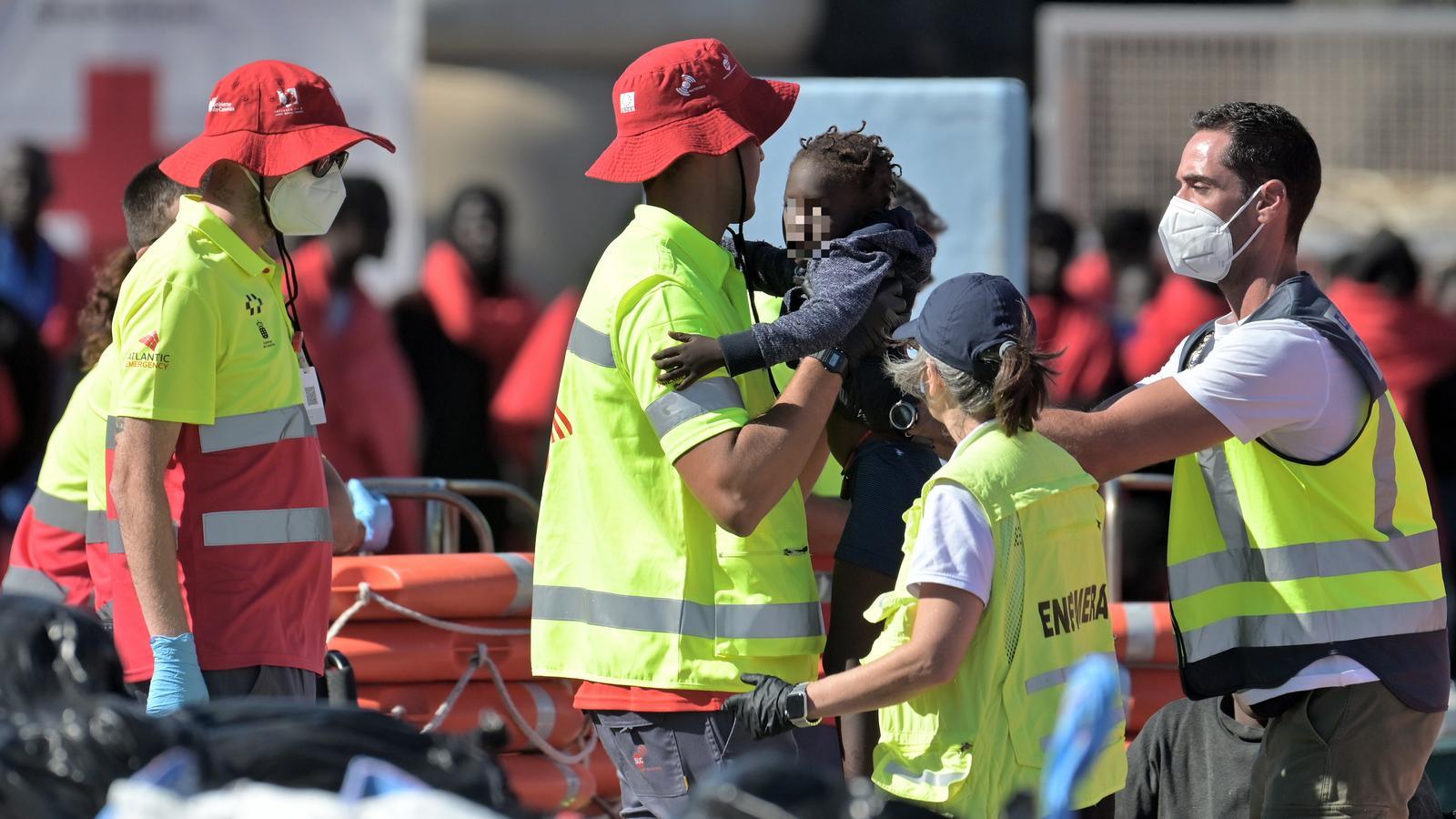
MadridAt the pier of La Restinga, on the small Canary island of El Hierro, the arrival of hundreds of migrants in boats has been hitting a new record for days. This month of November alone more than 10,000 people have landed there, according to the latest data from the Spanish government. Currently, about 500 people remain on the island, the government explains, after many have been transferred to other islands or to the mainland. Many others are at the Temporary Foreigner Attention Center (CATE) in El Hierro.
This Tuesday, a second interministerial immigration commission was held, in which the Spanish government and the Canary Islands government participated to analyze the evolution of the migration emergency. At the meeting, a new extra budget allocation of 5 million euros was agreed upon for health reinforcement and socio-economic impact, as well as an expansion of the police deployment. In addition, "diplomatic efforts" with countries of origin are being strengthened, sources from the Ministry of Territorial Policy explain.
Meanwhile, the Red Cross is reinforcing the teams in charge of providing initial humanitarian care on the island, and organizations like Caminando Fronteras warn that weather is no longer the determining factor for the growth of arrivals through the Atlantic route, which connects countries such as Senegal, Gambia, and Mauritania with the Canary archipelago.
This is not only one of the most dangerous migratory routes, but also the deadliest. "We are finding crossings [on the high seas] that last from 4 to 10 or 12 days," explains Lucía Romero, head of the Red Cross's first emergency response and relief on the island of El Hierro. The boats, she explains, are totally precarious: "Mostly cayucos," she specifies.
In the case of the crossing to El Hierro, there is another factor that makes it even more dangerous: "It is the westernmost island, and the furthest from the archipelago, and therefore, it is the last option to reach a safe port. If they do not find it and continue moving west, that is when cases appear of boats reaching the Caribbean, and often the people die along the way," says the Red Cross technician in a telephone conversation with ARA.

Health problems
The Red Cross is the entity in charge these days of an initial, very basic triage right at the moment people set foot on the island. “People who need more urgent care are transferred to a healthcare point and, if necessary, are referred to the hospital.” Beyond that, they are provided with dry clothing and footwear. “They arrive soaked to the bone,” relates Romero. They are also given oral rehydration serum and something to eat.
The first interview conducted with them is social in nature to assess their level of vulnerability: “The migratory process is observed, and if, for example, they are fleeing from a conflict situation in their country of origin, such as Mali,” he explains. Immediately after, the Ministry of the Interior comes into play, which is responsible for expulsion files or asylum applications.
All of this has a direct impact on the health status of the people arriving in El Hierro these days. “It is very deteriorated. They often arrive in a state of hypothermia, with burns that never go away or with serious infections from contact with the water for days on their feet and legs,” relates Romero.
Beyond the climate
The profile of migrants is similar to other times because “the poverty factor is decisive,” warns the Red Cross technician. “Then, there are degrees of vulnerability. For example, there are more and more people fleeing because of the political situation in their country, or many women who do so because of the violence they suffer,” she adds. Although the country of departure for the boats is mainly Senegal, the origin of the people goes further: “They come from all over the sub-Saharan territory. [...] There are people who have started their migratory journey three or four years earlier,” warns Romero.
The Red Cross had already foreseen an increase in arrivals due to weather conditions. The tide is favored by the decrease in trade winds, which pushes the boats to set out to sea, especially between the months of September and February. “If we look at the history of arrivals, it always coincides,” notes Romero. However, there are those who warn that the weather is no longer such a determining factor.
“It is the discourse from ten years ago. We have known for a long time that, unfortunately, it is no longer a deciding element for a migratory route to be activated. I wish it were, because it would mean that at least [the people] would have some more decision criteria, but that is not the case. People take the risk regardless of the weather,” says Helena Maleno, founder of Caminando Fronteras. And she adds: “In 2024, for example, the weather was terrible and many boats left anyway. Talking about the weather is not looking at what is happening at the origin or during the migratory transit.”

The head of the Red Cross speaks along the same lines, focusing on armed conflicts, the climate crisis—many countries see their lands becoming increasingly arid, which makes farm work difficult—or the decline in fishing, a key activity in places like Senegal that has been harmed by the impact of large ships from Europe and Asia. "There is a plunder of fishing taking place," denounces Maleno.
In the specific case of Senegal, organizations add another factor: young people see their future cut short. Beyond the economic context due to the difficulties of living off fishing, there is also a political situation that, in Maleno's view, is "incapable of offering any future prospects to young people." "At the same time that the Youth Olympic Games are being held, the situation for them has not improved. They have the boats right on the beach and board them overnight to flee."
